
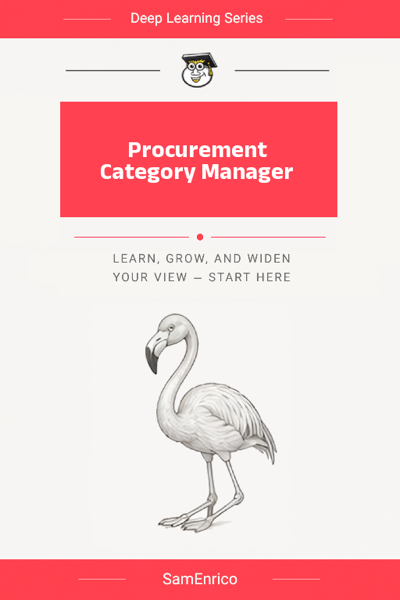
Non-FictionInformativeEducational
Procurement Category Manager eBook
A Coursebook on Procurement Category Manager
by Acuna Dong
A Coursebook on Procurement Category Manager
Formats
Free sample
Chapter 1: The Value Equation--–- On a rainy Tuesday morning in Birmingham, a procurement manager named Sarah watched her quarterly bonus disappear. She had done everything right. She had run a competitive tender with six suppliers. She had squeezed the incumbent down by 11 percent. She had followed the company’s seven-step sourcing process to the letter.
And yet, when the plant manager received the new shipment of industrial filters, they did not fit. The maintenance team lost three shifts. Production stopped for eight hours. The true cost of Sarah’s “successful negotiation” was nearly four times the savings she had generated.Sarah was not incompetent. She was working with an outdated playbook.For the past three decades, procurement professionals have been trained to believe that their primary value lies in reducing purchase prices.
This belief is wrong. It is not merely incomplete; it is actively dangerous. The single-minded pursuit of lower unit prices has destroyed more value in supply chains than any recession, trade war, or natural disaster. And yet, the vast majority of organizations continue to reward buyers based on how much they “saved” on the purchase order, while ignoring the downstream consequences of those savings.This book exists to correct that error.Welcome to the strategic category manager’s world. It is a world where you are no longer measured by the thickness of the folder containing competitive bids, but by the health of the entire value stream.
It is a world where you understand that a cheap component that fails during production is not a bargain but a liability. It is a world where your internal stakeholders see you not as an obstacle to their purchasing freedom, but as a partner who helps them achieve their operational and strategic goals.In short, it is a world where you move from being a cost-cutter to a value architect.The Great Misunderstanding: Price vs. Total Cost Before we can build a new framework, we must understand why the old one failed. The traditional procurement model, which persists in the majority of organizations today, is built on a simple assumption: lower purchase price equals higher profit. This assumption is seductive because it appears mathematically undeniable.
If a widget costs $10 instead of $12, the company saves $2. That $2 flows directly to the bottom line. Case closed.Except it is not.The $10 widget might require more frequent replacement. It might consume twice the energy of the $12 widget. It might arrive late, forcing expensive air freight for downstream components.
It might require your technicians to spend an extra hour each week on maintenance. It might fail catastrophically, shutting down an entire production line. Each of these costs is real. Each of them is measurable. And none of them appear on the purchase order.This is the central insight of strategic category management: the purchase price is the smallest part of the total cost of ownership.Consider a real-world example from the pharmaceutical industry.
A global drug manufacturer was procuring sterile filtration membranes for its production lines. The purchasing team, under pressure to deliver annual cost reductions, switched from a premium supplier to a lower-cost alternative. The price per membrane dropped by 18 percent. The purchasing team celebrated. They reported the savings to senior management.
They received their bonuses.Three months later, the failure rate of the new membranes was discovered to be 400 percent higher than the previous supplier. Each failure meant stopping a production line, discarding an entire batch of partially finished drug product, cleaning the line for eight hours, and restarting. The cost of each failure was calculated at $47,000 in lost product alone, not including labor, cleaning supplies, or delayed shipments to hospitals. The 18 percent price reduction generated annual savings of roughly $90,000. The increased failure rate generated annual costs of more than $1.2 million.The net result was a loss of over $1.1 million.
The purchasing team had successfully negotiated a worse outcome.This is not an isolated incident. It is the natural consequence of measuring success by the wrong metric.Defining Value: The Procurement Category Manager’s North Star If price is the wrong metric, what should replace it? The answer is value, and value must be defined with precision. Throughout this book, we will use a single, consistent definition of value in procurement:Value = (Quality + Service + Innovation) / Total Cost of Ownership Let us unpack each component of this equation.Quality is not a vague aspiration. It is the degree to which a product or service meets the specifications required for its intended use without failure or defect.
Quality can be measured in defect rates, rework percentages, warranty claims, and compliance with standards. When quality improves, value increases. When quality declines, value collapses—often in ways that are invisible to traditional procurement metrics.Service encompasses everything that surrounds the product: delivery reliability, responsiveness to inquiries, ease of doing business, technical support, training, and after-sales care. A supplier with impeccable product quality but terrible service creates hidden costs in the form of expediting efforts, internal frustration, and delayed projects. Conversely, a supplier with good service can offset slightly higher prices by reducing your internal labor costs.Innovation is the most overlooked component of value.
A strategic supplier can bring new ideas: a design change that reduces manufacturing cost, a material substitution that improves performance, a process improvement that shortens lead times, or a business model innovation that shifts risk. Innovation is not guaranteed—it must be cultivated through the right kind of relationship. But when it appears, it can generate value far exceeding any price reduction.Total Cost of Ownership (TCO) is the denominator, and it deserves special attention. TCO includes the purchase price, but also adds:Acquisition costs: Shipping, handling, customs duties, receiving inspection, and purchase order processing.Usage costs: Energy consumption, consumables, operator training, floor space, and changeover time.Maintenance costs: Spare parts, technician time, scheduled downtime, and calibration.Downtime costs: Lost production, idle labor, expediting of replacement parts, and customer penalties.End-of-life costs: Disposal, recycling, environmental compliance, and decommissioning.When you place quality, service, and innovation in the numerator, and TCO in the denominator, the implications become clear. Reducing the purchase price while quality declines may actually reduce value if the denominator (TCO) increases faster than the numerator decreases.
Increasing the purchase price while quality, service, or innovation improves may increase value if the numerator rises faster than the denominator.This is not academic hair-splitting. It is the difference between destroying and creating value.ROSMA: Measuring the Quality of Your Procurement Decisions If value is the goal, how do we measure whether we are achieving it? Traditional procurement metrics—cost savings, cost avoidance, purchase price variance—are inadequate because they only look at one input (price) while ignoring all other inputs and all outputs.A more sophisticated metric is needed. Enter ROSMA® (Return on Supply Management Assets) . Developed through research at Arizona State University and implemented by leading organizations, ROSMA measures the financial return generated by the procurement function relative to the resources invested.Unlike traditional savings metrics, ROSMA accounts for:Hard savings: Actual reductions in total cost that flow directly to the income statement.Soft savings: Cost avoidance that protects the budget from inflation or scope changes (reported separately from hard savings).Value creation: Revenue-enhancing contributions such as supplier-led innovation, improved…
This is the end of the free sample. Get the eBook to keep going. Buy now
About this book
Details
- Author
- Acuna Dong
- Publisher
- SamEnrico
- Language
- English
- Genre
- Non-Fiction, Informative, Educational
- Released
- 2026-06-03
- Pages (approx.)
- 157
- Available as
- eBook, Audiobook

Read better in the ZLOADR app
Your eBooks on your phone or tablet. Sign in with your SamEnrico account and start reading.
More by Acuna Dong
 Burnout and Meaning RecoveryAcuna Dong$11.99
 The Clean Fifteen GuideAcuna Dong$11.99
 Harvard Extension School DecodedAcuna Dong$11.99
 ADHD Nonverbal GuideAcuna Dong$11.99
 The Mathematicians of the Nile: Unveiling the Golden Age of African GeometryAcuna Dong$11.99
 Research Proposal Abstract WritingAcuna Dong$12.99
 How to Become a StickerAcuna Dong$11.99
You may also like
 Hong Kong Handover 1997Dunn Johnnie$11.99
 Zumba For Postnatal Recovery CourseNeal Christian$11.99
 Zumba for BeginnersLadner Nikia$11.99
 YouTube Comment Mining GuideHumes Pandora$12.99
 Worry Box MeditationCarlin Rudy$11.99
 Workplace Stress MeditationNguyen Lynn$11.99
 Workplace Stress and Sleep RepairHawley Ivory$11.99
 Workplace Perfectionism CureDelaney Jeffry$11.99
 Workplace Injustice Anger GuideWallen Isabelle$11.99
 Work Addiction and Burnout LinkGreenwood Ester$11.99
 Women in Yoga and WellnessBeattie Galina$11.99
 Women in Stand Up ComedyChun Evangeline$11.99