
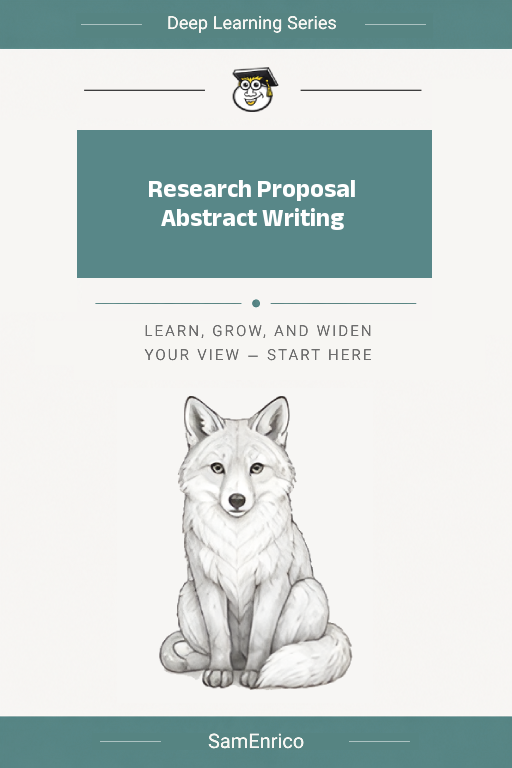
researchStudent's ShortcutAbstract Writing
Research Proposal Abstract Writing
Summarize entire grad proposals into compelling 25
by Acuna Dong
Summarize entire grad proposals into compelling 250-word abstracts. Hook readers, state problem, preview methods, and highlight expected contributions.
Formats
About this book
Free sample
Chapter 1: The 60-Second Execution--–- Most graduate students spend six months writing a proposal and six seconds losing a reviewer. Here is what no one tells you before you submit: your abstract is not read. It is filtered. The difference between those two verbs is the difference between funded and rejected, between advanced and deferred, between a career launched and a dream delayed.The scene is uncomfortably universal. A program officer at a federal agency—let us call her Dr.
Voss—opens her laptop at 4:47 PM on a Friday. She has forty-seven proposals to review by Monday. Her cursor hovers over your file. She has not had coffee in three hours. Her parking meter expired twenty minutes ago.
She clicks open your abstract. She will decide your fate before you finish reading this sentence.This is not cruelty. This is mathematics. The average grant reviewer handles one hundred to three hundred proposals per cycle. Each proposal receives between five and fifteen minutes of total attention.
But here is the brutal secret: ninety percent of that time is spent on proposals that have already passed the abstract test. The other ninety percent of proposals—the rejected ones—are dismissed in the first sixty seconds, often the first thirty, sometimes the first ten.Your abstract is not a summary. It is a gate.And you have been taught to build the gate upside down.The First Read Phenomenon Let us name the beast. The "First Read" phenomenon describes how academic reviewers actually process proposals, as opposed to how they claim to process them. When surveyed, most reviewers say they read the abstract carefully, then the introduction, then the methods, then the budget justification.
This is a lie—not a malicious lie, but a memory lie. Human beings confound how they wish they worked with how they actually work.Cognitive science research on document triage tells a different story. When experts are given a stack of documents to evaluate under time pressure, they do not read. They scan. Specifically, they scan vertically for nouns that signal relevance, then diagonally for logical connectors that promise coherence.…
This is the end of the free sample. Get the eBook to keep going. Buy now
Contents
- Chapter 1
- Chapter 2
- Chapter 3
- Chapter 4
- Chapter 5
- Chapter 6
- Chapter 7
- Chapter 8
- Chapter 9
- Chapter 10
- Chapter 11
- Chapter 12
Details
- Author
- Acuna Dong
- Publisher
- SamEnrico
- Language
- English
- Genre
- research, Student's Shortcut, Abstract Writing
- Released
- 2026-06-01
- Pages (approx.)
- 154
- Available as
- eBook, Audiobook

Read better in the ZLOADR app
Your eBooks on your phone or tablet. Sign in with your SamEnrico account and start reading.
More by Acuna Dong
 Burnout and Meaning RecoveryAcuna Dong$11.99
 The Clean Fifteen GuideAcuna Dong$11.99
 Harvard Extension School DecodedAcuna Dong$11.99
 ADHD Nonverbal GuideAcuna Dong$11.99
 The Mathematicians of the Nile: Unveiling the Golden Age of African GeometryAcuna Dong$11.99
 Procurement Category ManagerAcuna Dong$11.99
 How to Become a StickerAcuna Dong$11.99
You may also like
 Scientific Research On TM GuideMartens Nathanial$11.99
 Research Proposal Methodology Section MasteryPauley Debroah$11.99
 Research Proposal Appendix CompilationRaines Tyisha$11.99
 Academic Researcher Distraction GuideFord Virgil$11.99
 TM Research and ScienceCovert Nicki$11.99
 Social Anxiety Research ReviewRoberge Cole$11.99
 Research Proposal Significance Section GuideBock Tory$12.99
 Research Proposal Reviewer PsychologyLugo Tawanda$11.99
 Research Proposal Research Questions DesignLara Robbi$11.99
 Research Proposal References and CitationsPatten Shanice$11.99
 Research Proposal Mixed Methods DesignCameron Omega$11.99
 Research Proposal Data Management PlanAnderson Roberto$12.99