
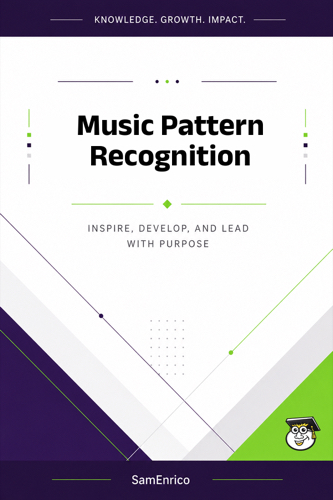
Non-FictionSelf-HelpMusic Memory
Music Pattern Recognition eBook
Memorize melodies and chord progressions using pat
by Ellis Monica
Memorize melodies and chord progressions using pattern techniques.
Formats
Free sample
Chapter 1: The Three Thieves of Memory--The moment your fingers forget everything, the audience doesn’t know yet. You have about three seconds before they do. In that sliver of time, your heart has already begun hammering against your ribs. Your palms, dry a moment ago, are now slick. The well-rehearsed landscape of your instrument—every fret, every key, every valve—has turned into an unfamiliar wilderness.This is the stage freeze.
And if you’ve played music for more than six months, it has already happened to you.Perhaps it was a piano recital when you were twelve. You were halfway through a sonatina, and suddenly—nothing. The next note, which you had played correctly a hundred times in practice, simply vanished from your mind. Your teacher’s encouraging smile from the front row became a mask of confusion. You started over from the beginning, got to the same spot, and froze again.
You have never forgotten that feeling.Perhaps it was a jazz gig in a dimly lit club. The bass player counted off a medium swing, you played a chorus of melody, and then it was your turn to solo. Four bars in, you lost the form. You didn’t know whether you were on the II chord or the V chord. You kept playing—anything, random notes—while your ears frantically tried to find the ground beneath your feet.Perhaps it was simply a Sunday afternoon at home.
You were playing through a piece you had performed flawlessly for years, and your mind wandered for half a second. When you came back, your fingers had stopped. You stared at your hands as if they belonged to a stranger.Here is the truth that no one tells you in music school, in You Tube tutorials, or in the practice room: Muscle memory is a liar.Not because it doesn’t work. It works beautifully—most of the time. But because it is the only memory system most musicians ever train, and it is the first system to collapse under pressure.
When adrenaline enters your bloodstream—and it will, every time you care about a performance—your fine motor control degrades. The very thing you relied upon becomes unreliable.This book exists because there is a better way. And it begins with understanding not just what you forgot, but how your brain was supposed to remember it in the first place.The Three Rooms of Musical Memory Imagine your brain as a mansion with three separate rooms. Each room stores musical memory differently. Each room has its own strengths and weaknesses.
And crucially, each room is controlled by a different neural pathway.The first room is Visual Memory. This room stores everything you see: the layout of sheet music, the geography of your instrument (which key is middle C, which fret is the fifth), the shape of a chord voicing on a page, the distance between your thumb and third finger on a piano keyboard. Visual memory is fast and reliable when your eyes are open and the lighting is good. But it fails in darkness, when you close your eyes to "feel" the music, or when your attention shifts to your hands.The second room is Aural Memory. This room stores everything you hear: the sound of a perfect fifth, the way a minor chord feels darker than a major chord, the exact pitch of the first note of your favorite song, the rhythmic groove of a bass line.
Aural memory is the oldest musical memory system in the human species—we were singing long before we were writing sheet music. But aural memory struggles with precision. You might know how a melody goes without knowing the exact pitch of the third note.The third room is Kinesthetic Memory. This room stores everything you feel: the weight of your arm dropping into a piano chord, the stretch between your first and fourth finger on a guitar fretboard, the resistance of a drumstick against a snare head, the breath pressure required for a high note on a trumpet. Kinesthetic memory is what musicians usually mean when they say "muscle memory." It is automatic, fast, and requires no conscious thought—until it fails.Most musicians live in only one of these rooms.
They practice until their fingers know the piece, and they call that "memorized." They have never opened the door to the other two rooms. They have no idea what furniture is inside.This chapter will take you on a tour of all three rooms. You will take a diagnostic quiz to discover which room you currently live in. You will learn why your preferred room is both your superpower and your vulnerability. And you will learn the first three drills for moving freely between rooms—so that when one room goes dark, you simply walk into another.The Diagnostic: Which Room Do You Live In?Before we fix the problem, we must name it.
Below is a simple self-diagnostic. For each statement, answer honestly: Rarely (1), Sometimes (2), Often (3), or Almost Always (4).Visual Memory Questions:I can close my eyes and picture the exact layout of my instrument (which keys are sharp, which frets have dots).I remember music better if I look at the sheet music while I practice, even after I’ve memorized it.When I forget a note, I can often "see" where it is on the page before I hear it.I learn new pieces faster when I watch someone else’s hands.Aural Memory Questions:I can hear a song once and hum it back, even if I don’t know the title.I remember chord progressions by how they feel (e.g., "this one sounds like it’s going home").I can recognize intervals (like a major third or perfect fifth) by ear without naming the notes.I learn songs faster by listening to a recording than by reading sheet music.Kinesthetic Memory Questions:My fingers often "know" what to do even when I’m not thinking about the notes.If I practice a passage slowly many times, it eventually becomes automatic.I learn music primarily by repeating physical motions, not by analyzing structure.When I make a mistake, my fingers sometimes correct it before my brain registers the error.Scoring:Add up your scores for each category. Your highest score is your dominant memory room. If two scores are tied, you are a hybrid—which is excellent, though you likely haven’t trained both systems equally.Most amateur musicians score highest on Kinesthetic (12-16), followed by Visual (8-12), followed by Aural (4-8). Professional musicians who never freeze tend to score 12+ in all three categories.
They are not smarter than you. They have simply learned to move between rooms.Now let us examine each room in detail—its gifts, its betrayals, and its secret passages.Room One: Visual Memory – The Architect’s Blueprint Visual memory is the most underappreciated musical superpower. In a culture that prizes "playing by ear" as a mystical gift, we have forgotten that human beings invented musical notation for a reason: because seeing music is faster than hearing it for certain tasks.When you develop strong visual memory, you can:Glance at a page of…
This is the end of the free sample. Get the eBook to keep going. Buy now
About this book
Details
- Author
- Ellis Monica
- Publisher
- SamEnrico
- Language
- English
- Genre
- Non-Fiction, Self-Help, Music Memory
- Released
- 2026-06-06
- Pages (approx.)
- 134
- Available as
- eBook, Audiobook

Read better in the ZLOADR app
Your eBooks on your phone or tablet. Sign in with your SamEnrico account and start reading.
More by Ellis Monica
 The Metabolic Adaptation for DietitiansEllis Monica$11.99
 Emotional First Aid for DivorceEllis Monica$11.99
 Thunberg Anti Capitalism ViewEllis Monica$11.99
 Warehouse Slotting AIEllis Monica$11.99
 Lying Child Parent AngerEllis Monica$11.99
 Constraints as Creative Fuel GuideEllis Monica$11.99
 Assertiveness for Social AnxietyEllis Monica$11.99
 The Vanishing of the Innocent: Australia's Custody Wars and the Children Who DisappearedEllis Monica$11.99
 The Buenos Aires Conspiracy: The Trial That Divided a Nation (1872)Ellis Monica$11.99
 How to Produce OuterwearEllis Monica$11.99
 How to Produce CondomsEllis Monica$11.99
 Expunged Records Discrimination ClaimsEllis Monica$12.99
You may also like
 Hong Kong Handover 1997Dunn Johnnie$11.99
 Zumba For Postnatal Recovery CourseNeal Christian$11.99
 Zumba for BeginnersLadner Nikia$11.99
 YouTube Comment Mining GuideHumes Pandora$12.99
 Worry Box MeditationCarlin Rudy$11.99
 Workplace Stress MeditationNguyen Lynn$11.99
 Workplace Stress and Sleep RepairHawley Ivory$11.99
 Workplace Perfectionism CureDelaney Jeffry$11.99
 Workplace Injustice Anger GuideWallen Isabelle$11.99
 Work Addiction and Burnout LinkGreenwood Ester$11.99
 Women in Yoga and WellnessBeattie Galina$11.99
 Women in Stand Up ComedyChun Evangeline$11.99