
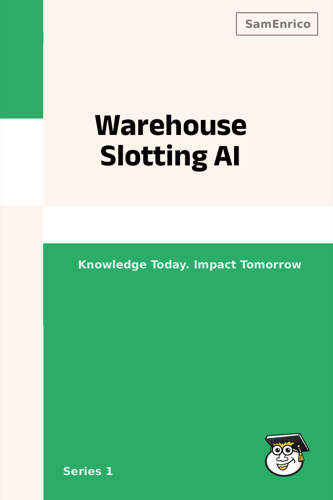
Non-FictionAI OperatorWarehouse Optimization
Warehouse Slotting AI
Optimize product placement using clustering algori
by Ellis Monica
Optimize product placement using clustering algorithms.
Formats
About this book
Free sample
Chapter 1: The $350 Billion Blind Spot--The phone rang at 2:47 AM on the Tuesday before Thanksgiving. Maria Vasquez, director of distribution for a regional grocery chain, knew before she answered that something had gone catastrophically wrong. Forty-seven trailers sat backed up to her loading docks. Three hundred thousand holiday orders were overdue. And her best picker, a twenty-year veteran named Leo, had just walked 14.3 miles in a single shift—most of it pushing an empty cart past the same products over and over again."This isn't a labor problem," Leo told her that morning, sweat soaking through his safety vest.
"I'm not walking slower. I'm walking farther. The stuff I need is everywhere except where it should be."Leo didn't know it, but he had just articulated the single largest source of waste in modern logistics: bad slotting.The Silent Killer of Warehouse Productivity Order picking consumes 50 to 65 percent of all warehouse operating costs. For a mid-sized distribution center handling $100 million in annual inventory, that means $10 million to $15 million each year is spent simply on the act of walking, reaching, and retrieving. Of that amount, travel time—the minutes and hours pickers spend moving between locations—accounts for the largest single slice, often 40 to 60 percent of total pick labor.Here is the truth that logistics consultants have known for decades but rarely say aloud: most warehouses are organized for the convenience of the people who put products away, not the people who pick them.The traditional approach is called static slotting.
Once a year, usually during a slow period like January or after inventory, a warehouse manager runs an ABC analysis. "A" items—the fastest movers—go to the most accessible locations. "B" items go to secondary zones. "C" items—the slow movers—are relegated to the high shelves, the back corners, the mezzanine. The spreadsheet is printed.
The team spends a weekend moving pallets. And then everyone forgets about slotting for another twelve months.This system worked reasonably well in the 1990s. Product mixes were stable. Order profiles were predictable. A grocery warehouse might have carried 5,000 SKUs, and 80 percent of…
This is the end of the free sample. Get the eBook to keep going. Buy now
Contents
- Chapter 1
- Chapter 2
- Chapter 3
- Chapter 4
- Chapter 5
- Chapter 6
- Chapter 7
- Chapter 8
- Chapter 9
- Chapter 10
- Chapter 11
- Chapter 12
Details
- Author
- Ellis Monica
- Publisher
- SamEnrico
- Language
- English
- Genre
- Non-Fiction, AI Operator, Warehouse Optimization
- Released
- 2026-06-07
- Pages (approx.)
- 134
- Available as
- eBook, Audiobook

Read better in the ZLOADR app
Your eBooks on your phone or tablet. Sign in with your SamEnrico account and start reading.
More by Ellis Monica
 The Metabolic Adaptation for DietitiansEllis Monica$11.99
 Emotional First Aid for DivorceEllis Monica$11.99
 Thunberg Anti Capitalism ViewEllis Monica$11.99
 Lying Child Parent AngerEllis Monica$11.99
 Music Pattern RecognitionEllis Monica$11.99
 Constraints as Creative Fuel GuideEllis Monica$11.99
 Assertiveness for Social AnxietyEllis Monica$11.99
 The Vanishing of the Innocent: Australia's Custody Wars and the Children Who DisappearedEllis Monica$11.99
 The Buenos Aires Conspiracy: The Trial That Divided a Nation (1872)Ellis Monica$11.99
 How to Produce OuterwearEllis Monica$11.99
 How to Produce CondomsEllis Monica$11.99
 Expunged Records Discrimination ClaimsEllis Monica$12.99
You may also like
 Hong Kong Handover 1997Dunn Johnnie$11.99
 Zumba For Postnatal Recovery CourseNeal Christian$11.99
 Zumba for BeginnersLadner Nikia$11.99
 YouTube Comment Mining GuideHumes Pandora$12.99
 Worry Box MeditationCarlin Rudy$11.99
 Workplace Stress MeditationNguyen Lynn$11.99
 Workplace Stress and Sleep RepairHawley Ivory$11.99
 Workplace Perfectionism CureDelaney Jeffry$11.99
 Workplace Injustice Anger GuideWallen Isabelle$11.99
 Work Addiction and Burnout LinkGreenwood Ester$11.99
 Women in Yoga and WellnessBeattie Galina$11.99
 Women in Stand Up ComedyChun Evangeline$11.99