
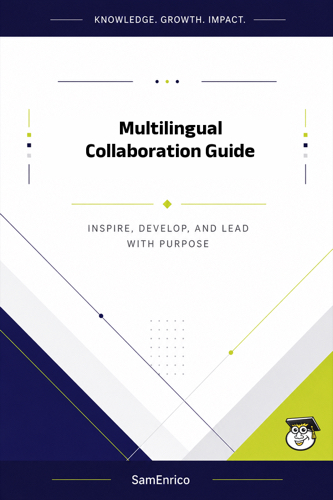
Non-FictionSelf-HelpGlobal Teams
Multilingual Collaboration Guide Audiobook
Bridge language differences in global teams using
by Gilbert Sam
Bridge language differences in global teams using translation and visual tools.
Formats
Free sample
Chapter 1: The Silence of Fluent Speakers--–- The email arrived at 2:17 PM on a Tuesday. Mariana, a senior product manager at a global fintech company, had spent three hours preparing her analysis of a critical compliance failure. She had run every sentence through Grammarly, rehearsed the logic twice, and translated key terms from her native Portuguese into what she believed was flawless English. She clicked send. Within fourteen minutes, a native English-speaking colleague replied: "I'm not sure what you're trying to say here.
Can someone rephrase this?"Mariana closed her laptop, walked to the bathroom, and cried for four minutes. Then she returned to her desk and never volunteered a strategic insight in writing again.This is not an outlier. This is the daily reality of global teams operating under the fiction that "English is our company language" solves anything. In the name of efficiency, organizations have built systems that systematically silence their most talented non-native speakers—not through malice, but through a profound misunderstanding of how language actually works when stakes are high and time is short.This chapter will force you to confront an uncomfortable truth: your team's English-first policy is probably costing you millions in lost innovation, slower decision-making, and quiet attrition. More importantly, it will introduce the framework you need to replace that broken model—not by abandoning English, but by understanding the difference between social fluency and cognitive fluency, and by recognizing that the first step toward multilingual collaboration is admitting that "everyone speaks English" is a dangerous myth.The Linguistic Asymmetry You've Never Measured Let's start with a thought experiment.
Imagine you are asked to solve a complex logic puzzle while simultaneously juggling three tennis balls. That is roughly the cognitive load a non-native English speaker carries in every high-stakes meeting. They are not just solving the problem at hand; they are translating the problem into their native language, formulating a response in that language, translating that response back into English, monitoring their grammar and accent, and watching the faces of native speakers for signs of impatience or confusion.Meanwhile, the native English speaker is just solving the problem.This imbalance is called linguistic asymmetry, and it is the single most overlooked drag on global team performance. Research published in the Journal of International Business Studies (2021) found that non-native speakers in English-dominant teams require 30-50% more cognitive processing time for the same intellectual task compared…
This is the end of the free sample. Get the Audiobook to keep going. Buy now
About this book
Details
- Author
- Gilbert Sam
- Publisher
- SamEnrico
- Language
- English
- Genre
- Non-Fiction, Self-Help, Global Teams
- Released
- 2026-06-10
- Pages (approx.)
- 128
- Available as
- eBook, Audiobook

Listen in the VoxFlicks app
Audiobooks and audio dramas wherever you go. Sign in with your SamEnrico account and press play.
More by Gilbert Sam
 Growth Mindset In ArtGilbert Sam$11.99
 Self Esteem for FreelancersGilbert Sam$11.99
 Drones in Logistics GuideGilbert Sam$11.99
 The SMART for ParentsGilbert Sam$11.99
 Brainstorming for EngineersGilbert Sam$11.99
 Delegation for ResearchersGilbert Sam$11.99
 Mindfulness for FreelancersGilbert Sam$11.99
 The Golden Scrolls of Nubia: Secrets of the Meroitic ScholarsGilbert Sam$11.99
 The Quantum Arches: Gaudi’s Sagrada Família and the Alchemy of LightGilbert Sam$11.99
 The Essential Guide to Christmas: ModernGilbert Sam$11.99
 How to Produce Emergency BlanketsGilbert Sam$11.99
 South Africa Business Loan Qualification GuideGilbert Sam$12.99
You may also like
 Hong Kong Handover 1997Dunn Johnnie$11.99
 Zumba For Postnatal Recovery CourseNeal Christian$11.99
 Zumba for BeginnersLadner Nikia$11.99
 YouTube Comment Mining GuideHumes Pandora$12.99
 Worry Box MeditationCarlin Rudy$11.99
 Workplace Stress MeditationNguyen Lynn$11.99
 Workplace Stress and Sleep RepairHawley Ivory$11.99
 Workplace Perfectionism CureDelaney Jeffry$11.99
 Workplace Injustice Anger GuideWallen Isabelle$11.99
 Work Addiction and Burnout LinkGreenwood Ester$11.99
 Women in Yoga and WellnessBeattie Galina$11.99
 Women in Stand Up ComedyChun Evangeline$11.99