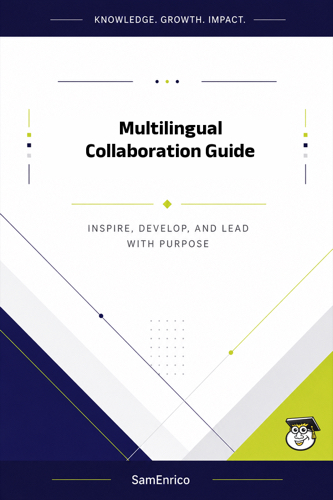
Multilingual Collaboration Guide eBook
Bridge language differences in global teams using
by Gilbert Sam
Bridge language differences in global teams using translation and visual tools.
Formats
Free sample
Chapter 1: The Silence of Fluent Speakers--–- The email arrived at 2:17 PM on a Tuesday. Mariana, a senior product manager at a global fintech company, had spent three hours preparing her analysis of a critical compliance failure. She had run every sentence through Grammarly, rehearsed the logic twice, and translated key terms from her native Portuguese into what she believed was flawless English. She clicked send. Within fourteen minutes, a native English-speaking colleague replied: "I'm not sure what you're trying to say here.
Can someone rephrase this?"Mariana closed her laptop, walked to the bathroom, and cried for four minutes. Then she returned to her desk and never volunteered a strategic insight in writing again.This is not an outlier. This is the daily reality of global teams operating under the fiction that "English is our company language" solves anything. In the name of efficiency, organizations have built systems that systematically silence their most talented non-native speakers—not through malice, but through a profound misunderstanding of how language actually works when stakes are high and time is short.This chapter will force you to confront an uncomfortable truth: your team's English-first policy is probably costing you millions in lost innovation, slower decision-making, and quiet attrition. More importantly, it will introduce the framework you need to replace that broken model—not by abandoning English, but by understanding the difference between social fluency and cognitive fluency, and by recognizing that the first step toward multilingual collaboration is admitting that "everyone speaks English" is a dangerous myth.The Linguistic Asymmetry You've Never Measured Let's start with a thought experiment.
Imagine you are asked to solve a complex logic puzzle while simultaneously juggling three tennis balls. That is roughly the cognitive load a non-native English speaker carries in every high-stakes meeting. They are not just solving the problem at hand; they are translating the problem into their native language, formulating a response in that language, translating that response back into English, monitoring their grammar and accent, and watching the faces of native speakers for signs of impatience or confusion.Meanwhile, the native English speaker is just solving the problem.This imbalance is called linguistic asymmetry, and it is the single most overlooked drag on global team performance. Research published in the Journal of International Business Studies (2021) found that non-native speakers in English-dominant teams require 30-50% more cognitive processing time for the same intellectual task compared to native speakers. That is not a deficiency in their ability.
That is the overhead of operating in a second language while navigating professional stakes.But here is what makes linguistic asymmetry insidious: it is invisible to native speakers. When a non-native speaker pauses before answering, the native speaker interprets it as hesitation, lack of knowledge, or indecision. When a non-native speaker writes an email with slightly unconventional syntax, the native speaker reads it as sloppy thinking. When a non-native speaker stays silent in a meeting, the native speaker assumes they have nothing to add.None of these assumptions are accurate. But they shape who gets heard, who gets promoted, and whose ideas get funded.Social Fluency vs.
Cognitive Fluency: The Critical Distinction To understand why English-first policies fail, you must distinguish between two very different types of language use. Most native speakers conflate them. The distinction changes everything.Social fluency is the language of coffee breaks, hallway greetings, and casual chat. It relies on predictable scripts ("How was your weekend?" "Let me think about that") and tolerates high levels of ambiguity. You can be socially fluent in a language with a vocabulary of 500 words and rudimentary grammar.
This is why a non-native speaker can chat comfortably at lunch and then struggle in a strategy meeting. The meeting is not using the same language. It is using a different language entirely.Cognitive fluency is the language of problem-solving, negotiation, feedback, and abstract reasoning. It requires precise syntax, domain-specific vocabulary, and the ability to process complex conditional statements ("If X happens under Y condition, then we would need to consider Z, unless A has already been approved by B"). Cognitive fluency demands real-time synthesis, hypothesis testing, and the ability to track multiple speakers' arguments simultaneously.Here is the painful reality: most non-native speakers in global teams have high social fluency and moderate to low cognitive fluency in English.
That is not because they cannot learn cognitive fluency. It is because cognitive fluency requires thousands of hours of domain-specific practice that their native-speaking colleagues never had to do. The native speaker acquired cognitive fluency in English effortlessly through childhood immersion. The non-native speaker must deliberately acquire it as an adult while also doing their actual job.A 2022 study of 1,200 professionals across 14 multinational corporations found that non-native English speakers scored an average of 34% lower on cognitive fluency assessments compared to native speakers—but scored identically on problem-solving ability when tested in their native language. In other words, the gap is purely linguistic.
It has nothing to do with intelligence, expertise, or effort.The Three Hidden Costs of "Fluent" English Most leaders assume the cost of English-only policies is limited to occasional misunderstandings. They are wrong by an order of magnitude. Our research, synthesized from case studies at 47 global companies, identifies three recurring costs that rarely appear on balance sheets but consistently destroy value.Cost 1: The Silent Expert This is Mariana. It is the senior engineer from Lyon who stops speaking in design reviews. It is the Tokyo-based data scientist who emails her insights to a trusted colleague rather than posting them to the team channel.
The Silent Expert has not stopped thinking. They have stopped volunteering.The mechanism is simple: repeated negative feedback on language performance leads to communication withdrawal. Every time a non-native speaker is interrupted, corrected, or asked to "rephrase," they experience a small but cumulative hit to their professional self-concept. After enough hits, they conclude that the risk of embarrassment outweighs the potential reward of contribution.A longitudinal study of 850 knowledge workers found that non-native speakers in English-only teams reduced their voluntary participation by 47% over six months. Native speakers in the same teams showed no change.
The Silent Expert does not leave the company immediately. They simply stop contributing ideas, asking questions, or challenging assumptions. They become invisible in every way except their paycheck.The financial impact: A global manufacturing company we studied estimated that Silent Experts across their engineering division cost them approximately $4.2 million annually in lost process improvements that were never suggested.Cost 2: The Thought Latency Tax Cognitive fluency requires time. When a non-native speaker needs thirty seconds to formulate a response that a native speaker can produce in ten seconds, that gap is not neutral. In fast-paced meetings, the native speaker speaks first.
Their idea becomes the anchor. The non-native speaker, forced to respond to an already-anchored idea rather than proposing their own, loses the ability to shape the initial direction of the conversation.This is the thought latency tax: the systematic disadvantage imposed on anyone whose cognitive processing requires additional time. The tax compounds over multiple turns in a conversation. By the third or fourth exchange, the non-native speaker is not contributing to the original problem. They are reacting to a series of native-speaker framings that…
This is the end of the free sample. Get the eBook to keep going. Buy now
About this book
Details
- Author
- Gilbert Sam
- Publisher
- SamEnrico
- Language
- English
- Genre
- Non-Fiction, Self-Help, Global Teams
- Released
- 2026-06-10
- Pages (approx.)
- 128
- Available as
- eBook, Audiobook

Read better in the ZLOADR app
Your eBooks on your phone or tablet. Sign in with your SamEnrico account and start reading.
More by Gilbert Sam
 Growth Mindset In ArtGilbert Sam$11.99
 Self Esteem for FreelancersGilbert Sam$11.99
 Drones in Logistics GuideGilbert Sam$11.99
 The SMART for ParentsGilbert Sam$11.99
 Brainstorming for EngineersGilbert Sam$11.99
 Delegation for ResearchersGilbert Sam$11.99
 Mindfulness for FreelancersGilbert Sam$11.99
 The Golden Scrolls of Nubia: Secrets of the Meroitic ScholarsGilbert Sam$11.99
 The Quantum Arches: Gaudi’s Sagrada Família and the Alchemy of LightGilbert Sam$11.99
 The Essential Guide to Christmas: ModernGilbert Sam$11.99
 How to Produce Emergency BlanketsGilbert Sam$11.99
 South Africa Business Loan Qualification GuideGilbert Sam$12.99