
Non-FictionSelf-HelpLean Startup
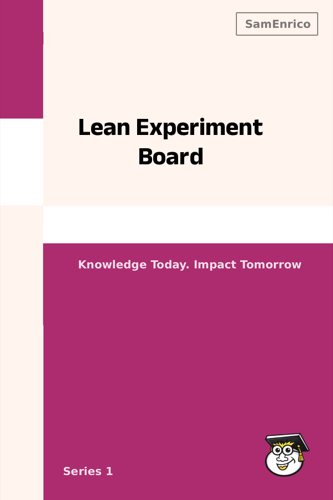
Lean Experiment Board eBook
States hypothesis, metric, and success criteria.
States hypothesis, metric, and success criteria.
Formats
Free sample
Chapter 1: The Motion Mirage--–- Most entrepreneurs and product leaders believe they have a speed problem. They think if they could just build faster, launch quicker, or iterate more rapidly, success would follow. This is a lie. The real problem is not speed. It is clarity.
Specifically, the clarity of the question you ask before you build anything.Let me tell you about a company I consulted for several years ago. Let us call them “Swift Pay.” They were a Series B fintech startup with forty engineers, a twelve-week roadmap, and a board that demanded growth. Swift Pay had a hypothesis: if they added a “social proof” feature—showing which of your friends were already using the product—their conversion rate would double. The product team spent six weeks designing, coding, and testing this feature. They launched it to great fanfare.
Conversion went up by 1.2 percent—statistically insignificant. The team shrugged. “We will iterate,” they said. They spent another four weeks tweaking colors, copy, and placement. Nothing moved.
Eighteen engineer-weeks, a quarter of a million dollars in burn, and zero learning. They had confused activity with progress.Swift Pay did not have a speed problem. They could build faster than almost any team I had ever seen. They had a knowledge problem. They did not know, before they wrote a single line of code, whether the feature addressed a real customer pain point.
They did not test the assumption that “social proof” was actually a driver of behavior for their specific audience. They assumed, built, launched, and prayed. This is not experimentation. This is gambling with an expensive casino.The central argument of this book is simple but radical: Successful innovation is not about how fast you can build. It is about the clarity of the question you ask before the experiment begins.
The Lean Experiment Board is the tool that forces that clarity. It is a one-page canvas that converts vague opinions into testable, time-boxed, and falsifiable hypotheses. It does not care about your brilliant idea. It cares about whether your idea can survive contact with reality.This chapter will expose the fundamental gap between strategy and reality—a gap that kills more startups and product initiatives than lack of funding or competition. You will learn why most “growth hacks” fail, why consultants charge millions for common sense, and why the traditional Business Model Canvas is static while the Lean Experiment Board is dynamic.
Most importantly, you will understand the true, dual definition of runway—not just months of cash, but the number of credible pivots you have left before you run out of ideas.The Great Conspiracy of Motion There is a silent conspiracy in most organizations. It is not malicious. It is worse: it is unintentional. The conspiracy is that motion is mistaken for progress. Teams hold daily standups, weekly sprint planning, bi-weekly retrospectives, and quarterly OKRs.
They ship code, close tickets, and move cards from “In Progress” to “Done.” Everyone is busy. Everyone is exhausted. And yet, the metrics do not move. The product does not find product-market fit. The startup runs out of money.Why?
Because activity is not progress. Progress is validated learning. Activity is just heat and noise.I have sat in hundreds of “post-mortem” meetings where teams explain why a feature failed. The explanations follow a predictable pattern: “The market was not ready.” “The design was off.” “We needed more time.” “The competitor launched first.” Rarely, if ever, does someone say: “We did not know what we were testing. We had no clear success criterion.
We confused our opinions with evidence.”This book exists to end that sentence.The Lean Experiment Board is a direct response to what I call the Knowledge Gap—the dangerous space between what you think is true and what is actually true. In most organizations, the Knowledge Gap is enormous. Teams argue about solutions because they have never agreed on the problem. They debate button colors because they have never validated that the button should exist at all. They optimize conversion rates on a page that nobody visits.
This is not lean. This is not agile. This is performance theater.Consider a typical product meeting. The product manager says, “We believe users need a dashboard.” The engineer says, “That will take eight weeks.” The designer says, “We should do user research first.” The CEO says, “We do not have time. Just build it.” Eight weeks later, the dashboard launches.
Nobody uses it. The team blames “adoption” and schedules another dashboard. This cycle repeats until the company runs out of money.Where did this fail? At the very first sentence: “We believe users need a dashboard.” That is not a hypothesis. That is a guess dressed in business casual.
A proper hypothesis specifies who, what action, and what measurable outcome. It distinguishes between the problem (users are lost without a dashboard) and the solution (a dashboard will fix it). It quantifies success before the experiment begins. And it time-boxes the test so you do not spend eight weeks validating a guess.The Lean Experiment Board forces you to write your guesses down in a structured format. Then it forces you to design the smallest possible test to validate or invalidate the riskiest assumption.
Then it forces you to declare, in advance, what “success” looks like. And finally, it forces you to make a decision: persevere, iterate, or pivot. This is not complicated. But it is difficult. It is difficult because it requires intellectual honesty.
It requires admitting that your brilliant idea might be wrong.Why Consultants Charge Millions for Common Sense There is a thriving industry of consultants who charge millions of dollars to do exactly what the Lean Experiment Board does for free. They run “strategy offsites” where executives write sticky notes on whiteboards. They facilitate “design thinking workshops” where teams build paper prototypes. They deliver “innovation frameworks” that are ninety pages long and contain exactly two useful insights. Why do companies pay for this?
Because the consultants offer a seductive promise: that strategy can be separated from execution, that thinking is different from doing, that you can plan your way to certainty.You cannot.The Lean Experiment Board is the anti-consultant tool. It does not care about your Power Point slides. It does not care about your beautifully designed Business Model Canvas. It cares only about one thing: what did you test this week, and what did you learn?The traditional Business Model Canvas, popularized by Alexander Osterwalder, is a wonderful tool for describing your business. It captures nine building blocks: customer segments, value propositions, channels, customer relationships, revenue streams, key resources, key activities, key partnerships, and cost structure.
It is a static snapshot of your current assumptions. It does not tell you which assumptions are risky. It does not tell you how to test them. It does not tell you when to stop.The Lean Experiment Board is the dynamic counterpart to the Business Model Canvas. While the canvas describes what you think, the board tells you how to test it.
Each cell on the board corresponds to a risk assumption from your canvas. You do not test everything at once. You test the riskiest…
This is the end of the free sample. Get the eBook to keep going. Buy now
About this book
Details
- Author
- Clinton Kristal
- Publisher
- SamEnrico
- Language
- English
- Genre
- Non-Fiction, Self-Help, Lean Startup
- Released
- 2026-06-08
- Pages (approx.)
- 152
- Available as
- eBook, Audiobook

Read better in the ZLOADR app
Your eBooks on your phone or tablet. Sign in with your SamEnrico account and start reading.
More by Clinton Kristal
 Hyperarousal Trauma ManagementClinton Kristal$11.99
 Cannabis Pesticide ContaminationClinton Kristal$11.99
 Cognitive Behavioral Therapy PainClinton Kristal$11.99
 Alcohol Recovery Sober Living HomesClinton Kristal$11.99
 Resistance Band Training GuideClinton Kristal$11.99
 Arm Levitation Induction TechniqueClinton Kristal$11.99
 Sarcopenia Vitamin D ProtocolClinton Kristal$11.99
 The Architect of the Cosmos: Nefertiti's Celestial LegacyClinton Kristal$11.99
 Dreaming for Architectural PlansClinton Kristal$11.99
 The Forgotten Pioneers: Australia's Alpine Ascents in the Mid-20th CenturyClinton Kristal$11.99
 The Last Whalers of the ArcticClinton Kristal$11.99
 The Dancer's Guide to Western Promenade DanceClinton Kristal$11.99
You may also like
 Hong Kong Handover 1997Dunn Johnnie$11.99
 Zumba For Postnatal Recovery CourseNeal Christian$11.99
 Zumba for BeginnersLadner Nikia$11.99
 YouTube Comment Mining GuideHumes Pandora$12.99
 Worry Box MeditationCarlin Rudy$11.99
 Workplace Stress MeditationNguyen Lynn$11.99
 Workplace Stress and Sleep RepairHawley Ivory$11.99
 Workplace Perfectionism CureDelaney Jeffry$11.99
 Workplace Injustice Anger GuideWallen Isabelle$11.99
 Work Addiction and Burnout LinkGreenwood Ester$11.99
 Women in Yoga and WellnessBeattie Galina$11.99
 Women in Stand Up ComedyChun Evangeline$11.99