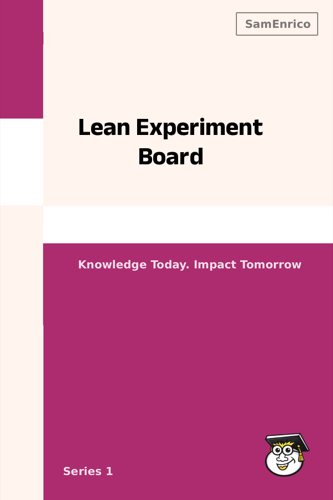
Lean Experiment Board Audiobook
States hypothesis, metric, and success criteria.
States hypothesis, metric, and success criteria.
Formats
Free sample
Chapter 1: The Motion Mirage--–- Most entrepreneurs and product leaders believe they have a speed problem. They think if they could just build faster, launch quicker, or iterate more rapidly, success would follow. This is a lie. The real problem is not speed. It is clarity.
Specifically, the clarity of the question you ask before you build anything.Let me tell you about a company I consulted for several years ago. Let us call them “Swift Pay.” They were a Series B fintech startup with forty engineers, a twelve-week roadmap, and a board that demanded growth. Swift Pay had a hypothesis: if they added a “social proof” feature—showing which of your friends were already using the product—their conversion rate would double. The product team spent six weeks designing, coding, and testing this feature. They launched it to great fanfare.
Conversion went up by 1.2 percent—statistically insignificant. The team shrugged. “We will iterate,” they said. They spent another four weeks tweaking colors, copy, and placement. Nothing moved.
Eighteen engineer-weeks, a quarter of a million dollars in burn, and zero learning. They had confused activity with progress.Swift Pay did not have a speed problem. They could build faster than almost any team I had ever seen. They had a knowledge problem. They did not know, before they wrote a single line of code, whether the feature addressed a real customer pain point.
They did not test the assumption that “social proof” was actually a driver of behavior for their specific audience. They assumed, built, launched, and prayed. This is not experimentation. This is gambling with an expensive casino.The central argument of this book is simple but radical: Successful innovation is not about how fast you can build. It is about the clarity of the question you ask before the experiment begins.
The Lean Experiment Board is the tool that forces that clarity. It is a one-page canvas that converts vague opinions into testable, time-boxed, and falsifiable hypotheses. It does not care about your brilliant idea. It cares about whether your idea can survive contact with reality.This chapter will expose the fundamental gap between strategy and reality—a gap that kills more startups and product initiatives than lack of funding or competition. You will learn why most “growth hacks” fail, why consultants charge millions for common sense, and why the traditional Business Model Canvas is static while the Lean Experiment…
This is the end of the free sample. Get the Audiobook to keep going. Buy now
About this book
Details
- Author
- Clinton Kristal
- Publisher
- SamEnrico
- Language
- English
- Genre
- Non-Fiction, Self-Help, Lean Startup
- Released
- 2026-06-08
- Pages (approx.)
- 152
- Available as
- eBook, Audiobook

Listen in the VoxFlicks app
Audiobooks and audio dramas wherever you go. Sign in with your SamEnrico account and press play.
More by Clinton Kristal
 Hyperarousal Trauma ManagementClinton Kristal$11.99
 Cannabis Pesticide ContaminationClinton Kristal$11.99
 Cognitive Behavioral Therapy PainClinton Kristal$11.99
 Alcohol Recovery Sober Living HomesClinton Kristal$11.99
 Resistance Band Training GuideClinton Kristal$11.99
 Arm Levitation Induction TechniqueClinton Kristal$11.99
 Sarcopenia Vitamin D ProtocolClinton Kristal$11.99
 The Architect of the Cosmos: Nefertiti's Celestial LegacyClinton Kristal$11.99
 Dreaming for Architectural PlansClinton Kristal$11.99
 The Forgotten Pioneers: Australia's Alpine Ascents in the Mid-20th CenturyClinton Kristal$11.99
 The Last Whalers of the ArcticClinton Kristal$11.99
 The Dancer's Guide to Western Promenade DanceClinton Kristal$11.99