
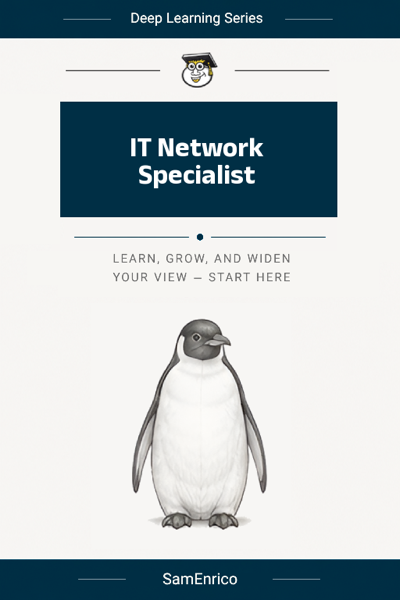
Non-FictionInformativeEducational
IT Network Specialist eBook
A Coursebook on IT Network Specialist
A Coursebook on IT Network Specialist
Formats
Free sample
Chapter 1: The Forgotten Layer...--–- The phone rang at 2:17 AM. On the other end, a hospital administrator’s voice trembled: “Our entire surgical wing just went dark. We have three operations in progress. The monitors work, the lights work, but the nurses can’t see any patient data. The doctors can’t access images.
Is it the network?”This is not a hypothetical scenario. It happens every day, somewhere in the world. And when it does, everyone blames “the network.” The surgeons blame IT. The administrators blame the “internet.” The patients blame the hospital. And somewhere, in a dark corner of a data center or a dusty wiring closet, a tiny component no bigger than a credit card is silently failing – a fiber optic transceiver that overheated, a switch port disabled by a well-meaning technician, a single misconfigured router that decided to send traffic into a black hole.You are about to become the person who answers that phone.
Not with panic, not with guesswork, but with a calm, methodical, almost surgical precision that separates a true network specialist from someone who just “knows computers.”Welcome to Chapter 1. Forget everything you think you know about networking being boring, dry, or purely academic. This chapter is not about memorizing cable colors or reciting the OSI model from a flashcard. This chapter is about understanding the hidden battlefield of modern enterprise networking – a battlefield where one wrong configuration can cost a company millions, and one correct diagnosis can make you a hero before breakfast.The Myth of the Simple Network Most people enter the networking field with a dangerous misconception: that a network is simply a collection of cables and boxes that somehow “move data.” They believe that if they set up a home Wi-Fi router and plug in a few computers, they understand the fundamentals. This is the equivalent of changing a car’s oil and claiming you can rebuild a Formula One engine.The modern enterprise network is not a single thing.
It is an organism. It breathes, it adapts, and yes, it sometimes gets sick. Consider what actually happens when a nurse in that surgical wing clicks “Send” on a patient’s lab results. In less than one second, the following must occur perfectly:Your laptop must encode the data into electrical signals. A switch must read the destination MAC address and consult its MAC address table – a table it built dynamically by watching traffic.
A router must examine the destination IP address, compare it against thousands of routes in its routing table, and choose the single best path based on a complex algorithm. A firewall must inspect the packet headers, verify that the session is legitimate, and rewrite the source address using Network Address Translation (NAT). Somewhere along the path, a wireless access point must convert those electrical signals into radio waves at precisely 5.8 gigahertz, avoiding interference from the microwave in the break room and the sixteen other access points in the same frequency band. A server must receive the packet, reassemble it from fragments that may have traveled different paths, and send back an acknowledgment – all while a hundred thousand other packets are doing the same thing simultaneously.One failure at any point in this chain, and the nurse sees a spinning wheel. The surgeon waits.
The patient suffers.This is not hyperbole. In 2021, a major telecommunications outage in Canada lasted over 24 hours, affecting 911 services, banking, and government operations. The root cause? A software update on a router that propagated a bad route across the entire backbone. In 2019, a single Google engineer’s configuration error sent traffic from Japan to China to Europe to the United States before reaching its destination, increasing latency by 1000% for hours.
In 2017, an Amazon S3 outage – caused by a mistyped command during debugging – took down large portions of the internet because so many websites depended on that single service for images, scripts, and data storage.The common thread across all these disasters? Each was caused by a mistake that a well-trained network specialist could have prevented. Each was a failure of understanding – not malice, not incompetence, but a gap between what the engineer thought would happen and what actually happened.The Unspoken Crisis: Why Your CLI-Only Skills Are Obsolete If you search job boards right now for “Network Specialist,” you will find an interesting pattern. Five years ago, the requirements read: “CCNA certification required, experience with Cisco routers and switches, knowledge of OSPF and BGP, ability to terminate Cat6 cable.” Today, the requirements read: “Experience with infrastructure as code, Python automation, cloud networking (AWS/Azure), Ansible or Terraform, CI/CD pipelines, and security best practices. Oh, and you should also know routing and switching.”The goalposts have moved.
And most network professionals are still standing at the old field.The hard truth is this: manual command-line interface (CLI) configuration is dying. It is not dead – and it will not die completely for another decade – but the era of the “CLI cowboy” who types commands into individual switches one by one is ending. The modern enterprise manages thousands of devices. You cannot SSH into each one to change a VLAN. You cannot type show interface on fifty routers to find a broadcast storm.
You cannot remember the password for every device when they cannot all be the same for security reasons.Instead, you write a Python script that connects to every switch in the network, runs show vlan, parses the output, and flags any switch missing the required VLAN. You write an Ansible playbook that deploys the same access list to forty firewalls in forty seconds. You define your entire network in Terraform code – yes, even the physical switches, using NETCONF and YANG models – and your version control system tracks every change like a programmer tracks source code.This book will teach you both. You will learn the CLI because you must understand what the automation is doing under the hood. You cannot debug a broken script if you do not understand the commands it is running.
But you will also learn Python, Ansible, and cloud networking because that is where the industry – and the salaries – are heading.Consider the salary data. According to recent surveys, a traditional “network administrator” with CLI-only skills earns an average of 65,000to65,000 to 65,000to85,000 USD per year. A “network automation engineer” with the same foundational knowledge plus Python and Ansible earns 110,000to110,000 to 110,000to160,000. The premium for automation skills is not incremental; it is transformative. Companies are desperate for professionals who can bridge the gap between traditional networking and modern Dev Ops practices.But money is not the only reason to learn automation.
The real reason is survival. Networks are too complex, too fragile, and too critical to be managed by hand. When you configure a device manually, you make mistakes. When you make mistakes, you cause outages. When you cause outages, you get calls at 2:17 AM.
Automation does not eliminate mistakes entirely, but it reduces them dramatically because the same validated, tested, code-reviewed configuration applies to every device identically.The Hybrid Model: Your First Topology Before you can fix a network, you must understand what a modern network actually looks like. Most textbooks present a diagram…
This is the end of the free sample. Get the eBook to keep going. Buy now
About this book
Details
- Author
- Winchester Lekisha
- Publisher
- SamEnrico
- Language
- English
- Genre
- Non-Fiction, Informative, Educational
- Released
- 2026-05-04
- Pages (approx.)
- 156
- Available as
- eBook, Audiobook

Read better in the ZLOADR app
Your eBooks on your phone or tablet. Sign in with your SamEnrico account and start reading.
More by Winchester Lekisha
 Tinnitus Sleep Meditation GuideWinchester Lekisha$11.99
 Malaysian Green Investment TaxWinchester Lekisha$11.99
 Email Marketing For Real EstateWinchester Lekisha$11.99
 Benzo Cognitive Repair WorkbookWinchester Lekisha$11.99
 The Unseen Playbook: How Vince Lombardi’s Secret Tapes Revolutionized CoachingWinchester Lekisha$11.99
 Raven’s Gambit: The Trickster’s Duel in the Northern WildernessWinchester Lekisha$11.99
 Fintech Regulation 2025 GuideWinchester Lekisha$12.99
 Learning Content Generation AIWinchester Lekisha$12.99
 How to Start a Primary Battery Business (Beginners Guide)Winchester Lekisha$11.99
 Understanding Ichthyosiform Erythroderma Corneal Involvement DeafnessWinchester Lekisha$17.99
You may also like
 Hong Kong Handover 1997Dunn Johnnie$11.99
 Zumba For Postnatal Recovery CourseNeal Christian$11.99
 Zumba for BeginnersLadner Nikia$11.99
 YouTube Comment Mining GuideHumes Pandora$12.99
 Worry Box MeditationCarlin Rudy$11.99
 Workplace Stress MeditationNguyen Lynn$11.99
 Workplace Stress and Sleep RepairHawley Ivory$11.99
 Workplace Perfectionism CureDelaney Jeffry$11.99
 Workplace Injustice Anger GuideWallen Isabelle$11.99
 Work Addiction and Burnout LinkGreenwood Ester$11.99
 Women in Yoga and WellnessBeattie Galina$11.99
 Women in Stand Up ComedyChun Evangeline$11.99