
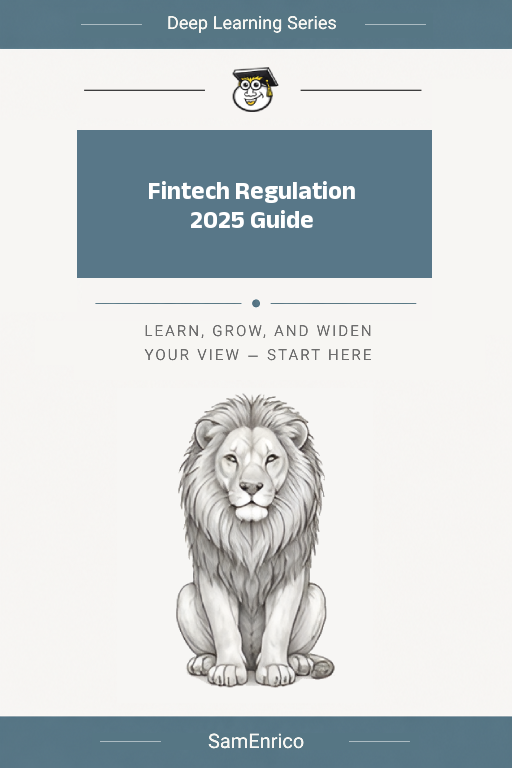
Non-FictionAnnual CheckupSector RulesAction Guide
Fintech Regulation 2025 Guide
Review open banking rules, crypto asset reporting,
Review open banking rules, crypto asset reporting, and money transmitter license updates. Covers CFPB guidance, state-level fintech sandbox renewals, and AML compliance calendar changes.
Formats
About this book
Free sample
Chapter 1: Write-Or-Die...--The year 2025 will not remember the fintechs that built the best aggregators. It will remember the ones that figured out how to move money without asking permission every single time.For the past decade, open banking has meant one thing: look, don't touch. Your budgeting app could see your checking account balance. Your mortgage refinance tool could pull your transaction history. Your wealth management dashboard could show you how much you spent on coffee last month.
But when it came time to actually do something—pay a bill, sweep savings, switch direct deposit—the user had to leave the app, log into their bank, and execute the transaction manually. This friction was not accidental. It was architectural.The banks built read-only APIs because read-only APIs are safe. They expose information, not authority. A bad actor with read-only access can embarrass you.
A bad actor with write access can ruin you. And for years, regulators accepted this trade-off. Consumers got convenience. Banks got liability protection. Fintechs got a business model that stopped at the water's edge of actual payment initiation.That era ends in 2025.The CFPB's Section 1033 rule, combined with state-level adoption of Variable Recurring Payment (VRP) frameworks, finally mandates what the industry has avoided: write access.
Third-party fintechs will be able to initiate payments, sweep funds between accounts, and switch primary banking relationships on behalf of consumers—all without forcing the user to log into their bank's clunky portal. This is not a technical upgrade. It is a complete rewiring of who controls consumer payment initiation.And most fintechs are completely unprepared.This chapter argues that the 2025 inflection point is not about data access—that battle was lost by the banks years ago. The new battlefield is write access: the ability to initiate, modify, and terminate payments on behalf of consumers. We will cover how to implement Variable Recurring Payments compliance, including consumer consent dashboards, payment limits, and real-time revocation.
We will provide a 5-step checklist for migrating from "aggregator" to "payment initiator" licenses. And we will analyze liability allocation for unauthorized write-access transactions—because when money actually moves…
This is the end of the free sample. Get the eBook to keep going. Buy now
Contents
- Chapter 1
- Chapter 2
- Chapter 3
- Chapter 4
- Chapter 5
- Chapter 6
- Chapter 7
- Chapter 8
- Chapter 9
- Chapter 10
- Chapter 11
- Chapter 12
Details
- Author
- Winchester Lekisha
- Publisher
- SamEnrico
- Language
- English
- Genre
- Non-Fiction, Annual Checkup, Sector Rules, Action Guide
- Released
- 2026-05-29
- Pages (approx.)
- 153
- Available as
- eBook, Audiobook

Read better in the ZLOADR app
Your eBooks on your phone or tablet. Sign in with your SamEnrico account and start reading.
More by Winchester Lekisha
 Tinnitus Sleep Meditation GuideWinchester Lekisha$11.99
 Malaysian Green Investment TaxWinchester Lekisha$11.99
 Email Marketing For Real EstateWinchester Lekisha$11.99
 Benzo Cognitive Repair WorkbookWinchester Lekisha$11.99
 The Unseen Playbook: How Vince Lombardi’s Secret Tapes Revolutionized CoachingWinchester Lekisha$11.99
 Raven’s Gambit: The Trickster’s Duel in the Northern WildernessWinchester Lekisha$11.99
 Learning Content Generation AIWinchester Lekisha$12.99
 How to Start a Primary Battery Business (Beginners Guide)Winchester Lekisha$11.99
 Understanding Ichthyosiform Erythroderma Corneal Involvement DeafnessWinchester Lekisha$17.99
 IT Network SpecialistWinchester Lekisha$11.99
You may also like
 Hong Kong Handover 1997Dunn Johnnie$11.99
 Zumba For Postnatal Recovery CourseNeal Christian$11.99
 Zumba for BeginnersLadner Nikia$11.99
 YouTube Comment Mining GuideHumes Pandora$12.99
 Worry Box MeditationCarlin Rudy$11.99
 Workplace Stress MeditationNguyen Lynn$11.99
 Workplace Stress and Sleep RepairHawley Ivory$11.99
 Workplace Perfectionism CureDelaney Jeffry$11.99
 Workplace Injustice Anger GuideWallen Isabelle$11.99
 Work Addiction and Burnout LinkGreenwood Ester$11.99
 Women in Yoga and WellnessBeattie Galina$11.99
 Women in Stand Up ComedyChun Evangeline$11.99