
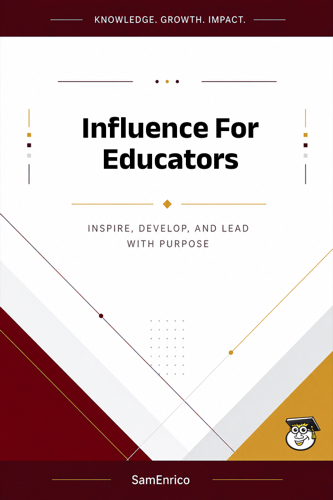
Influence For Educators eBook
Engages students and parents through motivational
Engages students and parents through motivational persuasion.
Formats
Free sample
Chapter 1: The Compliance Trap--–- The first time I realized I had become a police officer instead of a teacher, I was holding a clipboard and clicking a tally counter every time a student spoke out of turn.It was a Tuesday in October, my fourth year in the classroom, and I had spent the previous night printing color-coded behavior charts, laminating reward coupons, and arranging a prize box filled with erasers shaped like tacos. I thought I was being strategic. I thought I was being proactive. In reality, I was building a prison with prettier walls.The student who broke me was a seventh grader named Marcus. He had not done his homework for seventeen consecutive days.
He slouched in his chair with the practiced exhaustion of someone who had learned, years ago, that school was not a place where people like him succeeded. That Tuesday, after I publicly marked his name on the board under the "Warning" column, he looked up at me with an expression I have never forgotten. It was not anger. It was not defiance. It was pity.
He looked at me like he had figured something out that I had not yet understood."You know this doesn't actually make me want to do my work, right?" he said.I had no answer. Because he was right.The Great Misunderstanding For decades, the dominant model of classroom management has been built on a deceptively simple assumption: if you want someone to do something, you offer a reward for compliance and a consequence for non-compliance. This is not a teaching strategy. It is operant conditioning, borrowed from B.F. Skinner's experiments with pigeons and rats.
And somewhere along the way, we forgot that children are not pigeons.The compliance model is seductive because it produces short-term results. A student who wants the pizza party will complete the worksheet. A student who fears detention will silence their voice. A teacher who controls the behavior chart feels, for a moment, like an effective manager. But management is not teaching, and compliance is not commitment.
The difference between the two is the difference between a hostage and a volunteer. Both may do what you ask. Only one will stay when the guard leaves the room.I spent my first three years of teaching as a compliance architect. I had a three-tiered reward system, a public behavior ladder that moved students up and down based on daily conduct, and a parent call log that I only opened when something went wrong. I was efficient.
I was organized. And I was utterly failing to influence anyone.The data confirmed what Marcus already knew. My students did their work only when the reward was imminent. When the pizza party was two weeks away, effort cratered. When I left the room for a staff meeting, the substitute teacher described my class as "chaotic" and "disrespectful." My students had not learned self-regulation.
They had learned to perform compliance when the audience was watching. That is not influence. That is theater.The Cost of Compliance The damage caused by compliance-based systems extends far beyond temporary obedience. Research spanning four decades has documented a consistent pattern: extrinsic rewards reliably undermine intrinsic motivation. This is not a theory.
It is one of the most replicated findings in motivational psychology.When you offer a reward for an activity, you send an implicit message: this activity is not worth doing for its own sake. The reward becomes the reason. And when the reward disappears, the reason disappears with it. This is called the overjustification effect, and it explains why students who earn prizes for reading stop reading when the prizes stop. It explains why honor roll incentives produce grade-chasers rather than learners.
It explains why Marcus looked at me with pity—because he had realized, before I had, that my entire motivational system was a house of cards.The compliance model also damages relationships. When a teacher's primary role is rewarder and punisher, the teacher becomes a transactional figure rather than a relational one. Students do not trust the person who holds the whip and the carrot. They watch that person. They calculate.
They perform. But they do not open.I learned this the hard way during parent-teacher conferences my second year. A mother sat across from me as I listed her son's infractions: tardies, missing assignments, low quiz scores. She listened quietly, nodded, and then said something I still remember: "You've told me everything he's done wrong. You haven't told me one thing you know about him."She was not defensive.
She was not angry. She was asking a question I could not answer because I had been so focused on managing his behavior that I had never bothered to know his person.The Alternative: The Motivational Classroom The chapters that follow will introduce a comprehensive framework for building influence rather than enforcing compliance. But before we dive into specific strategies, we need a clear picture of what a motivational classroom looks like—and what it feels like from the inside.A motivational classroom is not a classroom without structure. This is a common misunderstanding that I want to dispel immediately. The choice is not between chaos and control.
The choice is between imposed control and shared ownership. A motivational classroom has clear expectations, consistent routines, and high standards. The difference is in where those expectations come from and how they are maintained.In a compliance classroom, expectations are imposed from above. The teacher says, "This is the rule because I said so." Violations are met with external consequences. Success is met with external rewards.
The teacher carries the entire weight of motivation on their own shoulders, and when they tire—as all humans eventually do—the entire system wobbles.In a motivational classroom, expectations are co-constructed or transparently justified. The teacher says, "This rule exists because it protects everyone's right to learn. Here is how it helps you." Violations are met with problem-solving conversations that ask, "What got in your way?" and "What will you do differently?" Success is met with descriptive feedback that builds competence: "I noticed you stuck with that problem for ten minutes. What did you learn from the struggle?"The difference is subtle but seismic. In a compliance classroom, students ask, "What do I have to do to avoid punishment or get the reward?" In a motivational classroom, students ask, "What am I learning, and why does it matter?" The first question produces strategic agents who are always calculating the minimum required effort.
The second question produces curious learners who are willing to persist even when no one is watching.The Bridge, Not the Endpoint One metaphor has guided my work more than any other: the educator as a bridge, not an endpoint.A bridge does not create the destination. It does not force anyone to cross. It simply provides a sturdy, reliable path for travelers who have their own reasons for getting to the other side. The endpoint is the student's own internal motivation—their sense of purpose, their curiosity, their desire to become capable and connected. The teacher's job is not to manufacture that motivation.
It is to connect students to the motivation they already have.This reframing is liberating and humbling in equal measure. It…
This is the end of the free sample. Get the eBook to keep going. Buy now
About this book
Details
- Author
- Browne Lucrecia
- Publisher
- SamEnrico
- Language
- English
- Genre
- Non-Fiction, Self-Help, Education
- Released
- 2026-06-10
- Pages (approx.)
- 135
- Available as
- eBook, Audiobook

Read better in the ZLOADR app
Your eBooks on your phone or tablet. Sign in with your SamEnrico account and start reading.
More by Browne Lucrecia
 Workaholism Recovery WorkbookBrowne Lucrecia$11.99
 Night Owl Morning AdaptationBrowne Lucrecia$11.99
 HIIT Warm Up and Cool DownBrowne Lucrecia$11.99
 Fitness Progress ComparisonBrowne Lucrecia$11.99
 Surfer Self Hypnosis GuideBrowne Lucrecia$11.99
 Emotion Focused TherapyBrowne Lucrecia$11.99
 Elderly Burn CareBrowne Lucrecia$11.99
 The Great Penguin Parade: March of the Little EmperorsBrowne Lucrecia$11.99
 Kicks of the Pharaohs: The Lost Sneakers of Ancient EgyptBrowne Lucrecia$11.99
 How to Start a Couch Business (Beginners Guide)Browne Lucrecia$11.99
 How to Produce Fitness and Body Building EquipmentBrowne Lucrecia$11.99
 Chinese Crested: Sensitive & AffectionateBrowne Lucrecia$11.99
You may also like
 Teaching Active Listening to StudentsDollar Dell$11.99
 Letting Go of School ShameJean Kylie$11.99
 Workaholism in TeachingMccoy Isabel$11.99
 Teacher Guide to Teen ConfidenceAshmore Fae$11.99
 Teacher Classroom ConfidenceGeorge Nichole$11.99
 Smoking Cessation for Teachers and EducatorsEaton Estell$11.99
 Nonverbal Cues For Teachers CourseBray Tandy$11.99
 Design Thinking for EducationTong Efren$11.99
 Anger Management for TeachersChavarria Catheryn$11.99
 TM School Curriculum GuideDawkins Ester$11.99
 The Time Blocking for TeachersWallis Weston$11.99
 The Teaching Nonverbal GuideCalabrese Terisa$11.99