
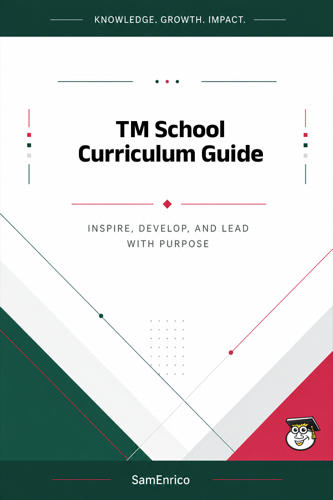
TM School Curriculum Guide
Introduce transcendental meditation in educational
Introduce transcendental meditation in educational settings to improve student outcomes.
Formats
About this book
Free sample
Chapter 1: The Quiet Revolution...--For the past three decades, American education has been trapped in a paradox. Schools have invested billions of dollars in social-emotional learning curricula, hired armies of counselors, implemented restorative justice programs, and adopted mindfulness initiatives. Yet by nearly every measurable metric, student mental health has deteriorated. Anxiety disorders among adolescents have increased by 70 percent in the past twenty-five years. Suicide rates for teenagers have climbed steadily.
Teacher burnout has reached crisis levels, with nearly half of all educators reporting that they want to leave the profession. The more interventions we add, the worse the outcomes become.This chapter argues that the failure is not one of effort or good intentions. It is a failure of diagnosis. Standard approaches to student well-being operate at the wrong level of the human system. They target thoughts, behaviors, and social dynamics while ignoring the fundamental physiological engine that drives them all: chronic stress.
A student drowning in stress cannot learn emotional regulation skills any more than a drowning person can learn to swim. The water must be calmed first. That is the case this chapter will make, drawing on decades of research, real-world school transformations, and a growing movement called Consciousness-Based Education.The Quiet Time programs that emerged in high-stress urban schools across the United States offer a compelling alternative. In San Francisco, Detroit, Washington D.C., and other cities, schools that implemented twice-daily Transcendental Meditation as part of the regular school day saw extraordinary results: a twenty-one percent increase in graduation rates, dramatic drops in suspensions, improvements in academic achievement, and measurable reductions in student anxiety and depression. These outcomes were achieved without changing textbooks, hiring additional staff, or extending the school day.
The only variable that changed was the physiological state of the students and teachers.This chapter is the first of twelve in this guide. It establishes the foundational problem that the rest of the book will solve. Subsequent chapters will define Transcendental Meditation precisely, distinguish it from other approaches, explore the neuroscience of stress reduction, and provide a step-by-step implementation framework for K-12 schools. But before we…
This is the end of the free sample. Get the eBook to keep going. Buy now
Contents
- Chapter 1
- Chapter 2
- Chapter 3
- Chapter 4
- Chapter 5
- Chapter 6
- Chapter 7
- Chapter 8
- Chapter 9
- Chapter 10
- Chapter 11
- Chapter 12
Details
- Author
- Dawkins Ester
- Publisher
- SamEnrico
- Language
- English
- Genre
- Non-Fiction, Self-Help, Education
- Released
- 2026-06-10
- Pages (approx.)
- 152
- Available as
- eBook, Audiobook

Read better in the ZLOADR app
Your eBooks on your phone or tablet. Sign in with your SamEnrico account and start reading.
More by Dawkins Ester
 Norwegian Green Incentives ManualDawkins Ester$11.99
 Slow Carb Sustainable Loss PlanDawkins Ester$11.99
 Nap Transition Strategies GuideDawkins Ester$11.99
 Stress Management for Customer Service RolesDawkins Ester$11.99
 The Trial That Split a Nation: The O.J. Simpson Civil Case RevisitedDawkins Ester$11.99
 The Gaia Hypothesis: Lovelock and the Living EarthDawkins Ester$11.99
 Understanding Chromosome 17, Trisomy 17p11 2Dawkins Ester$17.99
 How to Become a Calibration Laboratory TechnicianDawkins Ester$11.99
 Manitoba PNP for GraduatesDawkins Ester$12.99
 PDP Tracking DashboardDawkins Ester$12.99
 Build Your Cognitive AgilityDawkins Ester$11.99
You may also like
 Teaching Active Listening to StudentsDollar Dell$11.99
 Letting Go of School ShameJean Kylie$11.99
 Workaholism in TeachingMccoy Isabel$11.99
 Teacher Guide to Teen ConfidenceAshmore Fae$11.99
 Teacher Classroom ConfidenceGeorge Nichole$11.99
 Smoking Cessation for Teachers and EducatorsEaton Estell$11.99
 Nonverbal Cues For Teachers CourseBray Tandy$11.99
 Design Thinking for EducationTong Efren$11.99
 Anger Management for TeachersChavarria Catheryn$11.99
 The Time Blocking for TeachersWallis Weston$11.99
 The Teaching Nonverbal GuideCalabrese Terisa$11.99
 Flow for TeachersLeake Lenore$11.99