
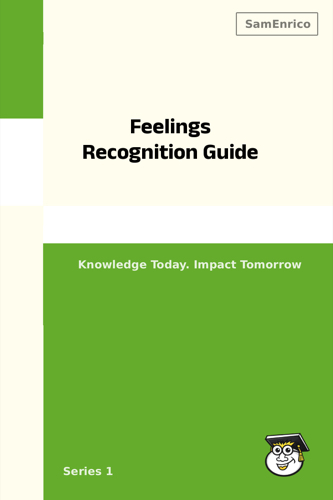
Feelings Recognition Guide
Teaches how to identify and name emotions in yours
by Luke Eugene
Teaches how to identify and name emotions in yourself and others accurately.
Formats
About this book
Free sample
Chapter 1: The Vocabulary Gap--–- Sarah had been in therapy for six years. She came every Tuesday, sat in the same chair, and told her therapist the same thing: "I'm angry at my father. I'm angry at my job. I'm angry at my partner. I'm just so angry all the time." They worked on anger management.
They practiced deep breathing. They explored childhood triggers. And after six years, nothing had changed. She was still angry. She was still miserable.
She was still stuck.Then, in a moment of accidental honesty during a session about her father's dismissal of her career, Sarah said something different. She didn't say "angry." She said, "I feel like I'm never enough. Like no matter what I do, I'm invisible to him. And that makes me feel... I don't know...
small. Humiliated, maybe? Like I'm a child begging for a parent who just walks past."Her therapist stopped writing. "Say that again.""Humiliated," Sarah said. And then she started to cry—not the frustrated tears of anger, but the deep, heaving sobs of grief.That moment changed everything.
Because Sarah wasn't angry. She was humiliated. The anger was a costume she had been wearing for six years because it felt safer than admitting how small and powerless her father made her feel. Anger is a forward-moving emotion; it feels like power, even when it's destructive. Humiliation is a shrinking emotion; it feels like disappearing.
Sarah had chosen the feeling that let her stand up and fight rather than the one that made her want to hide. But she had chosen wrong. And because she had the wrong name for what she was feeling, she had been trying to solve the wrong problem for six years.This chapter is about why that happens—why most of us walk around with an emotional vocabulary of fewer than twenty words, and why that poverty keeps us trapped. It is about the science of emotional granularity, the neuroscience of naming, and the first step toward becoming fluent in the language of your own heart.The Problem with "Fine"Ask someone how they are feeling…
This is the end of the free sample. Get the eBook to keep going. Buy now
Contents
- Chapter 1
- Chapter 2
- Chapter 3
- Chapter 4
- Chapter 5
- Chapter 6
- Chapter 7
- Chapter 8
- Chapter 9
- Chapter 10
- Chapter 11
- Chapter 12
Details
- Author
- Luke Eugene
- Publisher
- SamEnrico
- Language
- English
- Genre
- Non-Fiction, Self-Help
- Released
- 2026-06-06
- Pages (approx.)
- 128
- Available as
- eBook, Audiobook

Read better in the ZLOADR app
Your eBooks on your phone or tablet. Sign in with your SamEnrico account and start reading.
More by Luke Eugene
 The Stress Migraine Trigger GuideLuke Eugene$11.99
 Daily Priority Reset GuideLuke Eugene$11.99
 Construction Safety SignalsLuke Eugene$11.99
 Quercetin Allergy GuideLuke Eugene$11.99
 Persuasive Training ProposalLuke Eugene$11.99
 The Assertiveness Scripting HandbookLuke Eugene$11.99
 Postpartum Body AcceptanceLuke Eugene$11.99
 Hospice Care for ParentsLuke Eugene$11.99
 Whispers of the Forgotten River: The Lost Civilization of the IndusLuke Eugene$11.99
 The Last Waltz: How a King’s Ballroom Danced into OblivionLuke Eugene$11.99
 The Last Oracle of Delphi: Cracking the Code of the Ancient SeerLuke Eugene$11.99The Last Oracle of Delphi: Cracking the Code of the Ancient SeerLuke Eugene$11.99
You may also like
 Hong Kong Handover 1997Dunn Johnnie$11.99
 Zumba For Postnatal Recovery CourseNeal Christian$11.99
 Zumba for BeginnersLadner Nikia$11.99
 YouTube Comment Mining GuideHumes Pandora$12.99
 Worry Box MeditationCarlin Rudy$11.99
 Workplace Stress MeditationNguyen Lynn$11.99
 Workplace Stress and Sleep RepairHawley Ivory$11.99
 Workplace Perfectionism CureDelaney Jeffry$11.99
 Workplace Injustice Anger GuideWallen Isabelle$11.99
 Work Addiction and Burnout LinkGreenwood Ester$11.99
 Women in Yoga and WellnessBeattie Galina$11.99
 Women in Stand Up ComedyChun Evangeline$11.99