
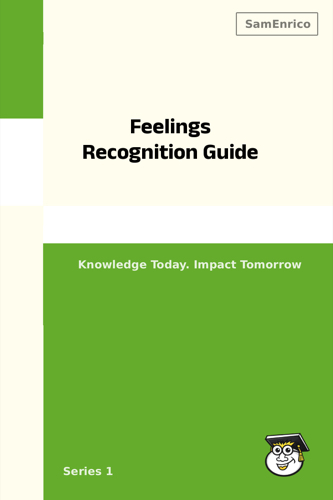
Feelings Recognition Guide eBook
Teaches how to identify and name emotions in yours
by Luke Eugene
Teaches how to identify and name emotions in yourself and others accurately.
Formats
Free sample
Chapter 1: The Vocabulary Gap--–- Sarah had been in therapy for six years. She came every Tuesday, sat in the same chair, and told her therapist the same thing: "I'm angry at my father. I'm angry at my job. I'm angry at my partner. I'm just so angry all the time." They worked on anger management.
They practiced deep breathing. They explored childhood triggers. And after six years, nothing had changed. She was still angry. She was still miserable.
She was still stuck.Then, in a moment of accidental honesty during a session about her father's dismissal of her career, Sarah said something different. She didn't say "angry." She said, "I feel like I'm never enough. Like no matter what I do, I'm invisible to him. And that makes me feel... I don't know...
small. Humiliated, maybe? Like I'm a child begging for a parent who just walks past."Her therapist stopped writing. "Say that again.""Humiliated," Sarah said. And then she started to cry—not the frustrated tears of anger, but the deep, heaving sobs of grief.That moment changed everything.
Because Sarah wasn't angry. She was humiliated. The anger was a costume she had been wearing for six years because it felt safer than admitting how small and powerless her father made her feel. Anger is a forward-moving emotion; it feels like power, even when it's destructive. Humiliation is a shrinking emotion; it feels like disappearing.
Sarah had chosen the feeling that let her stand up and fight rather than the one that made her want to hide. But she had chosen wrong. And because she had the wrong name for what she was feeling, she had been trying to solve the wrong problem for six years.This chapter is about why that happens—why most of us walk around with an emotional vocabulary of fewer than twenty words, and why that poverty keeps us trapped. It is about the science of emotional granularity, the neuroscience of naming, and the first step toward becoming fluent in the language of your own heart.The Problem with "Fine"Ask someone how they are feeling, and nine times out of ten, you will hear one of four words: good, bad, fine, or okay. Ask them to elaborate, and you might get "stressed" or "busy" or "tired"—none of which are actually emotions.
Stressed is a response to demand. Busy is a schedule. Tired is a physical state. These are not feelings; they are placeholders for feelings we have not yet learned to name.The English language contains more than three thousand words for emotions and emotional states. The average adult, according to research from the Yale Center for Emotional Intelligence, regularly uses only twelve to fifteen of them.
Think about that. You have access to a palette of three thousand colors, but you are painting your life with twelve. That is not a limitation of language. It is a limitation of attention, of training, of permission. And it has consequences.When you say "I feel bad," you could mean any of the following: disappointed, betrayed, exhausted, anxious, ashamed, lonely, jealous, guilty, hopeless, envious, overwhelmed, contemptuous, disgusted, frightened, sorrowful, irritable, or humiliated.
Each of these emotions has a different cause, a different body signature, and a different solution. Disappointment requires adjusting expectations. Betrayal requires rebuilding trust or ending a relationship. Exhaustion requires rest and boundaries. Anxiety requires grounding and reality-testing.
Shame requires self-compassion. Loneliness requires reaching out. If you do not know which one you are feeling, you will reach for the wrong solution every time.This is the hidden cost of emotional poverty: you waste years on solutions that do not work because you have misdiagnosed the problem.Emotional Granularity: The Science of Feeling Precisely The psychologist and neuroscientist Lisa Feldman Barrett has spent decades studying how the brain constructs emotions. Her central insight is counterintuitive but revolutionary: emotions are not reactions that happen to you. They are predictions that your brain makes based on past experience.
Your brain receives sensory input from your body and the world, and it guesses what emotion best fits that input. The more precise your brain's emotional vocabulary, the more accurate its guesses will be.Barrett introduced the concept of emotional granularity—the ability to distinguish between similar emotional states with precision. People with high emotional granularity are not feeling different emotions than the rest of us. They are simply better at telling the difference between one feeling and another. Where one person feels simply "bad," a person with high granularity feels "disappointed but not hopeless" or "anxious but not terrified." Where one person feels "angry," a person with high granularity feels "frustrated" (I hit an obstacle, but it is minor and solvable), "indignant" (I have been wronged, and that wrong demands acknowledgment), "resentful" (I have been keeping score, and the ledger is uneven), or "contemptuous" (I feel superior, and I am done engaging).Each of these distinctions matters because each leads to a different action.
Frustration asks, "What is in my way, and how do I remove it?" Indignation asks, "How do I communicate that this was wrong?" Resentment asks, "What is the imbalance, and how do I restore fairness?" Contempt asks, "How do I distance myself from this person or situation?" If you collapse all of these into "anger," you will reach for the same solution every time—usually some version of yelling or withdrawing—and you will be wrong most of the time.Barrett's research shows that emotional granularity is not fixed. It can be learned. It can be practiced. It can be expanded. And the first step is vocabulary.The Neuroscience of Naming: Why "Name It to Tame It" Works Here is what happens in your brain when you feel something and do not name it.
Sensory information arrives from your body: your heart is racing, your palms are sweating, your breath is shallow. Your amygdala—the brain's ancient alarm system—detects a threat and sounds the alarm. Cortisol and adrenaline flood your system. You are in a state of high physiological arousal, but you do not know why. You just know that something is wrong.
This is the "ugh" state: vague, diffuse, overwhelming.Now here is what happens when you attach a precise word to that same set of sensations. You pause. You notice the racing heart and shallow breath. You consider the context: you are about to give a presentation. And you say to yourself, "I am feeling nervous, not terrified." The moment you do that, f MRI studies show, your amygdala activity decreases.
The alarm system begins to quiet. At the same time, the right ventrolateral prefrontal cortex—a region associated with cognitive control and reappraisal—activates. Your brain shifts from reactive mode to reflective mode.This is the neurological basis of "name it to tame it." A study by Matthew Lieberman and his colleagues at UCLA found that simply labeling an emotion reduced physiological arousal by up to fifty percent. The effect was not psychological; it was biological. The brain literally calms down when you name what you are feeling.But here is the crucial detail: the label must be precise.
Vague labels like "bad" or "stressed" do not produce the same effect. The brain needs specificity. "I feel nervous because…
This is the end of the free sample. Get the eBook to keep going. Buy now
About this book
Details
- Author
- Luke Eugene
- Publisher
- SamEnrico
- Language
- English
- Genre
- Non-Fiction, Self-Help
- Released
- 2026-06-06
- Pages (approx.)
- 128
- Available as
- eBook, Audiobook

Read better in the ZLOADR app
Your eBooks on your phone or tablet. Sign in with your SamEnrico account and start reading.
More by Luke Eugene
 The Stress Migraine Trigger GuideLuke Eugene$11.99
 Daily Priority Reset GuideLuke Eugene$11.99
 Construction Safety SignalsLuke Eugene$11.99
 Quercetin Allergy GuideLuke Eugene$11.99
 Persuasive Training ProposalLuke Eugene$11.99
 The Assertiveness Scripting HandbookLuke Eugene$11.99
 Postpartum Body AcceptanceLuke Eugene$11.99
 Hospice Care for ParentsLuke Eugene$11.99
 Whispers of the Forgotten River: The Lost Civilization of the IndusLuke Eugene$11.99
 The Last Waltz: How a King’s Ballroom Danced into OblivionLuke Eugene$11.99
 The Last Oracle of Delphi: Cracking the Code of the Ancient SeerLuke Eugene$11.99The Last Oracle of Delphi: Cracking the Code of the Ancient SeerLuke Eugene$11.99
You may also like
 Hong Kong Handover 1997Dunn Johnnie$11.99
 Zumba For Postnatal Recovery CourseNeal Christian$11.99
 Zumba for BeginnersLadner Nikia$11.99
 YouTube Comment Mining GuideHumes Pandora$12.99
 Worry Box MeditationCarlin Rudy$11.99
 Workplace Stress MeditationNguyen Lynn$11.99
 Workplace Stress and Sleep RepairHawley Ivory$11.99
 Workplace Perfectionism CureDelaney Jeffry$11.99
 Workplace Injustice Anger GuideWallen Isabelle$11.99
 Work Addiction and Burnout LinkGreenwood Ester$11.99
 Women in Yoga and WellnessBeattie Galina$11.99
 Women in Stand Up ComedyChun Evangeline$11.99