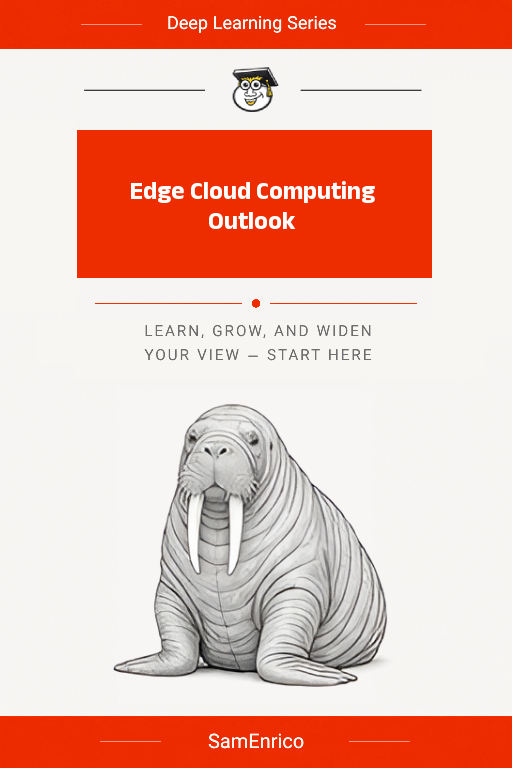
Edge Cloud Computing Outlook Audiobook
Forecast distributed cloud, edge node deployment,
Forecast distributed cloud, edge node deployment, latency-sensitive workload growth, and 5G integration through 2030.
Formats
Free sample
Chapter 1: The Latency Wall--–- The email arrived at 2:47 AM on a Tuesday, addressed to the chief technology officer of a midsized autonomous delivery startup. The subject line read: "Incident Report #2024-0917 – Collision Avoidance Failure." The CTO, who had been sleeping in his office for the third night that week, opened it with the grim resignation of someone who already knew what it contained.A vehicle—one of their flagship autonomous delivery robots, deployed in a pilot program with a major retail chain—had failed to brake for a pedestrian crossing a parking lot. The pedestrian was not injured; the vehicle's emergency stop had triggered at the last possible millisecond, stopping six inches from the pedestrian's knee. But the post-incident telemetry revealed something terrifying: the vehicle's onboard AI had detected the pedestrian 47 milliseconds before impact, but the inference request—the query to determine whether the object was a person and whether braking was required—had been sent to a centralized cloud data center 1,200 kilometers away. The round-trip latency was 94 milliseconds.
By the time the cloud responded with "BRAKE," the vehicle had already traveled 3.2 meters. The onboard emergency stop, a hardwired failsafe that operated independently of the cloud, was the only reason the pedestrian wasn't hospitalized.The root cause was not a software bug. It was not a hardware failure. It was the speed of light.This chapter dismantles the foundational assumption that has driven enterprise computing for the past fifteen years: the belief that all data should eventually flow to and from a few massive hyperscale data centers. It introduces the physical law that ends this model, the economic forces that are accelerating its collapse, and the paradigm shift that will define the next decade of computing.
By the end of this chapter, the reader will understand why the era of "cloud-only" architecture is ending—and why edge computing is not merely an option but an inevitability.The Physics That Cannot Be Engineered Away The speed of light in fiber optic cable is approximately 200,000 kilometers per second—roughly two-thirds of its speed in a vacuum. This is extraordinarily fast by human standards, but brutally slow by computing standards. A modern CPU operating at 3 gigahertz can execute three billion instructions in the time it takes light to travel 100 meters. From the perspective of a microprocessor, light crawls.Consider a concrete example. A data packet traveling from New York City to a central…
This is the end of the free sample. Get the Audiobook to keep going. Buy now
About this book
Details
- Author
- Dorman Brenna
- Publisher
- SamEnrico
- Language
- English
- Genre
- Non-Fiction, Forecast & Outlook, Edge Computing
- Released
- 2026-05-29
- Pages (approx.)
- 152
- Available as
- eBook, Audiobook

Listen in the VoxFlicks app
Audiobooks and audio dramas wherever you go. Sign in with your SamEnrico account and press play.
More by Dorman Brenna
 The Postpartum Anxiety Self Care PlanDorman Brenna$11.99
 First Responder Dream GuideDorman Brenna$11.99
 Sleep Energy Foundation GuideDorman Brenna$11.99
 Behavioral Addiction in the Deaf CommunityDorman Brenna$11.99
 The Hollow Hill's Bargain: A Fairy King's GambitDorman Brenna$11.99
 The Alchemist's Gamble: The Medieval Quest for the Philosopher's StoneDorman Brenna$11.99
 Arcade GamesDorman Brenna$11.99
 Understanding Hereditary DeafnessDorman Brenna$17.99
 Rwanda Business Registration WorkbookDorman Brenna$12.99
 How to Start a Casks Made of Wood Business (Beginners Guide)Dorman Brenna$11.99