
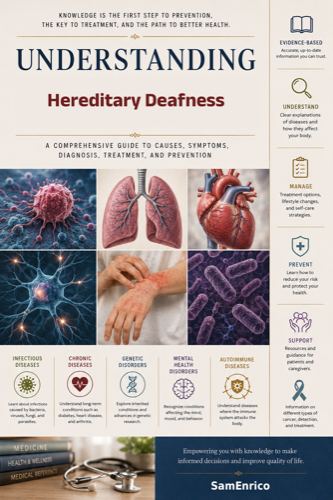
Understanding Hereditary Deafness
This disease publication, published by SamEnrico,
This disease publication, published by SamEnrico, covers Understanding Hereditary Deafness
Formats
About this book
Free sample
Chapter 1: The Silent Inheritance–- The first sound a healthy human ear ever detects is not a lullaby or a mother’s whisper. It is the rush of amniotic fluid past the developing cochlea at twenty weeks of gestation—a低频 rumble that the fetal brain cannot yet interpret but will soon learn to crave. By the time a newborn takes its first breath, the ear has already been listening for months. This remarkable organ, no larger than a blueberry at birth, contains within its spiral coils the entire history of our species’ relationship with sound. And when it fails—when the genetic blueprint for this intricate machinery carries a typo—the silence that follows is not merely an absence.
It is a presence. A presence that shapes identity, language, family, and future.This book is about that silence and the genes that write it. But before we can understand how hereditary deafness occurs, we must first understand the symphony of structures, cells, and electrical impulses that make hearing possible. This chapter provides the anatomical and physiological foundation for everything that follows. Without this knowledge, the subsequent discussions of mutations, audiograms, cochlear implants, and gene therapy would rest on uncertain ground.The Outer Ear: More Than Just a Funnel The journey of sound begins where we can see it—at the pinna, the visible cartilage-and-skin structure on the side of the head.
Most people think of the pinna as a simple funnel, but it is actually a sophisticated acoustic filter. Its ridges and valleys, unique to each individual like a fingerprint, selectively amplify certain frequencies while attenuating others. Specifically, the pinna boosts sounds in the 2,000 to 5,000 Hertz range—the exact frequencies where human speech consonants (like “s,” “f,” and “th”) reside. This is no accident. Evolution sculpted the outer ear to prioritize the sounds that matter most for social communication.From the pinna, sound waves travel down the ear canal (external auditory meatus), a narrow tube approximately 2.5 centimeters long in adults.
The canal is not a straight pipe; it has a gentle S-curve that protects the delicate eardrum from direct trauma…
This is the end of the free sample. Get the eBook to keep going. Buy now
Contents
- Chapter 1
- Chapter 2
- Chapter 3
- Chapter 4
- Chapter 5
- Chapter 6
- Chapter 7
- Chapter 8
- Chapter 9
- Chapter 10
- Chapter 11
- Chapter 12
Details
- Author
- Dorman Brenna
- Publisher
- SamEnrico
- Language
- English
- Genre
- Non-Fiction, Informative, Educational
- Released
- 2026-06-02
- Pages (approx.)
- 158
- Available as
- eBook, Audiobook

Read better in the ZLOADR app
Your eBooks on your phone or tablet. Sign in with your SamEnrico account and start reading.
More by Dorman Brenna
 The Postpartum Anxiety Self Care PlanDorman Brenna$11.99
 First Responder Dream GuideDorman Brenna$11.99
 Sleep Energy Foundation GuideDorman Brenna$11.99
 Behavioral Addiction in the Deaf CommunityDorman Brenna$11.99
 The Hollow Hill's Bargain: A Fairy King's GambitDorman Brenna$11.99
 The Alchemist's Gamble: The Medieval Quest for the Philosopher's StoneDorman Brenna$11.99
 Arcade GamesDorman Brenna$11.99
 Rwanda Business Registration WorkbookDorman Brenna$12.99
 Edge Cloud Computing OutlookDorman Brenna$12.99
 How to Start a Casks Made of Wood Business (Beginners Guide)Dorman Brenna$11.99