
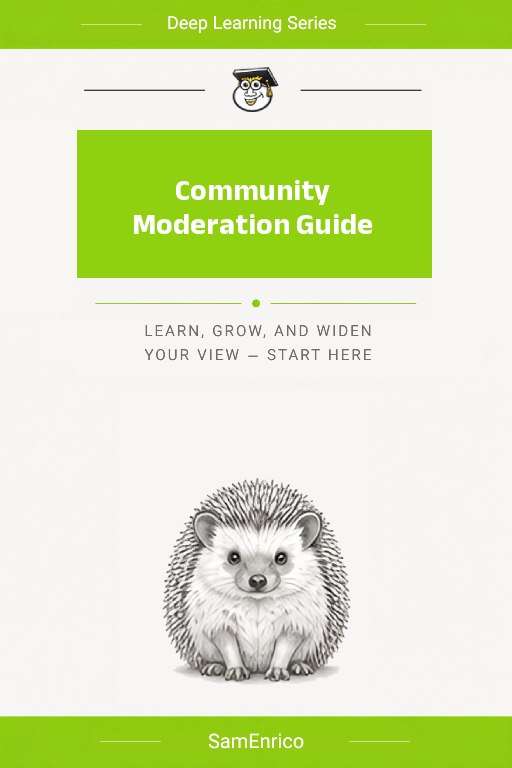
Non-FictionZero-to-One CreatorModeration
Community Moderation Guide eBook
Set rules, handle conflicts, and train moderators
Set rules, handle conflicts, and train moderators for safe paid community environment.
Formats
Free sample
Chapter 1: The Toxicity Tax--–- In 2022, a founder named Sarah launched a paid community for women in technology leadership. She charged 49permonth,cappedmembershipat500topreserveintimacy,andrecruitedthreevolunteermoderatorsfromherexistingfree Slackgroup.Withinsixmonths,shehadgrownto480payingmembersandwasgenerating49 per month, capped membership at 500 to preserve intimacy, and recruited three volunteer moderators from her existing free Slack group. Within six months, she had grown to 480 paying members and was generating 49permonth,cappedmembershipat500topreserveintimacy,andrecruitedthreevolunteermoderatorsfromherexistingfree Slackgroup.Withinsixmonths,shehadgrownto480payingmembersandwasgenerating23,520 in monthly recurring revenue. She was ecstatic. Her investor updates celebrated the hockey-stick growth.
Her social media channels featured testimonials from delighted members. Everything looked perfect from the outside.By month nine, she had 320 members. Monthly revenue had fallen to $15,680. She had lost 160 paying customers in ninety days, and she could not explain why. The product had not changed.
The price had not increased. Her marketing spend remained constant. When she finally surveyed the departing members, she expected to hear complaints about pricing, missing features, or technical bugs. Instead, 68 percent of them wrote some variation of the same sentence: “I left because I didn’t feel safe anymore.” Not one mentioned the price. Not one complained about the software.
They left because they were afraid, exhausted, or disgusted by what they had witnessed in the community they had paid to join.Sarah’s community did not fail because of competition or poor product-market fit. It failed because she treated moderation as an afterthought in a paid environment. She assumed that passionate volunteers could handle the emotional labor. She assumed that good people would naturally behave well. She assumed that toxicity was a free-speech problem rather than a customer-retention problem.
Every single assumption was wrong. This chapter is the story of why those assumptions fail and how to replace them with a framework that protects both your members and your revenue.The Silent Churn Engine Most community founders believe that “open conversation” is their primary selling point. They romanticize the town square, the Greek agora, the bustling forum where every voice matters equally. In a free public forum, that model can work. Reddit thrives on chaotic, unfiltered dialogue.
Twitter, for all its well-documented failures, built a global business on real-time, anything-goes communication. But a paid walled garden operates under fundamentally different economics. Paying customers are not users. They are subscribers. And subscribers expect a premium experience.
Chief among those expectations is the absence of harassment, trolling, spam, and digital noise. They are paying for peace of mind, not for a front-row seat to a digital brawl.The data is unforgiving. A multi-community study published in the Journal of Online Communities in 2024 analyzed churn patterns across twelve paid platforms, ranging from creator-led Discord servers to professional networking circles hosted on Circle and Mighty Networks. The study tracked 15,000 paying members over eighteen months. The findings flipped every assumption that community entrepreneurs hold dear.
Sixty-six percent of users canceled their paid subscriptions not because of price, feature gaps, or user interface issues, but because of toxicity. They left when they felt unsafe, personally attacked, or emotionally exhausted by unresolved conflict. They left when a troll was allowed to dominate a thread for three days before a moderator intervened. They left when they reported a racist comment and received an automated “we’ll look into it” reply that never came back. They left when the cost of staying—measured in emotional energy, anxiety, and anger—exceeded the value of the content they were paying to access.Price was the fourth or fifth reason on the list.
Safety was first by a margin of three to one. This finding has been replicated in smaller studies conducted by Circle, Mighty Networks, and even Discord’s internal research teams. The pattern is consistent across niches, price points, and community sizes. When paying members feel unsafe, they do not complain. They do not organize.
They do not give you a chance to fix the problem. They quietly cancel their subscriptions, often without ever telling you why. This is the silent churn engine, and it is the single greatest threat to the sustainability of paid communities.This book calls this phenomenon the Toxicity Tax. It is the invisible revenue leak that destroys paid communities from the inside. Most founders never see it coming because they are watching the wrong metrics.
They track new signups, engagement rates, daily active users, and average revenue per user. They do not track the number of members who quietly cancel after witnessing a public flame war. They do not survey departing members to ask the uncomfortable question, “Did you feel safe here?” They assume that if top-line revenue is growing, everything must be fine. But toxicity is a lagging indicator. A community can look healthy on the surface for months while the Toxicity Tax compounds beneath the waterline.
By the time churn accelerates and revenue flatlines, the cultural damage is already irreversible.The Airbnb Standard for Digital Spaces To understand why toxicity is uniquely fatal in paid communities, consider a metaphor that will recur throughout this book. When you book an Airbnb, you expect certain baseline conditions. You expect a clean room with no visible filth on the floors or bedding. You expect working locks on the doors and windows. You expect the host to enforce quiet hours so that you can sleep.
You do not expect to argue about free speech with the host. You do not expect to tolerate a neighbor screaming obscenities at 2 AM. You do not expect to clean up someone else’s mess before you can enjoy your stay. If any of those expectations are violated, you leave a one-star review, request a refund, and never book that property again.A paid community is no different. When a member pays $49 per month for access, they are buying a clean feed.
They are buying freedom from slurs, spam, doxxing, and coordinated harassment campaigns. They are buying the assurance that when they report a problem, a professional moderator will respond within minutes, not days or weeks. The community manager is the host. The members are the guests. And just as Airbnb hosts have a legal and ethical duty to deliver a clean, safe, quiet environment, community managers have a duty to deliver a clean, safe, constructive digital environment.
Failure to do so is not a “moderation problem” to be solved later when you have more budget or more staff. It is a breach of the implied contract between payer and provider.This is not a metaphor about censorship. It is a metaphor about customer experience. When Airbnb hosts fail to deliver cleanliness, they are not accused of suppressing free speech. They are accused of running a bad business.
They lose their Superhost status. They get delisted. They lose revenue. The same standard applies to paid communities. Safety is not a political stance.
It is a feature. It is a selling point. It is the difference between a community that grows through word-of-mouth referrals and a community that shrinks through silent cancellations. Every time a member recommends your community to a friend, they are implicitly promising that friend they will feel safe. Every time a member cancels because of toxicity, they are telling that same friend to stay away.The Airbnb standard forces a crucial reframing.…
This is the end of the free sample. Get the eBook to keep going. Buy now
About this book
Details
- Author
- Barnhill Mayme
- Publisher
- SamEnrico
- Language
- English
- Genre
- Non-Fiction, Zero-to-One Creator, Moderation
- Released
- 2026-05-30
- Pages (approx.)
- 123
- Available as
- eBook, Audiobook

Read better in the ZLOADR app
Your eBooks on your phone or tablet. Sign in with your SamEnrico account and start reading.
More by Barnhill Mayme
 Solopreneur ABCDE SystemBarnhill Mayme$11.99
 Rupture and Repair WorkbookBarnhill Mayme$11.99
 Parental Anger Bedtime BattlesBarnhill Mayme$11.99
 Franchising Your Local Brand Across Borders Currency HedgingBarnhill Mayme$11.99
 Intermittent Fasting Calorie LogBarnhill Mayme$11.99
 The Silent Heir: The Untold Story of Prince Harry’s Hidden StruggleBarnhill Mayme$11.99
 Echoes of the Ice: The Day the Arctic SpokeBarnhill Mayme$11.99
 Finance ClerkBarnhill Mayme$11.99
 Understanding Deafness Conductive Stapedial Ear Malformation Facial PalsyBarnhill Mayme$17.99
 Form 990 Public DisclosureBarnhill Mayme$12.99
 Ultimate Handbook Guide to St. Helier : (Jersey) Travel GuideBarnhill Mayme$11.99
You may also like
 Hong Kong Handover 1997Dunn Johnnie$11.99
 Zumba For Postnatal Recovery CourseNeal Christian$11.99
 Zumba for BeginnersLadner Nikia$11.99
 YouTube Comment Mining GuideHumes Pandora$12.99
 Worry Box MeditationCarlin Rudy$11.99
 Workplace Stress MeditationNguyen Lynn$11.99
 Workplace Stress and Sleep RepairHawley Ivory$11.99
 Workplace Perfectionism CureDelaney Jeffry$11.99
 Workplace Injustice Anger GuideWallen Isabelle$11.99
 Work Addiction and Burnout LinkGreenwood Ester$11.99
 Women in Yoga and WellnessBeattie Galina$11.99
 Women in Stand Up ComedyChun Evangeline$11.99