
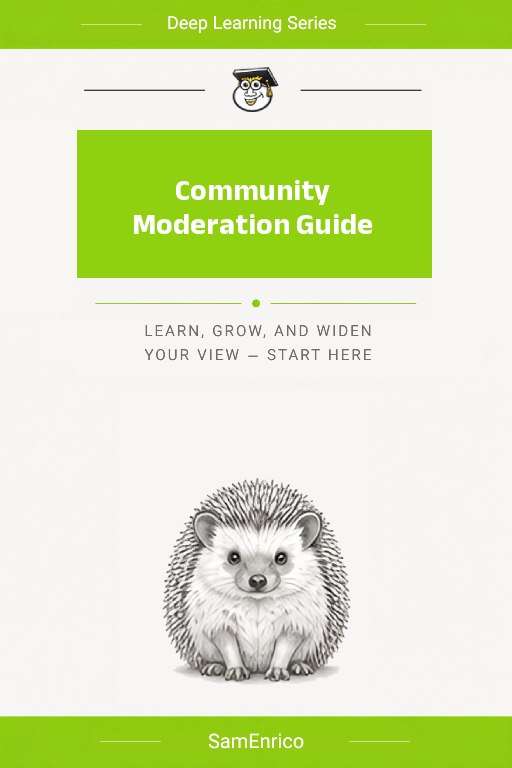
Non-FictionZero-to-One CreatorModeration
Community Moderation Guide
Set rules, handle conflicts, and train moderators
Set rules, handle conflicts, and train moderators for safe paid community environment.
Formats
About this book
Free sample
Chapter 1: The Toxicity Tax--–- In 2022, a founder named Sarah launched a paid community for women in technology leadership. She charged 49permonth,cappedmembershipat500topreserveintimacy,andrecruitedthreevolunteermoderatorsfromherexistingfree Slackgroup.Withinsixmonths,shehadgrownto480payingmembersandwasgenerating49 per month, capped membership at 500 to preserve intimacy, and recruited three volunteer moderators from her existing free Slack group. Within six months, she had grown to 480 paying members and was generating 49permonth,cappedmembershipat500topreserveintimacy,andrecruitedthreevolunteermoderatorsfromherexistingfree Slackgroup.Withinsixmonths,shehadgrownto480payingmembersandwasgenerating23,520 in monthly recurring revenue. She was ecstatic. Her investor updates celebrated the hockey-stick growth.
Her social media channels featured testimonials from delighted members. Everything looked perfect from the outside.By month nine, she had 320 members. Monthly revenue had fallen to $15,680. She had lost 160 paying customers in ninety days, and she could not explain why. The product had not changed.
The price had not increased. Her marketing spend remained constant. When she finally surveyed the departing members, she expected to hear complaints about pricing, missing features, or technical bugs. Instead, 68 percent of them wrote some variation of the same sentence: “I left because I didn’t feel safe anymore.” Not one mentioned the price. Not one complained about the software.
They left because they were afraid, exhausted, or disgusted by what they had witnessed in the community they had paid to join.Sarah’s community did not fail because of competition or poor product-market fit. It failed because she treated moderation as an afterthought in a paid environment. She assumed that passionate volunteers could handle the emotional labor. She assumed that good people would naturally behave well. She assumed that toxicity was a free-speech problem rather than a customer-retention problem.
Every single assumption was wrong. This chapter is the story of why those assumptions fail and how to replace them with a framework that protects both your members and your revenue.The Silent Churn Engine Most community founders believe that “open conversation” is their primary selling point. They romanticize the town square, the Greek agora, the bustling forum where every voice matters equally. In a free public forum, that model can work. Reddit thrives on chaotic, unfiltered dialogue.
Twitter, for all its well-documented failures, built a global business on real-time, anything-goes communication. But a paid walled garden operates…
This is the end of the free sample. Get the eBook to keep going. Buy now
Contents
- Chapter 1
- Chapter 2
- Chapter 3
- Chapter 4
- Chapter 5
- Chapter 6
- Chapter 7
- Chapter 8
- Chapter 9
- Chapter 10
- Chapter 11
- Chapter 12
Details
- Author
- Barnhill Mayme
- Publisher
- SamEnrico
- Language
- English
- Genre
- Non-Fiction, Zero-to-One Creator, Moderation
- Released
- 2026-05-30
- Pages (approx.)
- 123
- Available as
- eBook, Audiobook

Read better in the ZLOADR app
Your eBooks on your phone or tablet. Sign in with your SamEnrico account and start reading.
More by Barnhill Mayme
 Solopreneur ABCDE SystemBarnhill Mayme$11.99
 Rupture and Repair WorkbookBarnhill Mayme$11.99
 Parental Anger Bedtime BattlesBarnhill Mayme$11.99
 Franchising Your Local Brand Across Borders Currency HedgingBarnhill Mayme$11.99
 Intermittent Fasting Calorie LogBarnhill Mayme$11.99
 The Silent Heir: The Untold Story of Prince Harry’s Hidden StruggleBarnhill Mayme$11.99
 Echoes of the Ice: The Day the Arctic SpokeBarnhill Mayme$11.99
 Finance ClerkBarnhill Mayme$11.99
 Understanding Deafness Conductive Stapedial Ear Malformation Facial PalsyBarnhill Mayme$17.99
 Form 990 Public DisclosureBarnhill Mayme$12.99
 Ultimate Handbook Guide to St. Helier : (Jersey) Travel GuideBarnhill Mayme$11.99
You may also like
 Hong Kong Handover 1997Dunn Johnnie$11.99
 Zumba For Postnatal Recovery CourseNeal Christian$11.99
 Zumba for BeginnersLadner Nikia$11.99
 YouTube Comment Mining GuideHumes Pandora$12.99
 Worry Box MeditationCarlin Rudy$11.99
 Workplace Stress MeditationNguyen Lynn$11.99
 Workplace Stress and Sleep RepairHawley Ivory$11.99
 Workplace Perfectionism CureDelaney Jeffry$11.99
 Workplace Injustice Anger GuideWallen Isabelle$11.99
 Work Addiction and Burnout LinkGreenwood Ester$11.99
 Women in Yoga and WellnessBeattie Galina$11.99
 Women in Stand Up ComedyChun Evangeline$11.99