
Non-FictionSelf-HelpBehavioral Economics
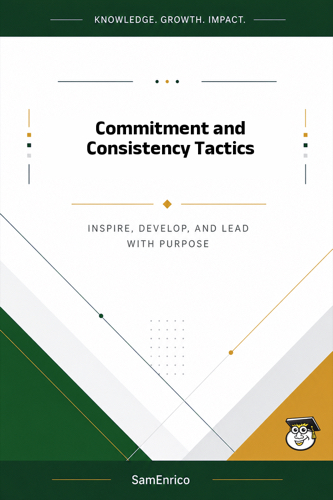
Commitment and Consistency Tactics Audiobook
Uses small initial agreements to lead to larger co
Uses small initial agreements to lead to larger compliance.
Formats
Free sample
Chapter 1: The Penny and the Pledge...--–- The first time I watched someone get trapped by a penny, I was sitting in a coffee shop in Chicago, watching a street fundraiser work a crowded sidewalk. He was young, energetic, and carrying a clipboard. His first request was not for money. It was for a signature on a petition to "protect local parks." Nearly everyone who walked by signed. It cost them nothing—maybe fifteen seconds and a squint at the fine print.
Then came the second request. "Would you be willing to make a small donation of just one dollar to support this cause?" The conversion rate was astonishing. People who had just signed the petition gave at a rate nearly four times higher than those he approached cold. The first request—the penny, the signature, the tiny yes—had already done its work before the second request was even spoken.This is not a trick. It is not hypnosis.
It is not even particularly clever. It is a deeply embedded feature of the human brain, one that has been refined by evolution and exploited by everyone from used car salespeople to political campaign managers to the apps on your phone. The principle is simple, almost embarrassingly so: people are more likely to comply with a larger request if they have first agreed to a smaller one. Psychologists call this the foot-in-the-door technique. I call it the Penny and the Pledge, because the smallest unit of commitment—a penny, a click, a signature, a nod—creates a psychological pledge that the brain refuses to break.This chapter is the foundation of everything that follows.
By the time you finish reading, you will understand exactly how a three-second agreement can lock you into a three-year obligation. You will see the neural pathways that make consistency feel like virtue. You will recognize the three characteristics that make a tiny yes almost impossible to refuse. And you will never again underestimate the power of a small request.The 1966 Study That Changed Everything In 1966, two Stanford psychologists named Jonathan Freedman and Scott Fraser published a study that became the cornerstone of everything we understand about commitment and consistency. They were not studying sales or marketing.
They were studying something much stranger: why people agree to things that are clearly against their own immediate interests.The experiment was simple, elegant, and slightly devious. Researchers called…
This is the end of the free sample. Get the Audiobook to keep going. Buy now
About this book
Details
- Author
- Blackmon Carolyne
- Publisher
- SamEnrico
- Language
- English
- Genre
- Non-Fiction, Self-Help, Behavioral Economics
- Released
- 2026-06-05
- Pages (approx.)
- 143
- Available as
- eBook, Audiobook

Listen in the VoxFlicks app
Audiobooks and audio dramas wherever you go. Sign in with your SamEnrico account and press play.
More by Blackmon Carolyne
 Bridge Visualization Crossing GuideBlackmon Carolyne$11.99
 Latin America Consumer GuideBlackmon Carolyne$11.99
 Biofeedback For DriversBlackmon Carolyne$11.99
 Trustee Responsibilities PrimerBlackmon Carolyne$11.99
 The Lost Voyages of the Punt Expeditions: Africa's Ancient MarinersBlackmon Carolyne$11.99
 Understanding Osteosarcoma Limb Anomalies Erythroid MacrocytosisBlackmon Carolyne$17.99
 Web Application DeveloperBlackmon Carolyne$11.99
 How to Become a Type-rolling-machine OperatorBlackmon Carolyne$11.99
 White Label Terms of Service GuideBlackmon Carolyne$12.99
 Tutoring Chinese University Application EssaysBlackmon Carolyne$12.99
You may also like
 Hong Kong Handover 1997Dunn Johnnie$11.99
 Zumba For Postnatal Recovery CourseNeal Christian$11.99
 Zumba for BeginnersLadner Nikia$11.99
 YouTube Comment Mining GuideHumes Pandora$12.99
 Worry Box MeditationCarlin Rudy$11.99
 Workplace Stress MeditationNguyen Lynn$11.99
 Workplace Stress and Sleep RepairHawley Ivory$11.99
 Workplace Perfectionism CureDelaney Jeffry$11.99
 Workplace Injustice Anger GuideWallen Isabelle$11.99
 Work Addiction and Burnout LinkGreenwood Ester$11.99
 Women in Yoga and WellnessBeattie Galina$11.99
 Women in Stand Up ComedyChun Evangeline$11.99