
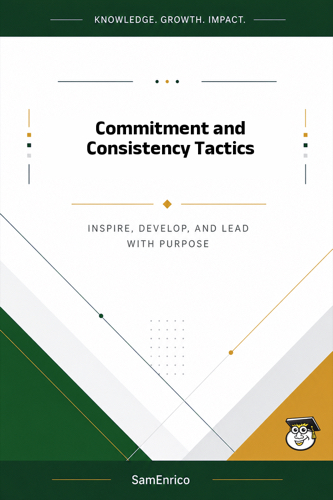
Commitment and Consistency Tactics eBook
Uses small initial agreements to lead to larger co
Uses small initial agreements to lead to larger compliance.
Formats
Free sample
Chapter 1: The Penny and the Pledge...--–- The first time I watched someone get trapped by a penny, I was sitting in a coffee shop in Chicago, watching a street fundraiser work a crowded sidewalk. He was young, energetic, and carrying a clipboard. His first request was not for money. It was for a signature on a petition to "protect local parks." Nearly everyone who walked by signed. It cost them nothing—maybe fifteen seconds and a squint at the fine print.
Then came the second request. "Would you be willing to make a small donation of just one dollar to support this cause?" The conversion rate was astonishing. People who had just signed the petition gave at a rate nearly four times higher than those he approached cold. The first request—the penny, the signature, the tiny yes—had already done its work before the second request was even spoken.This is not a trick. It is not hypnosis.
It is not even particularly clever. It is a deeply embedded feature of the human brain, one that has been refined by evolution and exploited by everyone from used car salespeople to political campaign managers to the apps on your phone. The principle is simple, almost embarrassingly so: people are more likely to comply with a larger request if they have first agreed to a smaller one. Psychologists call this the foot-in-the-door technique. I call it the Penny and the Pledge, because the smallest unit of commitment—a penny, a click, a signature, a nod—creates a psychological pledge that the brain refuses to break.This chapter is the foundation of everything that follows.
By the time you finish reading, you will understand exactly how a three-second agreement can lock you into a three-year obligation. You will see the neural pathways that make consistency feel like virtue. You will recognize the three characteristics that make a tiny yes almost impossible to refuse. And you will never again underestimate the power of a small request.The 1966 Study That Changed Everything In 1966, two Stanford psychologists named Jonathan Freedman and Scott Fraser published a study that became the cornerstone of everything we understand about commitment and consistency. They were not studying sales or marketing.
They were studying something much stranger: why people agree to things that are clearly against their own immediate interests.The experiment was simple, elegant, and slightly devious. Researchers called homemakers in a California neighborhood and asked if they would answer a few questions about household products. The request was trivial. It took less than thirty seconds. Almost everyone agreed.
That was the tiny yes.A few days later, a different researcher called the same women and asked a much larger favor: would they allow a team of five or six men to come into their homes for two hours to "inventory all of their household products"? This was, by any reasonable standard, an intrusive and bizarre request. Strangers in your home, touching your things, for two hours. Among the women who had not received the first call, only 22 percent agreed. Among those who had said yes to the tiny survey, 53 percent agreed—more than double.But Freedman and Fraser wanted to push further.
In a second experiment, they asked homemakers to sign a petition supporting "safe driving in California." The petition was bland, uncontroversial, and took three seconds to sign. Nearly everyone signed. Two weeks later, a different researcher asked if they would place a massive, ugly billboard on their front lawns that read "DRIVE SAFELY." The billboard was so large it would block a window. It was aesthetically terrible. It would lower the property value of any home that hosted it.Among the control group—people who had never signed the petition—only 17 percent agreed to the billboard.
Among those who had signed the petition, 76 percent agreed.Let me repeat that number: seventy-six percent. A three-second signature on a bland petition made people nearly four and a half times more likely to deface their own front lawns with an ugly sign.The researchers called this the "foot-in-the-door" technique, a metaphor borrowed from door-to-door salespeople who would place their foot in the door to prevent it from closing before they could make a larger pitch. But the metaphor undersells what is actually happening. The foot is not the mechanism. The mechanism is the self.The Neuroscience of a Small Yes What happens inside your brain when you say yes to a tiny request?
More than you might think.When you make a commitment—even a trivial one—your brain releases dopamine in the ventral striatum, a region associated with reward and reinforcement. This is the same circuitry that lights up when you eat sugar or receive a compliment. Your brain is literally rewarding you for being consistent. But that is only the beginning.The medial prefrontal cortex, a region just behind your forehead, is responsible for something called self-representation. This is where your brain keeps the story of who you are.
When you act in a way that matches your past actions, the medial prefrontal cortex sends a signal to the reward system: good job staying true to yourself. When you act inconsistently—when you say yes to something that contradicts a previous yes—the anterior cingulate cortex (a region associated with physical pain) activates. Changing your mind hurts. It hurts in a way that your brain can measure, like a mild burn or a pinch.This is not a metaphor. Neuroscientists have put people in f MRI machines and watched the anterior cingulate cortex light up when subjects were forced to contradict their own prior statements.
The brain treats inconsistency as an error, a failure, a small betrayal of the self. Consistency, on the other hand, feels like a reward.Here is the cruel irony: the initial yes does not even need to be meaningful. It does not need to be expensive. It does not need to be public. It only needs to exist.
Once you have said yes to anything—a petition, a survey, a free sample, a click on a button—your brain begins to build a narrative around that yes. I am the kind of person who supports safe driving. I am the kind of person who helps researchers. I am the kind of person who clicks "like" on social justice posts. That narrative then drives future behavior, not because you are being manipulated, but because your brain wants to avoid the pain of being wrong about who you are.The Identity Contradiction Trap The most powerful aspect of the foot-in-the-door technique is not the escalation of requests.
It is the identity contradiction that refusal would create.Imagine you are the homemaker in the 1966 study. You signed the safe driving petition two weeks ago. You did it without thinking. It was a good cause, and it cost you nothing. Now a researcher is asking you to put an ugly sign on your lawn.
Your first instinct is to say no. But then something happens. A quiet voice in your head says: If I say no to this sign, what does that say about me? I signed the petition. I support safe driving.
Saying no would mean I don't actually care that much. Am I a hypocrite?That voice is the identity contradiction. It…
This is the end of the free sample. Get the eBook to keep going. Buy now
About this book
Details
- Author
- Blackmon Carolyne
- Publisher
- SamEnrico
- Language
- English
- Genre
- Non-Fiction, Self-Help, Behavioral Economics
- Released
- 2026-06-05
- Pages (approx.)
- 143
- Available as
- eBook, Audiobook

Read better in the ZLOADR app
Your eBooks on your phone or tablet. Sign in with your SamEnrico account and start reading.
More by Blackmon Carolyne
 Bridge Visualization Crossing GuideBlackmon Carolyne$11.99
 Latin America Consumer GuideBlackmon Carolyne$11.99
 Biofeedback For DriversBlackmon Carolyne$11.99
 Trustee Responsibilities PrimerBlackmon Carolyne$11.99
 The Lost Voyages of the Punt Expeditions: Africa's Ancient MarinersBlackmon Carolyne$11.99
 Understanding Osteosarcoma Limb Anomalies Erythroid MacrocytosisBlackmon Carolyne$17.99
 Web Application DeveloperBlackmon Carolyne$11.99
 How to Become a Type-rolling-machine OperatorBlackmon Carolyne$11.99
 White Label Terms of Service GuideBlackmon Carolyne$12.99
 Tutoring Chinese University Application EssaysBlackmon Carolyne$12.99
You may also like
 Cigarette Pack Cost Calculator GuideChurch Dorla$11.99
 The Compulsive Shopper WorkbookNowlin Adelia$11.99
 Shopping Addiction Trigger Identification WorkbookRoney Evelynn$11.99
 Consistency Influence MethodRaymond Fernanda$11.99
 The Scarcity Influence MethodBlock Trenton$11.99
 Tobacco Cessation Reward SystemWinfrey Merlin$11.99
 Cigarette Money Jar SystemHines Monique$11.99
 Financial Incentive QuittingHoneycutt Dick$11.99
 Financial Incentives for Smoking QuitStull Shea$11.99
 Smoking Cessation Reward SystemJose Tillie$11.99
 Reciprocity In PersuasionFerrara Tyra$11.99
 Financial Incentives for QuittingCotton Arminda$11.99