
Non-FictionSelf-HelpFacilitation
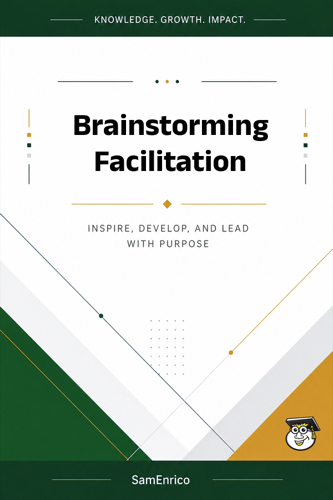
Brainstorming Facilitation eBook
Run inclusive, high energy ideation sessions that
Run inclusive, high energy ideation sessions that avoid groupthink.
Formats
Free sample
Chapter 1: The Silent Meeting Killer--–- The conference room was perfect. Whiteboards lined three walls, post-it notes in six colors sat in neat stacks, and the CEO had personally cleared her calendar for two hours. Twelve smart, motivated people gathered around the table. The problem was urgent but not impossible: how to redesign the customer onboarding flow before the next quarter’s revenue targets became impossible to hit.The facilitator, a sharp product manager named Elena, opened with the standard invitation. “No bad ideas.
Let’s just get everything out there. Go wild.” She smiled. People nodded. And then, for the next ninety minutes, exactly three people did 80 percent of the talking. The most senior engineer shot down two ideas before they were fully stated.
A junior designer wrote six post-it notes, then quietly peeled them off the wall and stuffed them in her pocket when she thought no one was looking. The quietest person in the room—a data analyst who had actually run the numbers on the existing funnel—said exactly four words: “I agree with Mark.”At the end of the session, Elena felt exhausted but productive. They had generated thirty-seven ideas. The team voted on the top three. Everyone left feeling like they had accomplished something.Six weeks later, all three ideas had failed.
The engineering team built a feature that customers actively hated. The marketing team launched a campaign that confused users. The pricing change drove away 12 percent of existing subscribers.In the post-mortem, someone finally said what everyone had been thinking: “We never actually solved the problem. We just voted on the loudest opinions.”This is not a story about bad people or lazy teams. It is a story about a broken process that almost every organization mistakes for creativity.The Most Expensive Meeting You’re Still Running Brainstorming is the most widely used creativity technique in the world—and by most measures, it doesn’t work.
Not as advertised, anyway. Alex Osborn, the advertising executive who coined the term in his 1953 book Applied Imagination, established four basic rules: defer judgment, go for quantity, encourage wild ideas, and build on the ideas of others. These rules sound sensible. They sound inclusive. They sound like the foundation of a high-functioning creative team.They are, in fact, a recipe for groupthink.More than sixty years of research has replicated the same uncomfortable finding.
In study after study, people working alone generate more ideas—and more original ideas—than people working in traditional brainstorming groups. The phenomenon has been given many names: production blocking, evaluation apprehension, social loafing. But the underlying mechanism is simple. When you put people in a room and tell them to “just throw out ideas,” you are not liberating their creativity. You are activating a predictable set of social dynamics that systematically silence the quietest people, reward the loudest voices, and produce the illusion of consensus long before any real thinking has occurred.Consider the data.
In a typical unstructured brainstorm, two people will generate 62 percent of the ideas. In a group of ten, that means eight people are along for the ride. The most senior person in the room speaks first and most often, regardless of expertise. Ideas suggested early in the session receive disproportionate attention, regardless of quality. And by the time the facilitator says “anyone else?” for the fifth time, the room has already decided which ideas matter—not because those ideas are better, but because they were spoken by the right people at the right time.This chapter is not an argument against group creativity.
It is an argument against naive creativity—the belief that removing structure unlocks innovation. What follows is a dismantling of the unstructured brainstorm, an introduction to the three psychological mechanisms that make it fail, and a first glimpse of the alternative that the rest of this book will build.The Psychological Safety Paradox Let us begin with a paradox that will recur throughout this book: the more you tell people there are “no rules,” the more they follow hidden rules.When a facilitator says “just throw out ideas,” what participants actually hear depends on their position in the organizational hierarchy, their personality, their past experiences of being judged, and their cultural background. A senior vice president hears “your ideas are welcome.” A junior designer who was publicly mocked in a meeting three months ago hears “your ideas will be judged.” An introverted engineer hears “you will have to compete for airtime.” A neurodivergent thinker who processes slowly hears “you will be left behind.”This is the psychological safety paradox. Without explicit structure, people do not feel free. They feel anxious.
And anxiety is the enemy of original thought.The research on psychological safety, pioneered by Amy Edmondson at Harvard Business School, has shown that teams with high psychological safety outperform teams with low psychological safety not because they are nicer, but because they are more willing to take interpersonal risks. They ask questions. They admit mistakes. They offer half-formed ideas. They disagree with senior people.Notice what psychological safety is not.
It is not about being comfortable. It is not about avoiding conflict. It is not about everyone feeling happy. Psychological safety is the shared belief that the group will not punish, humiliate, or reject someone for speaking up. It is the difference between a room where a junior person says “I think we’re missing something” and a room where that same person silently updates their resume.The unstructured brainstorm systematically destroys psychological safety.
When there are no rules for turn-taking, speaking becomes a competition. When there are no rules for how to disagree, disagreement becomes dangerous. When there is no structure for building on ideas, building becomes a performance. The people who are most vulnerable—juniors, introverts, women in male-dominated fields, people from cultures that value indirect communication—learn quickly that “just throw out ideas” actually means “just throw out ideas that will make you look good.”And so they withdraw. Not because they have nothing to contribute.
Because the environment has taught them that contributing is risky.The Loudest-Voice-Wins Dynamic The second mechanism that kills unstructured brainstorms is the simplest and most predictable: people who speak first and most often win.This is not because their ideas are better. It is because of a cognitive bias called anchoring. The first idea offered in a discussion becomes the reference point against which all subsequent ideas are compared. If the first idea is mediocre, the group does not reject it and move on. The group unconsciously treats it as the baseline.
An idea that is 20 percent better than the mediocre baseline feels brilliant. An idea that is 50 percent different feels risky.Anchoring is amplified by recency bias. In a ninety-minute brainstorm, the last few ideas spoken receive disproportionate attention because they are freshest in working memory. This means that whoever speaks in the final ten minutes of a session has an unfair advantage over whoever spoke in the first ten minutes—regardless of the quality of their contributions.Now add status effects. In almost every organization, people accurately perceive who has more power.
Senior people speak first, more often, and with fewer interruptions. When a senior person endorses an idea, junior people are…
This is the end of the free sample. Get the eBook to keep going. Buy now
About this book
Details
- Author
- Brandon Jonnie
- Publisher
- SamEnrico
- Language
- English
- Genre
- Non-Fiction, Self-Help, Facilitation
- Released
- 2026-06-08
- Pages (approx.)
- 155
- Available as
- eBook, Audiobook

Read better in the ZLOADR app
Your eBooks on your phone or tablet. Sign in with your SamEnrico account and start reading.
More by Brandon Jonnie
 Self Esteem for Anxious AttachmentBrandon Jonnie$11.99
 Hypothyroidism and FoodBrandon Jonnie$11.99
 ACT for Dysthymia GuideBrandon Jonnie$11.99
 Alcoholism Recovery for PerfectionistsBrandon Jonnie$11.99
 Senior Housing ESG GuideBrandon Jonnie$11.99
 Quality Time StressBrandon Jonnie$11.99
 COGS Calculation For StartupsBrandon Jonnie$11.99
 Frostbound: The Troll King's Forbidden LoveBrandon Jonnie$11.99
 The Samurai Strategist: How a Forgotten Warlord Built Japan's First Elite Warrior TeamBrandon Jonnie$11.99
 Disadvantaged Business Enterprise GuideBrandon Jonnie$12.99
 Cradle to Cradle CertificationBrandon Jonnie$12.99
 Mastering The Art of German Ju-jutsuBrandon Jonnie$11.99
You may also like
 Hong Kong Handover 1997Dunn Johnnie$11.99
 Zumba For Postnatal Recovery CourseNeal Christian$11.99
 Zumba for BeginnersLadner Nikia$11.99
 YouTube Comment Mining GuideHumes Pandora$12.99
 Worry Box MeditationCarlin Rudy$11.99
 Workplace Stress MeditationNguyen Lynn$11.99
 Workplace Stress and Sleep RepairHawley Ivory$11.99
 Workplace Perfectionism CureDelaney Jeffry$11.99
 Workplace Injustice Anger GuideWallen Isabelle$11.99
 Work Addiction and Burnout LinkGreenwood Ester$11.99
 Women in Yoga and WellnessBeattie Galina$11.99
 Women in Stand Up ComedyChun Evangeline$11.99