
Non-FictionSelf-HelpPerformance ReviewFeedback
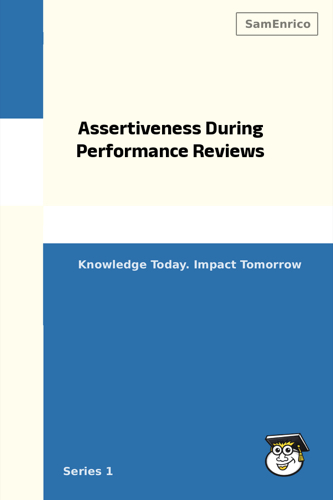
Assertiveness During Performance Reviews eBook
Present accomplishments and advocate for recogniti
Present accomplishments and advocate for recognition without arrogance.
Formats
Free sample
Chapter 1: The Qualified Quiet--–- Sara had just finished the best quarter of her career. She had brought in three new enterprise clients, streamlined a reporting process that saved her team twenty hours a week, and stepped in to cover for a colleague on medical leave—all while hitting every single one of her individual targets. When she walked into her annual performance review, she felt a quiet confidence. Not arrogance. Just the calm satisfaction of a job well done.Her manager, David, opened a file on his laptop and glanced at it for the first time in what looked like weeks.
"So, Sara," he said, "how do you think things went this year?"Sara hesitated. Every instinct told her to list her achievements. But another voice—louder, older, more anxious—whispered: Don't brag. Don't be that person. Good work speaks for itself.So she said: "I think it went fine.
There's always room for improvement."David nodded, made a note, and moved on. The conversation lasted twelve minutes. Sara walked out with a "meets expectations" rating and a 2% cost-of-living adjustment. The three new clients, the twenty hours saved, the colleague she had supported—none of it appeared in the final write-up. Not because David was malicious.
Because Sara had handed him the story of her year on a silver platter of modesty, and he had no reason to dig deeper.Two floors up, her colleague Marcus had just finished his own review. Marcus had closed two new clients—fewer than Sara—and had been out for three weeks with a family emergency. But Marcus had a habit. Every Friday, he emailed David a one-sentence update on his wins. Before the review, he sent a one-page summary.
And when David asked, "How do you think things went?" Marcus said: "I'm proud of the work I did. Let me walk you through the numbers."Marcus walked out with a "exceeds expectations" rating, a 7% raise, and a verbal offer to lead a new pilot project.Sara and Marcus were equally competent. But only one of them had learned to be visible. The other was trapped in what this book calls the Qualified Quiet—highly capable professionals who remain undervalued not because of what they do, but because of what they fail to say.The Myth That Keeps You Stuck The Qualified Quiet is not a personality type. It is a condition—one that is actively cultivated by a culture that has spent centuries telling good people that humility means silence, that self-promotion is vanity, and that "your work will speak for itself."That last phrase might be the most expensive piece of career advice ever spoken.Let us be precise about what this myth asserts.
The myth claims that if you do excellent work consistently enough, the right people will notice, remember, and reward you without any effort on your part. It sounds reasonable. It sounds fair. It sounds like the world should work that way.It does not.The research is unambiguous. A 2021 study published in the Journal of Applied Psychology followed 1,200 professionals across three industries for two years.
The researchers found that self-advocacy—the act of explicitly stating one's contributions—was a stronger predictor of salary growth and promotion velocity than actual performance metrics. In other words, two employees with identical output could have dramatically different career trajectories based solely on whether they spoke up about their work.Another study, this one from Cornell University, asked managers to evaluate anonymous employee profiles. When the profiles included self-advocacy statements ("I led this project," "I resolved this issue"), managers rated the employees as 34% more competent than identical profiles that omitted those statements—even when the actual accomplishments were the same.The myth survives not because it is true, but because it serves those who benefit from your silence. If you believe that good work speaks for itself, you will never demand recognition. You will never ask for a raise.
You will never challenge a low rating. And your manager—who is overworked, under-resourced, and managing seven to ten other people—will happily accept the gift of your invisibility. It makes their job easier.This is not malice. This is cognitive load. Your manager is not sitting in their office thinking, How can I ignore Sara's accomplishments today?
They are thinking about their own deadlines, their own boss, and the fifteen unread emails in their inbox. Your work will not speak for itself because no one is listening for it.The Anatomy of the Qualified Quiet Let us name the symptoms so you can recognize them in yourself.Symptom One: You assume that results are enough. You finish a project, close a deal, or solve a crisis, and you move on to the next thing without documenting or sharing what you did. You believe that the outcome itself is the message. It is not.
Outcomes are data points without narrators. They require someone to notice, interpret, and remember them. That someone is supposed to be you.Symptom Two: You downplay compliments reflexively. When someone says, "Great job on that presentation," you respond with "Oh, it was nothing" or "Anyone could have done it" or "I just got lucky." These are not humble. They are erasive.
Each time you deflect a compliment, you train the people around you to stop offering them. You also train yourself to believe that your accomplishments are not worth acknowledging.Symptom Three: You wait to be asked. You do not volunteer information about your wins because you are waiting for the "right moment"—the quarterly review, the annual summary, the moment your manager explicitly asks. But here is the secret that high-advocacy professionals understand: that moment never comes unless you create it. Your manager will not ask because they do not know what you have done.
They do not know because you did not tell them. The cycle feeds itself.Symptom Four: You confuse confidence with arrogance. Somewhere along the way, you learned that stating your accomplishments is indistinguishable from bragging. You fear being seen as "full of yourself," "self-promoting," or "that person." So you swing to the opposite extreme: you say nothing. This is a category error.
Arrogance says, "I am better than everyone else." Assertiveness says, "Here is what I did, measured against an objective standard." The difference is not volume. It is evidence.Symptom Five: You assume others are tracking your work. This is the most dangerous symptom because it feels reasonable. You think: My manager sees what I do every day. They know I stayed late.
They know I fixed that client issue. They were copied on the email. But being copied on an email is not the same as registering its significance. Your manager may have seen your name on fifty emails this week. They remember exactly zero of them.
Attention is a scarce resource, and you are competing with a dozen other priorities for a slice of it.If you recognize yourself in three or more of these symptoms, you are likely a member of the Qualified Quiet. The good news is that this condition is not permanent. It is a set of habits, and habits can be changed.The Real Costs of Invisibility Before…
This is the end of the free sample. Get the eBook to keep going. Buy now
About this book
Details
- Author
- Littleton Randell
- Publisher
- SamEnrico
- Language
- English
- Genre
- Non-Fiction, Self-Help, Performance Review, Feedback
- Released
- 2026-06-09
- Pages (approx.)
- 126
- Available as
- eBook, Audiobook

Read better in the ZLOADR app
Your eBooks on your phone or tablet. Sign in with your SamEnrico account and start reading.
More by Littleton Randell
 Disability Body Self Esteem GuideLittleton Randell$11.99
 The Anger Intelligence WorkbookLittleton Randell$11.99
 Personal Property DepreciationLittleton Randell$11.99
 EQ for Workplace Leadership PrimerLittleton Randell$11.99
 The Light of Byzantium: The Science of the Eastern Roman EmpireLittleton Randell$11.99
 Data Presentation Glossary TermsLittleton Randell$12.99
 Strategic Sourcing Efficiency GuideLittleton Randell$12.99
 Understanding Macular Degeneration, PolymorphicLittleton Randell$17.99
 Loader OperativeLittleton Randell$11.99
 A Beginners Guide to Dragon boat racing (Volume 1)Littleton Randell$11.99
You may also like
 Hong Kong Handover 1997Dunn Johnnie$11.99
 Zumba For Postnatal Recovery CourseNeal Christian$11.99
 Zumba for BeginnersLadner Nikia$11.99
 YouTube Comment Mining GuideHumes Pandora$12.99
 Worry Box MeditationCarlin Rudy$11.99
 Workplace Stress MeditationNguyen Lynn$11.99
 Workplace Stress and Sleep RepairHawley Ivory$11.99
 Workplace Perfectionism CureDelaney Jeffry$11.99
 Workplace Injustice Anger GuideWallen Isabelle$11.99
 Work Addiction and Burnout LinkGreenwood Ester$11.99
 Women in Yoga and WellnessBeattie Galina$11.99
 Women in Stand Up ComedyChun Evangeline$11.99