
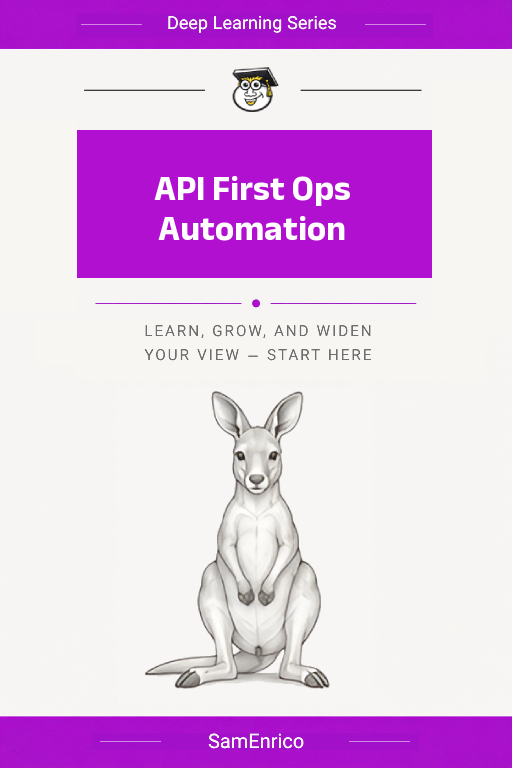
API First Ops Automation eBook
Connect your CRM, ticketing system, and data wareh
by Brill Justin
Connect your CRM, ticketing system, and data warehouse using no code API calls to create seamless cross platform operations workflows.
Formats
Free sample
Chapter 1: The Silent Crisis--–- It was 3:47 PM on a Wednesday when Maria, the head of revenue operations at a fast-growing Saa S company, discovered that $2.3 million in qualified leads had been sitting in a spreadsheet for eleven days instead of flowing into the sales team’s workflow. The marketing automation platform had updated a single field name overnight—changing “lead_score” to “lead Score” in their API—and three separate integration scripts had broken silently. No alerts. No error logs. No notifications.
Just eleven days of invisible failure.Maria’s story is not an exception. It is the rule.Every operations leader has a version of this story. The finance team discovers that invoice data hasn’t synced to the CRM for six weeks. The support team realizes that tickets created from high-priority customer emails have been going to a dead folder because a webhook timed out. The data team finds that the warehouse hasn’t received updated customer records since the last sprint, when someone “fixed” a script without updating its dependencies.These are not technology failures.
They are architecture failures. And they are costing companies millions in lost revenue, wasted labor, and eroded customer trust.This chapter introduces the fundamental problem that the rest of this book solves: the crisis of point-to-point integration in modern operations. You will learn why traditional integration methods create brittle, unmanageable “spaghetti code,” how operational debt accumulates silently, and why the solution lies in a radical shift from pipelines to orchestration. By the end of this chapter, you will understand why the API-first, orchestration-centric approach is not merely a technical preference but a strategic necessity.The Anatomy of a Silent Failure Let us dissect what happened to Maria’s company because it reveals the hidden mechanics of integration failure. The company had three core systems: a marketing automation platform (Hub Spot), a CRM (Salesforce), and a ticketing system (Zendesk).
The lead flow was simple: when a lead scored above 80 in Hub Spot, a custom Python script running on a scheduled EC2 instance would copy the lead to Salesforce, then another script would create a follow-up task in Zendesk.This architecture had worked for eighteen months. Then Hub Spot updated its API from version 3 to version 4. The field “lead_score” became “lead Score.” The Python script, which referenced the old field name, began throwing Key Error exceptions. The script had no error handling, no retry logic, and no alerting. It simply failed and stopped executing.
Because the script was scheduled to run every hour, it failed once per hour, silently, for eleven days.The tragedy is not that the script failed. The tragedy is that no one knew.This is the defining characteristic of point-to-point integration failures: they are silent until they are catastrophic. Unlike a database outage or a server crash, which trigger alarms and page on-call engineers, broken integration scripts simply stop moving data. The business continues operating on stale information. Decisions are made based on incomplete pictures.
Customers fall through cracks.The Spaghetti Code Phenomenon Point-to-point integration creates what software engineers call “spaghetti code”—a tangled, unstructured mess of connections that becomes impossible to understand, maintain, or debug. The metaphor is apt: like a bowl of spaghetti, each integration is a noodle connecting two systems directly. As you add more integrations, the noodles tangle. Eventually, pulling on one noodle (changing a single field or API endpoint) causes a cascade of breaks across the entire bowl.Consider a typical mid-sized company with ten core systems: CRM, ticketing, marketing automation, billing, data warehouse, HRIS, project management, customer success platform, analytics, and communication tools. In a point-to-point architecture, the number of potential connections grows according to the formula n(n-1)/2.
For ten systems, that is 45 possible direct connections. Most companies do not build all 45—but they build enough that the dependency graph becomes incomprehensible.Each direct connection is a small piece of custom code. A Python script here. A Zapier webhook there. A custom middleware function written by an intern who has since left the company.
These scripts live in different repositories, written in different languages, maintained by different teams, with different logging standards and error handling approaches. Some have documentation. Most do not.The result is what we call Operations Debt—the operational equivalent of technical debt. Operations debt accrues every time a team chooses a quick, point-to-point integration over a reusable, orchestrated one. The interest payments on this debt come due in the form of firefighting hours, customer complaints, missed SLAs, and the cognitive load of keeping a thousand invisible dependencies running.The Three False Promises of Point-to-Point Integration Why do smart teams continue building point-to-point integrations despite decades of evidence that they fail at scale?
Because point-to-point integration makes three seductive promises that turn out to be false.False Promise One: Simplicity. At first glance, connecting System A directly to System B seems simpler than introducing an intermediary orchestration layer. The direct connection requires fewer moving parts, less infrastructure, and less upfront design. A developer can write a Python script in an afternoon that moves data from Salesforce to Zendesk. What could be simpler?The deception is that simplicity is not the same as low complexity.
The direct connection is simple for the first integration. It is simple for the second. By the third or fourth integration, however, the lack of a central architecture becomes a liability. You cannot see the full graph of dependencies. You cannot predict the impact of changing a field in one system.
The simplicity of each individual connection creates the complexity of the whole system.False Promise Two: Speed. Point-to-point integrations are fast to build. A developer can write a script, test it with a handful of records, and deploy it to production within a day. In a business environment that prizes velocity, this speed feels like a competitive advantage.The deception is that speed-to-build is not the same as speed-to-value. The fast script that breaks silently and goes undetected for eleven days has delivered negative value.
A more robust, orchestrated integration might take three days to build but will include error handling, logging, alerting, and idempotency—features that prevent silent failures and reduce long-term maintenance. The point-to-point approach trades upfront speed for downstream toil.False Promise Three: Control. When you write a custom integration script, you control every line of code. You are not beholden to a vendor’s roadmap or a platform’s limitations. You can add any logic, call any API, transform any data format.
This sense of control feels empowering.The deception is that control without visibility is an illusion. You control the script, but you do not control the dependencies. You cannot control when Hub Spot changes its API schema. You cannot control when Salesforce enforces stricter rate limits. You cannot control when the EC2 instance runs out of memory.
Your script gives you control over the code but not over the operational environment in which it runs. True control comes from architectures that anticipate change, not from code that assumes stasis.The True Cost of Operations Debt Operations debt is not an abstract technical concept. It has real, measurable costs that impact every part of the business.Labor Cost. Every hour…
This is the end of the free sample. Get the eBook to keep going. Buy now
About this book
Details
- Author
- Brill Justin
- Publisher
- SamEnrico
- Language
- English
- Genre
- Non-Fiction, AI Operator, Systems Integration
- Released
- 2026-06-01
- Pages (approx.)
- 136
- Available as
- eBook, Audiobook

Read better in the ZLOADR app
Your eBooks on your phone or tablet. Sign in with your SamEnrico account and start reading.
More by Brill Justin
 Valerian Root Recall GuideBrill Justin$11.99
 Meth Legal Recovery GuideBrill Justin$11.99
 Empowerment for ParentsBrill Justin$11.99
 Angry Driver Self Talk GuideBrill Justin$11.99
 Imposter Syndrome for New AttorneysBrill Justin$11.99
 Dual User Recovery GuideBrill Justin$11.99
 Videla ArgentinaBrill Justin$11.99
 Pattern Recognition in FinanceBrill Justin$11.99
 TM For Anger ManagementBrill Justin$11.99
 The Spice DNA: Unlocking Ancient Genetic Secrets Along the AmazonBrill Justin$11.99
 The Last Voyage of the SS America: How a Floating City Sank into OblivionBrill Justin$11.99
 The Last Broadcast: When the Internet DiedBrill Justin$11.99