
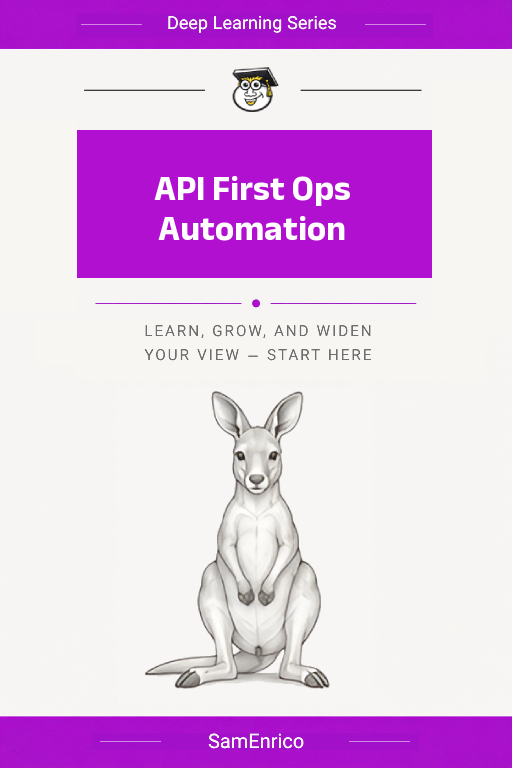
API First Ops Automation
Connect your CRM, ticketing system, and data wareh
by Brill Justin
Connect your CRM, ticketing system, and data warehouse using no code API calls to create seamless cross platform operations workflows.
Formats
About this book
Free sample
Chapter 1: The Silent Crisis--–- It was 3:47 PM on a Wednesday when Maria, the head of revenue operations at a fast-growing Saa S company, discovered that $2.3 million in qualified leads had been sitting in a spreadsheet for eleven days instead of flowing into the sales team’s workflow. The marketing automation platform had updated a single field name overnight—changing “lead_score” to “lead Score” in their API—and three separate integration scripts had broken silently. No alerts. No error logs. No notifications.
Just eleven days of invisible failure.Maria’s story is not an exception. It is the rule.Every operations leader has a version of this story. The finance team discovers that invoice data hasn’t synced to the CRM for six weeks. The support team realizes that tickets created from high-priority customer emails have been going to a dead folder because a webhook timed out. The data team finds that the warehouse hasn’t received updated customer records since the last sprint, when someone “fixed” a script without updating its dependencies.These are not technology failures.
They are architecture failures. And they are costing companies millions in lost revenue, wasted labor, and eroded customer trust.This chapter introduces the fundamental problem that the rest of this book solves: the crisis of point-to-point integration in modern operations. You will learn why traditional integration methods create brittle, unmanageable “spaghetti code,” how operational debt accumulates silently, and why the solution lies in a radical shift from pipelines to orchestration. By the end of this chapter, you will understand why the API-first, orchestration-centric approach is not merely a technical preference but a strategic necessity.The Anatomy of a Silent Failure Let us dissect what happened to Maria’s company because it reveals the hidden mechanics of integration failure. The company had three core systems: a marketing automation platform (Hub Spot), a CRM (Salesforce), and a ticketing system (Zendesk).
The lead flow was simple: when a lead scored above 80 in Hub Spot, a custom Python script running on a scheduled EC2 instance would copy the lead to Salesforce, then another script…
This is the end of the free sample. Get the eBook to keep going. Buy now
Contents
- Chapter 1
- Chapter 2
- Chapter 3
- Chapter 4
- Chapter 5
- Chapter 6
- Chapter 7
- Chapter 8
- Chapter 9
- Chapter 10
- Chapter 11
- Chapter 12
Details
- Author
- Brill Justin
- Publisher
- SamEnrico
- Language
- English
- Genre
- Non-Fiction, AI Operator, Systems Integration
- Released
- 2026-06-01
- Pages (approx.)
- 136
- Available as
- eBook, Audiobook

Read better in the ZLOADR app
Your eBooks on your phone or tablet. Sign in with your SamEnrico account and start reading.
More by Brill Justin
 Valerian Root Recall GuideBrill Justin$11.99
 Meth Legal Recovery GuideBrill Justin$11.99
 Empowerment for ParentsBrill Justin$11.99
 Angry Driver Self Talk GuideBrill Justin$11.99
 Imposter Syndrome for New AttorneysBrill Justin$11.99
 Dual User Recovery GuideBrill Justin$11.99
 Videla ArgentinaBrill Justin$11.99
 Pattern Recognition in FinanceBrill Justin$11.99
 TM For Anger ManagementBrill Justin$11.99
 The Spice DNA: Unlocking Ancient Genetic Secrets Along the AmazonBrill Justin$11.99
 The Last Voyage of the SS America: How a Floating City Sank into OblivionBrill Justin$11.99
 The Last Broadcast: When the Internet DiedBrill Justin$11.99