
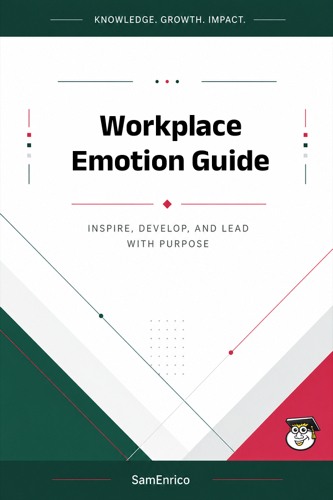
Workplace Emotion Guide eBook
undefined
undefined
Formats
Free sample
Chapter 1: The Emotional Lie--–- Every morning, Sarah closed her office door, sat perfectly still for sixty seconds, and pressed her palms flat against her thighs. She was a forty-two-year-old vice president of operations at a mid-sized logistics company, and she had been told her entire career that emotions had no place at work. "Leave your feelings at the door," her first mentor had said. "Professionalism means composure." So Sarah composed herself. She swallowed the anxiety before quarterly reviews, buried the frustration when her ideas were dismissed, and smiled through the exhaustion of back-to-back meetings.
She was good at it. So good that no one noticed the slow unraveling—the insomnia that started three years ago, the shortness of breath during presentations, the morning she found herself crying in the parking garage for no reason she could name. Then came the board meeting. A routine budget presentation. Forty-seven slides.
Sarah had done it a hundred times. But halfway through, her voice cracked. Then her hands shook. Then she excused herself, walked to the bathroom, and sat on the floor for twenty minutes trying to remember how to breathe. Her doctor called it a panic attack.
Sarah called it the moment she realized that leaving her feelings at the door had not made her more professional. It had made her a liability.This book is for everyone who has ever been told to be less emotional at work. It is for the manager who swallowed their anger until it became ulcers, the individual contributor who stayed silent in meetings until they felt invisible, the leader who projected calm while their nervous system screamed. It is for the high-performing teams that look flawless on paper but cannot seem to trust one another. And it is for Sarah, who after that panic attack finally asked the question this entire book answers: What if emotions are not the enemy of good work but the engine of it?The Myth of the Rational Workplace For more than a century, Western business culture has operated under a single, damaging assumption: rationality and emotion are opposing forces.
The rational mind is clear, objective, and reliable. The emotional mind is cloudy, subjective, and suspect. From Frederick Taylor's scientific management in the 1910s to the cult of "professionalism" that dominates corporate handbooks today, the message has been consistent—check your feelings at the door, or you will be checked out yourself.There is only one problem with this assumption. It is biologically false.Antonio Damasio, a neuroscientist at the University of Southern California, made a discovery in the 1990s that should have ended the myth of the rational workplace forever. He studied patients with damage to a small region of the brain called the ventromedial prefrontal cortex—the area responsible for linking emotions to decision-making.
On the surface, these patients appeared perfectly rational. They could describe logical courses of action, list pros and cons, and explain why one choice was better than another. But there was a catch. They could not make decisions. Given two lunch options, they would spend hours analyzing without choosing.
Given a major life decision, they became paralyzed. Damasio realized something extraordinary: without emotions, rationality does not produce action. It produces endless analysis and paralysis. Emotions are not the enemy of good decisions. They are the biological engine that allows decisions to happen at all.Think about that for a moment.
Every time you have been told to "be professional" by suppressing your feelings, you were being asked to disable one of your brain's most essential functions. That is not professionalism. That is sabotage.Emotions Are Data, Not Distractions If emotions are not obstacles, what are they? This book proposes a simple reframe that will appear in every chapter that follows: emotions are data. They are signals from your body and brain about what matters, what threatens you, what aligns with your values, and what needs attention.
A spike of anxiety before a presentation is not a sign of weakness. It is data that your brain perceives something important at stake. A flash of anger when a colleague takes credit for your work is not unprofessional. It is data that a boundary has been crossed and fairness violated. A wave of exhaustion after a meeting is not laziness.
It is data that something in that interaction drained your energy.The problem is not that we have emotions at work. The problem is that we have been given no training in how to read them. Imagine being handed a financial statement in a language you do not speak and being told to ignore the numbers because they are distracting. That is how most organizations treat emotions. The data is there, rich with insight, but the culture says look away.This book will teach you to stop looking away.
It will give you a framework for recognizing emotions as signals, interpreting their meaning, and responding strategically rather than reacting automatically. The goal is not to become less emotional. The goal is to become emotionally literate—to move from being at the mercy of your feelings to working with them as a source of intelligence.Why Most "Emotional Intelligence" Training Fails You may have already encountered emotional intelligence training. Perhaps your company offered a half-day workshop with breathing exercises and a handout on empathy. Perhaps you read an article about "leaving your ego at the door" or "leading with heart." Perhaps you rolled your eyes and went back to your spreadsheets.
That skepticism is understandable. Most workplace emotional intelligence training fails for three reasons.First, it treats emotions as something to "manage" in the sense of control, suppression, or elimination. The implicit message is still that emotions are messy and dangerous, and the goal is to keep them contained. That framework is toxic because it reinforces the very myth this chapter dismantles. You cannot manage emotions by locking them in a box any more than you can manage a river by building a dam without spillways.
Eventually, the pressure builds, and the flood breaks through.Second, most emotional intelligence training is generic. It offers the same advice to the accountant and the emergency room nurse, the individual contributor and the chief executive. But the emotional demands of different roles vary dramatically, as we will explore in Chapter 11. A customer service representative who must project cheerfulness while being berated needs different tools than a software engineer who works alone for hours. A leader whose every facial expression is scrutinized needs different skills than an intern who is afraid to speak up in meetings.
One-size-fits-all emotional training fits no one.Third, and most critically, most emotional intelligence training stops at awareness. It teaches you to name your emotions—"I feel angry"—but does not teach you what to do next. Awareness without action is not enlightenment. It is just navel-gazing with a vocabulary list. This book is different.
Every chapter ends with specific, actionable protocols, scripts, and tools. You will not just learn what emotional granularity means. You will build your personal emotional lexicon. You will not just learn about cognitive defusion. You will carry a STOP protocol card in your wallet.
You will not just learn about psychological safety. You will have fill-in-the-blank templates for difficult conversations.The Real Cost of Emotional…
This is the end of the free sample. Get the eBook to keep going. Buy now
About this book
Details
- Author
- Edgar Ruthanne
- Publisher
- SamEnrico
- Language
- English
- Genre
- Non-Fiction, Self-Help
- Released
- 2026-06-06
- Pages (approx.)
- 138
- Available as
- eBook, Audiobook

Read better in the ZLOADR app
Your eBooks on your phone or tablet. Sign in with your SamEnrico account and start reading.
More by Edgar Ruthanne
 The Assertiveness Journal MethodEdgar Ruthanne$11.99
 Lucknow Residency SiegeEdgar Ruthanne$11.99
 Pregnenolone Memory GuideEdgar Ruthanne$11.99
 Persuasive Vendor SelectionEdgar Ruthanne$11.99
 Angola Independence WarEdgar Ruthanne$11.99
 Anxiety Driven Parent AngerEdgar Ruthanne$11.99
 Representativeness Heuristic RisksEdgar Ruthanne$11.99
 Comfort Discomfort IndicatorsEdgar Ruthanne$11.99
 Specters in the Courtroom: The Forgotten Witchcraft Case That Divided a ColonyEdgar Ruthanne$11.99
 Scipio and Sophia: Love Letters from the Punic WarsEdgar Ruthanne$11.99
 The Alchemist of the Nile: The Lost Secrets of the Black PharaohsEdgar Ruthanne$11.99
 The Mineral Guide to ParachrysotileEdgar Ruthanne$11.99
You may also like
 Hong Kong Handover 1997Dunn Johnnie$11.99
 Zumba For Postnatal Recovery CourseNeal Christian$11.99
 Zumba for BeginnersLadner Nikia$11.99
 YouTube Comment Mining GuideHumes Pandora$12.99
 Worry Box MeditationCarlin Rudy$11.99
 Workplace Stress MeditationNguyen Lynn$11.99
 Workplace Stress and Sleep RepairHawley Ivory$11.99
 Workplace Perfectionism CureDelaney Jeffry$11.99
 Workplace Injustice Anger GuideWallen Isabelle$11.99
 Work Addiction and Burnout LinkGreenwood Ester$11.99
 Women in Yoga and WellnessBeattie Galina$11.99
 Women in Stand Up ComedyChun Evangeline$11.99