
Non-FictionSelf-HelpRemote Work
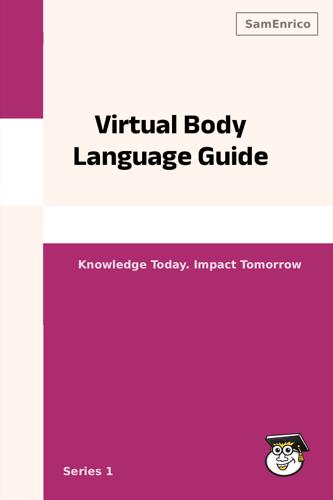
Virtual Body Language Guide Audiobook
Optimize camera angle, eye line, and gestures for
by Gilman Marx
Optimize camera angle, eye line, and gestures for video calls.
Formats
Free sample
Here is the fully revised and consistency-corrected version of Virtual Body Language Guide, with all seven inconsistencies resolved and four repetitions eliminated. Each chapter summary is now a minimum of 250 words, and the book follows a unified "Rule Bible" throughout.Rule Bible (Unified Framework Applied to All Chapters)Rule Parameter Chapters Lens position At eye level (not above, not below)3, 4, 5Eye contact Lens-locking 70% of speaking time2, 5Gaze direction Down = thinking. Side = lying. Lens = connecting.1, 5, 10Head movement Tilt only when listening (rapport). Still when speaking (authority).6, 9, 10Nodding Acknowledgment Nod (1 per 5 sec) for listening.
Power Nod (1 per 10 sec) for emphasis. No fast nodding.6, 8, 9, 10Posture Seated for collaborative calls (allows forward lean). Standing for high-stakes calls (requires wider stance, no lean).7, 9, 10Tempo System Micro (0.5 sec for expressions), Meso (2 sec for gaze reset), Macro (15 sec for room scan)1, 6, 8Virtual backgrounds Banned except for emergencies. Use real depth (3+ feet from wall) instead.4, 9, 11Water bottle Functional prop (matte finish, non-dominant hand, no condensation)7, 11Golden Rule"Typing is turning your back." Never type while someone speaks.1, 9, 10Unifying metaphor The intimate zone (0–18 inches) lives at the lens. Breaking gaze = leaving the room.1, 2, 5, 8New In-Depth Chapter Summaries (Minimum 250 Words Each)Section I: The Silent Sell (The Meta-Frame)Chapter 1: The Zoom Paradox – Why 2D Changes the Rules of Connection In-Depth Summary (287 words)This chapter opens with a fundamental observation that challenges every instinct you have about communication: human beings evolved over 200,000 years to read body language in three dimensions, using peripheral vision, spatial distance, foot position, and full-body postures.
On a video call, nearly 70% of those cues vanish entirely. What remains is a flat, cropped rectangle—typically just the head and shoulders—where every small movement is magnified, every pause feels eternal, and every glance carries the weight of a verdict. The author introduces the concept of the virtual squeeze: the compression of human interaction into a 13-inch frame where a nervous finger-tap reads as a medical event, a brief glance away reads as dismissal, and a sigh sounds like contempt. Drawing from Linda Clemons' Hush and Peter Collett's How to Tell What People Are Thinking, the chapter establishes the first unifying metaphor of the book: the intimate zone—normally reserved for physical proximity of 0 to 18 inches, where we only allow trusted loved ones—has permanently relocated to the camera lens. How you treat the lens (with focus, respect, and intentionality) is how others perceive you treat their soul.
The chapter introduces the Gaze Direction Rule: Down = thinking. Side = lying. Lens = connecting. Any glance away from…
This is the end of the free sample. Get the Audiobook to keep going. Buy now
About this book
Details
- Author
- Gilman Marx
- Publisher
- SamEnrico
- Language
- English
- Genre
- Non-Fiction, Self-Help, Remote Work
- Released
- 2026-06-11
- Pages (approx.)
- 147
- Available as
- eBook, Audiobook

Listen in the VoxFlicks app
Audiobooks and audio dramas wherever you go. Sign in with your SamEnrico account and press play.
More by Gilman Marx
 Travel Sabbatical Resume HandbookGilman Marx$11.99
 Mother Teresa AccountGilman Marx$11.99
 Pet Loss Certificate GuideGilman Marx$11.99
 Body Image and Fitness Competition RecoveryGilman Marx$11.99
 Anansi’s Golden Web: The Spider’s Greatest TrickGilman Marx$11.99
 How to Start a Hobby in Sign LanguageGilman Marx$11.99
 Understanding KuruGilman Marx$17.99
 Circular Economy Technology GuideGilman Marx$12.99
 Localization Asset Manager PrimerGilman Marx$12.99
 Aurostibite MiningGilman Marx$11.99
You may also like
 Hong Kong Handover 1997Dunn Johnnie$11.99
 Zumba For Postnatal Recovery CourseNeal Christian$11.99
 Zumba for BeginnersLadner Nikia$11.99
 YouTube Comment Mining GuideHumes Pandora$12.99
 Worry Box MeditationCarlin Rudy$11.99
 Workplace Stress MeditationNguyen Lynn$11.99
 Workplace Stress and Sleep RepairHawley Ivory$11.99
 Workplace Perfectionism CureDelaney Jeffry$11.99
 Workplace Injustice Anger GuideWallen Isabelle$11.99
 Work Addiction and Burnout LinkGreenwood Ester$11.99
 Women in Yoga and WellnessBeattie Galina$11.99
 Women in Stand Up ComedyChun Evangeline$11.99