
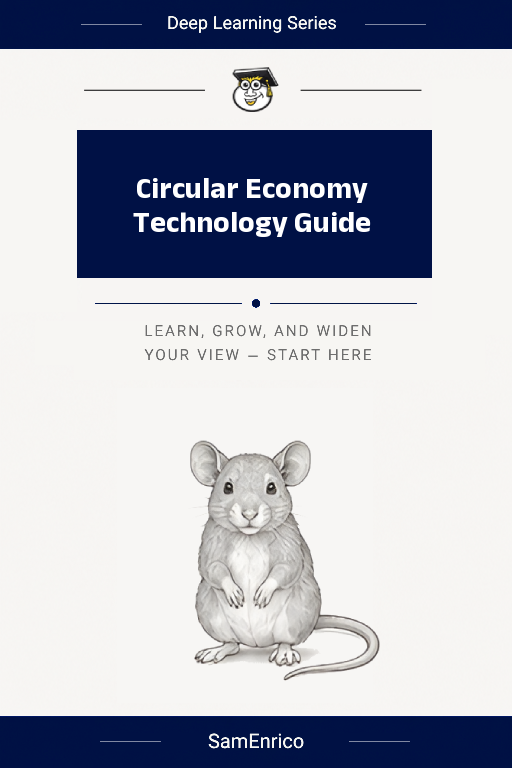
Circular Economy Technology Guide
Project recycling robotics, material tracking, and
by Gilman Marx
Project recycling robotics, material tracking, and product-as-a-service models adoption through 2030.
Formats
About this book
Free sample
Chapter 1: The $4.5 Trillion Blind Spot--The landfill in Accra, Ghana, rises from the coastal plain like a gray mountain range. From a distance, it could be mistaken for a geological formation—weathered, ancient, indifferent. But as the delivery truck crests the final hill, the truth asserts itself through the open window: the smell of burning insulation, the acrid sweetness of decomposing electronics, the low haze of smoke that never quite dissipates. This is Agbogbloshie, one of the world's largest informal e-waste dumps. And somewhere in that sprawling graveyard of cathode ray tubes and crushed laptop cases is the laptop you threw away three years ago.Not your laptop specifically, of course.
But statistically, the odds are uncomfortably high. Of the 53.6 million metric tons of electronic waste generated globally in 2023, the United Nations estimates that only 17 percent was formally collected and recycled. The remaining 83 percent—more than 44 million tons—was incinerated, landfilled, or, like the stream flowing into Agbogbloshie, shipped across borders under the fiction of "reuse" and "repair." The European Union banned the export of hazardous e-waste to non-OECD countries in 2006. Then again in 2014. Then again with stronger enforcement in 2021.
And yet the containers keep arriving, and the smoke keeps rising, because the economic logic of the linear economy is brutally simple: it is cheaper to ship your waste to someone else's horizon than to process it where it falls.This book exists because that logic is running out of horizons.The Invisible Price Tag For most of industrial history, waste was treated as an externality—a problem that belonged to someone else, somewhere else, some other time. Manufacturers extracted raw materials, transformed them into products, sold them to consumers, and walked away. The end-of-life bill was left to municipalities, taxpayers, and the environment. This model, sometimes called "take-make-waste," powered two centuries of unprecedented economic growth. It also created a $4.5 trillion blind spot.That number—4.5trillion—isthe World Economic Forum′sestimateoftheeconomicvalueembeddedinthecirculareconomyby2030.Notthecostoftransitioning.Nottheregulatorypenaltyfornoncompliance.The∗value∗.Therevenuewaitingtobecapturedbycompaniesthatfigureouthowtokeepmaterialsincirculationinsteadofsendingthemto Accraortheincinerator.Toputthatnumberinperspective:4.5 trillion—is the World Economic Forum's estimate of the economic value embedded in the circular economy by 2030.
Not the cost of transitioning. Not the regulatory penalty for noncompliance. The *value*. The revenue waiting to be captured by…
This is the end of the free sample. Get the eBook to keep going. Buy now
Contents
- Chapter 1
- Chapter 2
- Chapter 3
- Chapter 4
- Chapter 5
- Chapter 6
- Chapter 7
- Chapter 8
- Chapter 9
- Chapter 10
- Chapter 11
- Chapter 12
Details
- Author
- Gilman Marx
- Publisher
- SamEnrico
- Language
- English
- Genre
- Non-Fiction, Forecast & Outlook, Circular Economy
- Released
- 2026-05-30
- Pages (approx.)
- 148
- Available as
- eBook, Audiobook

Read better in the ZLOADR app
Your eBooks on your phone or tablet. Sign in with your SamEnrico account and start reading.
More by Gilman Marx
 Virtual Body Language GuideGilman Marx$11.99
 Travel Sabbatical Resume HandbookGilman Marx$11.99
 Mother Teresa AccountGilman Marx$11.99
 Pet Loss Certificate GuideGilman Marx$11.99
 Body Image and Fitness Competition RecoveryGilman Marx$11.99
 Anansi’s Golden Web: The Spider’s Greatest TrickGilman Marx$11.99
 How to Start a Hobby in Sign LanguageGilman Marx$11.99
 Understanding KuruGilman Marx$17.99
 Localization Asset Manager PrimerGilman Marx$12.99
 Aurostibite MiningGilman Marx$11.99
You may also like
 Circular Supply Chain TechBoynton Remedios$11.99
 Circular Economy GuideBlock Merrill$11.99
 Slovenian Circular Economy TransitionVenable Laronda$11.99
 Waste Tech Recycling InvestmentFeldman Lenna$11.99
 SEA Sustainable Packaging GuideMcdowell Sharen$12.99
 Circular Economy Investment GuideBedford Heide$12.99
 Renewable Energy Recycling OutlookMesser Loura$12.99
 Plastic Waste Circular Economy GuideBroderick Necole$12.99