
Non-FictionInformativeEducational
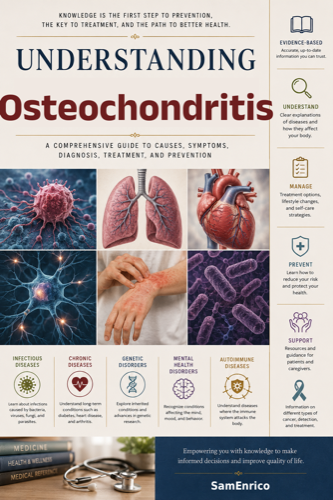
Understanding Osteochondritis eBook
This disease publication, published by SamEnrico,
by Hurd Alvera
This disease publication, published by SamEnrico, covers Understanding Osteochondritis
Formats
Free sample
Chapter 1: The Silent Fracture...--–- The boy who couldn't straighten his knee did not limp. Not at first. Fourteen-year-old Marcus Chen was a point guard with a future—coaches used words like "instincts" and "court vision" when they talked about him. He had played competitive basketball since age seven, logging an estimated 4,500 hours of organized practice and game time by his freshman year of high school. His father, a former college player himself, had kept a meticulous log: every practice, every tournament, every AAU weekend.
Marcus lived by one rule: never miss a workout.The pain began quietly, the way most orthopedic tragedies do. In October, during a preseason scrimmage, Marcus felt a dull ache deep inside his left knee after a hard landing from a rebound. He ignored it. By November, the ache had become a stiffness that resolved after the first ten minutes of practice—what trainers call the "warm-up phenomenon." Marcus interpreted this as a good sign. If it hurt but went away, it couldn't be serious, right?
By December, the stiffness returned after games, worse than before. He would sit on the bench after the final buzzer, unable to fully extend his knee for thirty or forty minutes. His mother noticed him limping through the grocery store. "It's nothing," he said. "Just sore."In January, Marcus's knee gave way during a fast break—no contact, no twist, just a sudden, terrifying sensation that his leg was about to buckle.
He caught himself before falling, finished the play, and said nothing. In February, the knee locked. He was walking to class when his left leg simply stopped bending. He stood in the hallway for ten minutes, flexing and extending, until the joint released with a pop he felt more than heard. A school nurse told him it was probably a meniscus tear.
An urgent care doctor ordered X-rays and called them normal. "Growing pains," she said. "You're fourteen. It happens."In March, Marcus's season ended. An MRI ordered by a sports medicine specialist revealed the truth: a 1.8-centimeter osteochondral lesion on the posterolateral aspect of his medial femoral condyle.
The fragment was unstable, surrounded by fluid, and had already begun to separate from the underlying bone. The cartilage overlying the lesion was fissured and partially detached. Marcus required surgery—arthroscopic drilling followed by screw fixation. He missed his entire sophomore season. By the time he returned to basketball eighteen months later, he had lost his starting position, his vertical leap, and most crucially, his confidence.
He would never play college basketball. When his father finally asked the surgeon why they hadn't caught it earlier, the answer was honest and devastating: "Because nobody was looking for it."The Silent Fracture: What Marcus's Doctors Missed Marcus's story is not unusual. It is, in fact, painfully typical. Osteochondritis Dissecans, or OCD, is a condition that defies easy categorization. It is not arthritis, though it leads to arthritis.
It is not a fracture, though it behaves like one. It is not a bone disease, though the pathology begins in bone. And it is not rare—not really—but it is rare enough that most general practitioners, pediatricians, and even many orthopedists will see only a handful of cases in their careers. The result is a diagnostic delay that averages four to six months, during which time a stable, healable lesion can progress to an unstable, surgical lesion. In one study of 120 consecutive juvenile OCD patients, the average time from symptom onset to diagnosis was 7.2 months.
By the time of diagnosis, 68 percent had already developed unstable lesions requiring surgery.OCD is defined as a focal, idiopathic alteration of subchondral bone and its overlying articular cartilage, with potential for instability and progressive cartilage breakdown. Let us unpack that dense sentence. "Focal" means the disease is localized—it strikes a specific spot, not the whole joint. "Idiopathic" is medical language for "we don't fully understand why it starts in this person at this time." "Subchondral bone" is the layer of bone just beneath the articular cartilage, the shock absorber that distributes load from the cartilage to the underlying skeleton. And "instability" is the critical concept: the bone fragment can loosen, like a tile lifting from a floor, and eventually break free entirely, becoming a loose body that floats within the joint, causing locking, catching, and accelerated cartilage wear.The name itself is a historical accident.
When German surgeon Franz König first described the condition in 1887, he believed it was caused by inflammation—hence the "-itis" suffix. He was wrong. Modern histologic studies show little to no inflammation in early lesions. What they show instead is necrosis: dead bone, surrounded by a zone of attempted healing, often with a sclerotic barrier that prevents blood vessels from reaching the fragment. The contemporary understanding views OCD as a subchondral stress fracture that fails to heal, usually in the context of repetitive microtrauma, vascular vulnerability, and possibly genetic predisposition.The Epidemiology: How Common Is Common Enough to Worry?The prevalence of OCD is frequently cited as 15 to 29 cases per 100,000 persons.
These numbers, drawn from large population-based studies in Scandinavia and the United States, create a paradox. On one hand, 15 to 29 per 100,000 is genuinely uncommon. A primary care physician with a panel of 2,000 patients might see one case of OCD in an entire career. On the other hand, consider the denominator differently. Among adolescents aged 10 to 15—the peak age range for juvenile OCD—the prevalence rises substantially.
In a 2012 study from the Mayo Clinic, the annual incidence of knee OCD in adolescents was 7.8 per 100,000 person-years. Among young athletes participating in high-impact sports, the prevalence is higher still, though precise numbers are difficult to obtain because many cases go undiagnosed.What does this mean for the practicing clinician? It means that OCD is a condition you must think about even though you will rarely see it. It is a diagnostic zebra in a field of horses, but the consequences of missing the zebra are severe. A missed meniscus tear can be addressed months later with arthroscopy and debridement.
A missed ACL tear can be reconstructed. But a missed OCD lesion that progresses from stable to unstable, or from unstable to completely detached, results in a cartilage defect that cannot be restored to native hyaline cartilage with any current technology. The best we can offer is a repair—drilling, fixation, or ultimately, replacement with graft tissue. And even the best repairs have failure rates of 10 to 30 percent in the long term.The Bimodal Age Distribution: Two Diseases or One?OCD presents in two distinct age peaks: juvenile OCD occurring in children aged 10 to 15 years with open physes (growth plates), and adult OCD occurring in patients aged 20 to 40 years with closed physes. This bimodal distribution has fueled decades of debate.
Are juvenile and adult OCD the same disease expressed at different ages? Or are they distinct entities with different pathophysiologies, natural histories, and treatment responses?The evidence increasingly favors the view that adult OCD is, in most cases, unresolved juvenile OCD. Longitudinal studies that have followed cohorts of juvenile OCD patients into adulthood provide compelling support. In a 2015 study from the ROCK (Research in Osteochondritis of the Knee) group, 73…
This is the end of the free sample. Get the eBook to keep going. Buy now
About this book
Details
- Author
- Hurd Alvera
- Publisher
- SamEnrico
- Language
- English
- Genre
- Non-Fiction, Informative, Educational
- Released
- 2026-05-09
- Pages (approx.)
- 152
- Available as
- eBook, Audiobook

Read better in the ZLOADR app
Your eBooks on your phone or tablet. Sign in with your SamEnrico account and start reading.
More by Hurd Alvera
 Waterfall Visualization Cleansing GuideHurd Alvera$11.99
 MBSR For Emotional Eating CourseHurd Alvera$11.99
 PCOS Ovasitol GuideHurd Alvera$11.99
 Hybrid Work Stress SolverHurd Alvera$11.99
 The Erwin Schrödinger Cat ParadoxHurd Alvera$11.99
 The Great Escape of Kilimani: Kenya's Most Audacious Prison BreakHurd Alvera$11.99
 Canadian Graduate Settlement FundsHurd Alvera$12.99
 Aon SWOT LibraryHurd Alvera$12.99
 Shih Tzu BreedingHurd Alvera$11.99
 A Beginners Guide to Frisian handball (Volume 1)Hurd Alvera$11.99
You may also like
 Hong Kong Handover 1997Dunn Johnnie$11.99
 Zumba For Postnatal Recovery CourseNeal Christian$11.99
 Zumba for BeginnersLadner Nikia$11.99
 YouTube Comment Mining GuideHumes Pandora$12.99
 Worry Box MeditationCarlin Rudy$11.99
 Workplace Stress MeditationNguyen Lynn$11.99
 Workplace Stress and Sleep RepairHawley Ivory$11.99
 Workplace Perfectionism CureDelaney Jeffry$11.99
 Workplace Injustice Anger GuideWallen Isabelle$11.99
 Work Addiction and Burnout LinkGreenwood Ester$11.99
 Women in Yoga and WellnessBeattie Galina$11.99
 Women in Stand Up ComedyChun Evangeline$11.99