
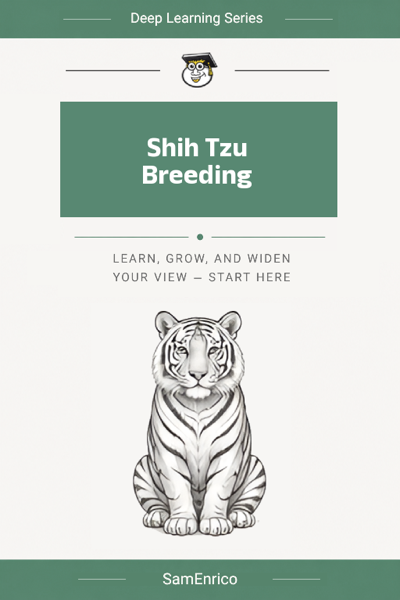
Non-FictionInformativeEducational
Shih Tzu Breeding
A Coursebook on Shih Tzu Breeding
by Hurd Alvera
A Coursebook on Shih Tzu Breeding
Formats
About this book
Free sample
Chapter 1: The Lion’s Legacy--Every purebred Shih Tzu alive today descends from just fourteen dogs.Let that number settle. Fourteen individuals—survivors of revolution, war, and near-extinction—form the genetic foundation of every champion, every pet, and every puppy you will ever breed. When you hold a newborn Shih Tzu in your palm, you are holding a living thread that connects back to Tibetan monasteries, Chinese imperial courts, and one of the most remarkable canine survival stories ever recorded. Understanding that story is not merely an exercise in nostalgia. It is the first and most essential step toward becoming an ethical, informed, and successful breeder.This chapter establishes the historical and functional context for every breeding decision you will make.
You cannot know where you are going until you understand where the breed has been. You cannot evaluate a Shih Tzu against the breed standard unless you grasp why that standard was written the way it was—what the original breeders valued, what they rejected, and what they fought to preserve through decades of upheaval. And you cannot claim to be improving the breed unless you understand what the breed was intended to be: a companion animal of singular charm, resilience, and temperament.So let us begin at the beginning. Not with whelping boxes or progesterone tests or pedigrees, but with the mountains of Tibet and the courts of China, where the "Lion Dog" earned its name and its place in history.The Tibetan Origins: Guardians of the Monasteries The Shih Tzu story does not begin in China, despite its long association with Chinese royalty. Most canine historians trace the breed’s ancestors to Tibet, where small, lion-like dogs were bred in Buddhist monasteries as early as the seventh century.
These dogs were known as "little lions"—a name derived not from their size but from their spiritual significance. In Tibetan Buddhism, the lion is a symbol of dharma (cosmic law and order), and the Snow Lion is one of the Four Dignities, representing fearlessness and joy. To have a dog that physically resembled a lion was to invite those qualities…
This is the end of the free sample. Get the eBook to keep going. Buy now
Contents
- Chapter 1
- Chapter 2
- Chapter 3
- Chapter 4
- Chapter 5
- Chapter 6
- Chapter 7
- Chapter 8
- Chapter 9
- Chapter 10
- Chapter 11
- Chapter 12
Details
- Author
- Hurd Alvera
- Publisher
- SamEnrico
- Language
- English
- Genre
- Non-Fiction, Informative, Educational
- Released
- 2026-05-09
- Pages (approx.)
- 158
- Available as
- eBook, Audiobook

Read better in the ZLOADR app
Your eBooks on your phone or tablet. Sign in with your SamEnrico account and start reading.
More by Hurd Alvera
 Waterfall Visualization Cleansing GuideHurd Alvera$11.99
 MBSR For Emotional Eating CourseHurd Alvera$11.99
 PCOS Ovasitol GuideHurd Alvera$11.99
 Hybrid Work Stress SolverHurd Alvera$11.99
 The Erwin Schrödinger Cat ParadoxHurd Alvera$11.99
 The Great Escape of Kilimani: Kenya's Most Audacious Prison BreakHurd Alvera$11.99
 Canadian Graduate Settlement FundsHurd Alvera$12.99
 Aon SWOT LibraryHurd Alvera$12.99
 Understanding OsteochondritisHurd Alvera$17.99
 A Beginners Guide to Frisian handball (Volume 1)Hurd Alvera$11.99
You may also like
 Hong Kong Handover 1997Dunn Johnnie$11.99
 Zumba For Postnatal Recovery CourseNeal Christian$11.99
 Zumba for BeginnersLadner Nikia$11.99
 YouTube Comment Mining GuideHumes Pandora$12.99
 Worry Box MeditationCarlin Rudy$11.99
 Workplace Stress MeditationNguyen Lynn$11.99
 Workplace Stress and Sleep RepairHawley Ivory$11.99
 Workplace Perfectionism CureDelaney Jeffry$11.99
 Workplace Injustice Anger GuideWallen Isabelle$11.99
 Work Addiction and Burnout LinkGreenwood Ester$11.99
 Women in Yoga and WellnessBeattie Galina$11.99
 Women in Stand Up ComedyChun Evangeline$11.99