
Non-FictionInformativeEducational
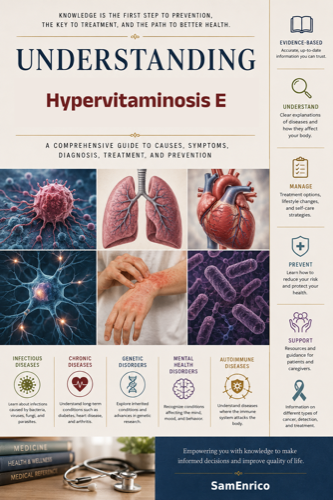
Understanding Hypervitaminosis E eBook
This disease publication, published by SamEnrico,
This disease publication, published by SamEnrico, covers Understanding Hypervitaminosis E
Formats
Free sample
Chapter 1: The Silent Epidemic--On a crisp October morning in 2018, Robert Chen kissed his wife goodbye, laced his running shoes, and headed out for his usual five-mile loop through the suburban streets of Boulder, Colorado. At fifty-eight, Robert was the picture of health—lean, energetic, and meticulous about his wellness regimen. He had never smoked, drank only socially, and his annual physicals consistently returned with blood pressure of 118/76, LDL cholesterol of 85 mg/d L, and a resting heart rate of fifty-two beats per minute. His doctor had once joked that Robert was “aging in reverse.” What no one knew—not his wife, not his physician, not even Robert himself—was that his body had been accumulating a silent poison for nearly seven years.Three miles into his run, Robert stumbled on an uneven patch of sidewalk. It was a minor fall, the kind that happens to everyone.
But this time, he did not get up. A passerby found him unconscious, a trickle of blood seeping from his left ear. Paramedics arrived within seven minutes. In the ambulance, his blood pressure was 210/110, his pupils were unequal, and his Glasgow Coma Scale score was six—indicating severe brain injury. At the hospital, a CT scan revealed the cause: a massive intracerebral hemorrhage spanning the right basal ganglia and thalamus.
Blood had filled nearly a third of his cranial cavity. Neurosurgeons operated immediately, but the damage was too extensive. Robert Chen died on the operating table fifty-three minutes after arrival.The hospital’s stroke team reviewed his case, searching for an explanation. He had no history of hypertension, no arteriovenous malformation, no aneurysm, no trauma to the head beyond the minor fall. His coagulation panel, drawn in the emergency department, provided the clue: prothrombin time of 28.3 seconds (normal range 11–13.5), INR of 2.9 (normal range 0.9–1.2).
Robert’s blood had been as thin as water. When his wife brought in his medication list, the mystery solved itself. Robert had been taking 1,200 IU of vitamin E daily for seven years. He had read online that vitamin E “prevents heart disease” and “slows aging.” He had never mentioned it to his doctor because, as he once told a friend, “It’s just a vitamin. What could possibly go wrong?”What went wrong is the subject of this book.The Invisible Crisis Robert’s death was not an isolated medical curiosity.
It was a sentinel event—a warning light flashing in an otherwise quiet room. Hypervitaminosis E, the condition of vitamin E excess leading to adverse effects, is vastly underrecognized, underdiagnosed, and underdiscussed. Yet the data suggest it is anything but rare. According to the National Health and Nutrition Examination Survey (NHANES), approximately 12% of American adults take supplemental vitamin E, with nearly 5% consuming doses that exceed the Tolerable Upper Intake Level (UL) of 1,000 milligrams per day. Among older adults, those most likely to be taking anticoagulant medications and most vulnerable to hemorrhagic stroke, the prevalence of high-dose vitamin E use approaches 8%.These numbers translate into real patients.
A 2019 analysis of the FDA’s Adverse Event Reporting System identified 3,247 reports of bleeding complications associated with vitamin E supplements over a ten-year period, including 412 deaths. The true number is almost certainly higher, because most cases go unreported. Physicians rarely ask about supplements; patients rarely volunteer the information; and when a patient on warfarin or aspirin presents with a nosebleed or a bruise, the default assumption is medication effect, not vitamin toxicity. Hypervitaminosis E is the perfect hidden epidemic—easily preventable, easily treatable, and almost systematically overlooked.This chapter introduces the central paradox that animates the entire book: vitamin E is both essential and dangerous. It is essential because humans cannot synthesize it; we must obtain it from diet.
It is dangerous because, unlike water-soluble vitamins that are readily excreted, vitamin E accumulates in adipose tissue and the liver, reaching toxic levels over months or years of overconsumption. The same antioxidant properties that protect cell membranes at physiological concentrations become pro-oxidant and anticoagulant at supraphysiological doses. This is not a theoretical concern. It is the mechanism that killed Robert Chen.Defining Hypervitaminosis EBefore proceeding, we must be precise about what hypervitaminosis E means. The term derives from the Greek hyper (over, above), the Latin vitaminus (vital amine), and the suffix -osis (condition or process).
In clinical practice, hypervitaminosis E is defined as a state of vitamin E excess sufficient to produce measurable adverse effects, most commonly bleeding diathesis. The diagnosis requires three elements: documented high-dose vitamin E intake (generally >1,000 IU daily for adults), laboratory evidence of elevated serum alpha-tocopherol (greater than 30 mcg/m L), and clinical manifestations such as prolonged bleeding time, easy bruising, epistaxis, or, in severe cases, hemorrhagic stroke.It is important to distinguish hypervitaminosis E from vitamin E deficiency, which is the condition that has historically received most of the medical literature’s attention. Vitamin E deficiency is rare in healthy adults, occurring primarily in individuals with fat malabsorption disorders such as cystic fibrosis, Crohn’s disease, or short bowel syndrome. Symptoms include peripheral neuropathy, ataxia, and retinopathy. The RDA of 15 milligrams per day is sufficient to prevent deficiency in nearly all healthy individuals.
Deficiency is so uncommon that the US Preventive Services Task Force recommends against routine vitamin E screening in asymptomatic adults. Yet the supplement industry has built a multibillion-dollar market on the implicit fear of deficiency—a fear that has no epidemiological basis.Hypervitaminosis E, by contrast, is the condition of abundance. It is the disease of the health-conscious, the supplement-taker, the person who believes that if a little is good, more must be better. This belief is not only wrong; it is dangerous. The dose-response relationship for vitamin E follows a U-shaped curve: too little causes deficiency, too much causes toxicity, and the safe window between the two is relatively narrow.
For an adult, the RDA is 15 milligrams. The UL is 1,000 milligrams. That is a sixty-sevenfold range—wide enough to accommodate individual variation but narrow enough that typical supplement doses (400–1,000 IU, or approximately 268–670 milligrams) sit perilously close to the upper boundary. A single “high potency” supplement of 2,000 IU contains 1,340 milligrams, exceeding the UL by 34%. Taken daily for months or years, such a dose is virtually guaranteed to produce toxicity.The Epidemiology of Overconsumption Who is at risk for hypervitaminosis E?
The answer is almost anyone who takes vitamin E supplements, but certain populations face elevated risk. Understanding these risk groups is essential for both prevention and early detection.Older adults constitute the largest group. The same NHANES data that identified 12% overall supplement use found that among adults aged sixty and older, the prevalence rises to 18%. Older adults are also more likely to be taking anticoagulant medications such as warfarin or antiplatelet agents such as aspirin and clopidogrel, creating dangerous drug-supplement interactions. The combination of high-dose vitamin E and warfarin potentiates the anticoagulant effect, increasing INR by 30–50% and elevating the risk of bleeding complications fourfold.
For an older adult with atrial fibrillation or a mechanical heart valve, adding vitamin E to a warfarin regimen is functionally equivalent to doubling the warfarin dose without physician oversight.Patients preparing for surgery represent a second high-risk group. A 2017 survey of preoperative patients at a major academic medical center found that…
This is the end of the free sample. Get the eBook to keep going. Buy now
About this book
Details
- Author
- Gunn Jessenia
- Publisher
- SamEnrico
- Language
- English
- Genre
- Non-Fiction, Informative, Educational
- Released
- 2026-06-02
- Pages (approx.)
- 154
- Available as
- eBook, Audiobook

Read better in the ZLOADR app
Your eBooks on your phone or tablet. Sign in with your SamEnrico account and start reading.
More by Gunn Jessenia
 Anima Animus Dream Symbols GuideGunn Jessenia$11.99
 Franchise Builder's Franchisee Association LeaderGunn Jessenia$11.99
 Weekly Learning ReviewGunn Jessenia$11.99
 Glute Stretching For Low BackGunn Jessenia$11.99
 The Great Toilet Paper Heist: How a Global Shortage Exposed Capitalism's FlawsGunn Jessenia$11.99
 The Unseen Hand: How a Silent Film Star Shaped Modern HollywoodGunn Jessenia$11.99
 Laser Interstitial Thermal TherapyGunn Jessenia$12.99
 Supply Chain Entry Level GuideGunn Jessenia$12.99
 Neutron Diffractometer TechnicianGunn Jessenia$11.99
 How to Become a Multineedle-chainstitch-machine OperatorGunn Jessenia$11.99
You may also like
 Hong Kong Handover 1997Dunn Johnnie$11.99
 Zumba For Postnatal Recovery CourseNeal Christian$11.99
 Zumba for BeginnersLadner Nikia$11.99
 YouTube Comment Mining GuideHumes Pandora$12.99
 Worry Box MeditationCarlin Rudy$11.99
 Workplace Stress MeditationNguyen Lynn$11.99
 Workplace Stress and Sleep RepairHawley Ivory$11.99
 Workplace Perfectionism CureDelaney Jeffry$11.99
 Workplace Injustice Anger GuideWallen Isabelle$11.99
 Work Addiction and Burnout LinkGreenwood Ester$11.99
 Women in Yoga and WellnessBeattie Galina$11.99
 Women in Stand Up ComedyChun Evangeline$11.99