
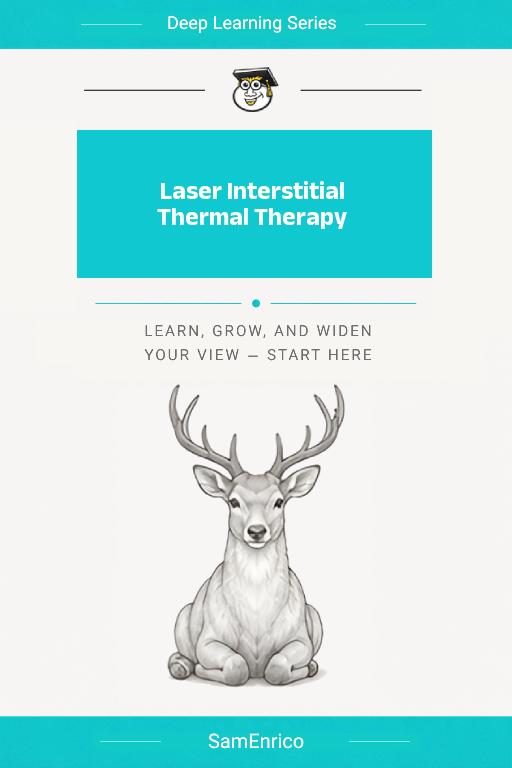
Non-FictionForecast & OutlookLaser Therapy
Laser Interstitial Thermal Therapy
Discover minimally invasive brain tumor ablation u
Discover minimally invasive brain tumor ablation using MRI-guided laser probes replacing open craniotomies.
Formats
About this book
Free sample
Chapter 1: The Craniotomy Ceiling--–- The human skull is a masterpiece of evolution—curved, layered, and nearly impenetrable. For centuries, its very strength made it an enemy to the surgeons who sought to save the minds it protected. To reach a tumor buried deep within the brain, the only path was destruction: saw through bone, retract healthy tissue, and hope that the damage inflicted along the way was less devastating than the disease itself. This was the covenant of open brain surgery. And for millions of patients, it was the only choice.But what if the covenant was flawed?
What if the very act of opening the skull—the craniotomy—created a ceiling beyond which surgery could not safely pass? This chapter examines that ceiling in brutal detail. It quantifies the physical toll of traditional brain surgery, exposes the anatomical limits that leave deep-seated lesions untouchable, and introduces the patient-preference data that would eventually demand a new approach. By the end, you will understand why neurosurgeons began searching for a way to heat the brain without cutting it open.The Gold Standard That Was Never Golden To understand why Laser Interstitial Thermal Therapy (LITT) emerged as a revolution, one must first understand what it replaced. The craniotomy—temporarily removing a portion of the skull to access the brain—has been the cornerstone of neurosurgery for over a century.
In skilled hands, it is a life-saving marvel. But "life-saving" is not the same as "gentle," and the gap between those two words defines the entire history of brain tumor and epilepsy surgery.Consider the mechanics of a typical craniotomy for a deep-seated tumor. The patient is positioned, the head fixed in a three-point pinion device that penetrates the scalp to prevent any movement. An incision is made—often ten to fifteen centimeters long, sometimes curving from behind the ear to the hairline. The surgeon uses a high-speed drill to create one or more burr holes, then a bone saw (a craniotome) to connect them, lifting a free bone flap the size of a cookie.
The underlying dura—the tough, leathery membrane covering the brain—is opened and tacked back.Now the surgeon faces the brain itself. Unlike…
This is the end of the free sample. Get the eBook to keep going. Buy now
Contents
- Chapter 1
- Chapter 2
- Chapter 3
- Chapter 4
- Chapter 5
- Chapter 6
- Chapter 7
- Chapter 8
- Chapter 9
- Chapter 10
- Chapter 11
- Chapter 12
Details
- Author
- Gunn Jessenia
- Publisher
- SamEnrico
- Language
- English
- Genre
- Non-Fiction, Forecast & Outlook, Laser Therapy
- Released
- 2026-05-30
- Pages (approx.)
- 143
- Available as
- eBook, Audiobook

Read better in the ZLOADR app
Your eBooks on your phone or tablet. Sign in with your SamEnrico account and start reading.
More by Gunn Jessenia
 Anima Animus Dream Symbols GuideGunn Jessenia$11.99
 Franchise Builder's Franchisee Association LeaderGunn Jessenia$11.99
 Weekly Learning ReviewGunn Jessenia$11.99
 Glute Stretching For Low BackGunn Jessenia$11.99
 The Great Toilet Paper Heist: How a Global Shortage Exposed Capitalism's FlawsGunn Jessenia$11.99
 The Unseen Hand: How a Silent Film Star Shaped Modern HollywoodGunn Jessenia$11.99
 Understanding Hypervitaminosis EGunn Jessenia$17.99
 Supply Chain Entry Level GuideGunn Jessenia$12.99
 Neutron Diffractometer TechnicianGunn Jessenia$11.99
 How to Become a Multineedle-chainstitch-machine OperatorGunn Jessenia$11.99
You may also like
 Hong Kong Handover 1997Dunn Johnnie$11.99
 Zumba For Postnatal Recovery CourseNeal Christian$11.99
 Zumba for BeginnersLadner Nikia$11.99
 YouTube Comment Mining GuideHumes Pandora$12.99
 Worry Box MeditationCarlin Rudy$11.99
 Workplace Stress MeditationNguyen Lynn$11.99
 Workplace Stress and Sleep RepairHawley Ivory$11.99
 Workplace Perfectionism CureDelaney Jeffry$11.99
 Workplace Injustice Anger GuideWallen Isabelle$11.99
 Work Addiction and Burnout LinkGreenwood Ester$11.99
 Women in Yoga and WellnessBeattie Galina$11.99
 Women in Stand Up ComedyChun Evangeline$11.99