
Non-FictionInformativeEducational
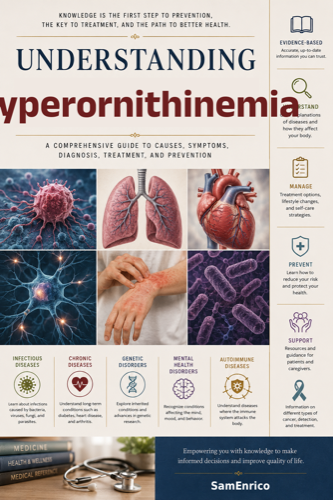
Understanding Hyperornithinemia
This disease publication, published by SamEnrico,
This disease publication, published by SamEnrico, covers Understanding Hyperornithinemia
Formats
About this book
Free sample
Chapter 1: The Fork in the Road--The first thing you need to understand about hyperornithinemia is that it does not exist.Not as a single disease, anyway. Walk into any medical genetics conference and announce that you specialize in "hyperornithinemia," and the experts will immediately ask you a clarifying question: "Which one?" Because the word itself describes only a laboratory finding—an elevated level of a specific amino acid called ornithine in the blood. That finding, taken alone, tells you almost nothing about what is actually wrong with the patient. It is the medical equivalent of a check engine light. It signals that something has gone wrong under the hood, but it does not tell you whether the problem is a loose gas cap, a failing transmission, or a cracked engine block.For the families who receive this diagnosis, the confusion is often devastating.
A parent sits in a genetic counselor's office and hears, "Your child has hyperornithinemia." They go home, open a laptop, and type those syllables into a search engine. What they find is a bewildering landscape of medical jargon, conflicting information, and—if they are unlucky—outdated case reports that describe outcomes far worse than anything their child is experiencing. They cannot understand why one website talks about blindness, another talks about brain damage, and a third talks about diet restrictions that seem to contradict each other. They begin to wonder if the doctor even knows what they are talking about.The doctor, to be fair, may also be confused. Hyperornithinemia is rare.
The two conditions that cause it—Gyrate Atrophy of the choroid and retina (GA) and HHH Syndrome (named for the three investigators who first described it: Hyperornithinemia, Hyperammonemia, and Homocitrullinuria)—are among the rarest of the rare. A general pediatrician might see one case in an entire career. A neurologist might diagnose HHH once every ten years. An ophthalmologist might encounter GA only after decades in practice. When these clinicians open their textbooks, they find separate chapters written by different authors, with no cross-referencing to warn them that these two diseases share a lab value but nothing…
This is the end of the free sample. Get the eBook to keep going. Buy now
Contents
- Chapter 1
- Chapter 2
- Chapter 3
- Chapter 4
- Chapter 5
- Chapter 6
- Chapter 7
- Chapter 8
- Chapter 9
- Chapter 10
- Chapter 11
- Chapter 12
Details
- Author
- Walling Nanette
- Publisher
- SamEnrico
- Language
- English
- Genre
- Non-Fiction, Informative, Educational
- Released
- 2026-06-03
- Pages (approx.)
- 150
- Available as
- eBook, Audiobook

Read better in the ZLOADR app
Your eBooks on your phone or tablet. Sign in with your SamEnrico account and start reading.
More by Walling Nanette
 NA Step Working HandbookWalling Nanette$11.99
 Anger Trigger Frequency TrackerWalling Nanette$11.99
 Project Time Blocking MethodWalling Nanette$11.99
 PNE App Patient GuideWalling Nanette$11.99
 The Hollow Hill: A Druid's Last Stand Against the Iron AgeWalling Nanette$11.99
 The Poisoner's Apprentice: The Untold Story of Graham YoungWalling Nanette$11.99
 Robo Advisor Technology StackWalling Nanette$12.99
 Corporate Career Stability PrimerWalling Nanette$12.99
 A Beginners Guide to Baseball (Volume 1)Walling Nanette$11.99
 Surgical First AssistantWalling Nanette$11.99
You may also like
 Hong Kong Handover 1997Dunn Johnnie$11.99
 Zumba For Postnatal Recovery CourseNeal Christian$11.99
 Zumba for BeginnersLadner Nikia$11.99
 YouTube Comment Mining GuideHumes Pandora$12.99
 Worry Box MeditationCarlin Rudy$11.99
 Workplace Stress MeditationNguyen Lynn$11.99
 Workplace Stress and Sleep RepairHawley Ivory$11.99
 Workplace Perfectionism CureDelaney Jeffry$11.99
 Workplace Injustice Anger GuideWallen Isabelle$11.99
 Work Addiction and Burnout LinkGreenwood Ester$11.99
 Women in Yoga and WellnessBeattie Galina$11.99
 Women in Stand Up ComedyChun Evangeline$11.99