
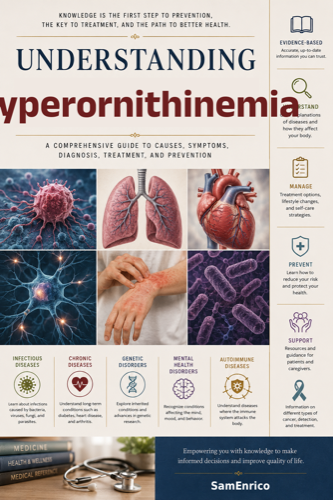
Non-FictionInformativeEducational
Understanding Hyperornithinemia eBook
This disease publication, published by SamEnrico,
This disease publication, published by SamEnrico, covers Understanding Hyperornithinemia
Formats
Free sample
Chapter 1: The Fork in the Road--The first thing you need to understand about hyperornithinemia is that it does not exist.Not as a single disease, anyway. Walk into any medical genetics conference and announce that you specialize in "hyperornithinemia," and the experts will immediately ask you a clarifying question: "Which one?" Because the word itself describes only a laboratory finding—an elevated level of a specific amino acid called ornithine in the blood. That finding, taken alone, tells you almost nothing about what is actually wrong with the patient. It is the medical equivalent of a check engine light. It signals that something has gone wrong under the hood, but it does not tell you whether the problem is a loose gas cap, a failing transmission, or a cracked engine block.For the families who receive this diagnosis, the confusion is often devastating.
A parent sits in a genetic counselor's office and hears, "Your child has hyperornithinemia." They go home, open a laptop, and type those syllables into a search engine. What they find is a bewildering landscape of medical jargon, conflicting information, and—if they are unlucky—outdated case reports that describe outcomes far worse than anything their child is experiencing. They cannot understand why one website talks about blindness, another talks about brain damage, and a third talks about diet restrictions that seem to contradict each other. They begin to wonder if the doctor even knows what they are talking about.The doctor, to be fair, may also be confused. Hyperornithinemia is rare.
The two conditions that cause it—Gyrate Atrophy of the choroid and retina (GA) and HHH Syndrome (named for the three investigators who first described it: Hyperornithinemia, Hyperammonemia, and Homocitrullinuria)—are among the rarest of the rare. A general pediatrician might see one case in an entire career. A neurologist might diagnose HHH once every ten years. An ophthalmologist might encounter GA only after decades in practice. When these clinicians open their textbooks, they find separate chapters written by different authors, with no cross-referencing to warn them that these two diseases share a lab value but nothing else.This chapter exists to solve that confusion, once and for all.
By the time you finish reading, you will understand why "hyperornithinemia" is a diagnostic fork in the road, why taking the wrong path leads to dangerous treatment errors, and how to know with certainty which disease you or your loved one is facing.The Problem with a Lab Value Let us begin with the basics. Ornithine is an amino acid—one of the building blocks of protein—but it is unusual among amino acids because it is not used to build proteins. You will not find ornithine in a steak or a bean. It is synthesized inside the body from another amino acid called arginine, and its primary job is to act as a molecular shuttle in a process that is absolutely essential to human survival: the disposal of nitrogen waste.Every time you eat protein, your body breaks it down into amino acids. Those amino acids are then either used to build new proteins or stripped of their nitrogen atoms, which are converted into ammonia.
Ammonia is highly toxic to the brain. In fact, ammonia poisoning is one of the fastest ways to cause irreversible neurological damage. Your body has evolved an elegant solution to this problem: the urea cycle. This cycle, which takes place primarily in your liver, takes ammonia and converts it into urea, a much less toxic compound that you excrete in your urine. Ornithine is the carrier that makes this cycle work.
It accepts ammonia, shuttles it through a series of chemical reactions, and emerges at the end unchanged, ready to do the job again.In a healthy person, ornithine levels in the blood are tightly regulated, typically between 40 and 120 micromoles per liter (µmol/L). When those levels climb above 200 µmol/L, the laboratory report flags "hyperornithinemia." But here is the critical point: elevated ornithine itself is not the primary cause of damage in either GA or HHH. It is a marker, a symptom, a clue. The real damage comes from what the elevated ornithine tells you about what has gone wrong upstream.The Fork in the Road: Two Diseases, One Lab Value Imagine a city with a waste disposal system. Trucks collect garbage from homes and businesses, then drive to a processing plant.
At the plant, the trucks must pass through a gate into the incinerator yard, where the garbage is burned safely. Now imagine two different failures in this system.In the first failure, the incinerator itself breaks down. The trucks can still drive through the gate and enter the yard, but the garbage cannot be burned. It piles up. The pile grows larger and larger, eventually spilling back into the streets.
The city becomes filthy, but the air remains breathable. No toxic fumes are released. This is Gyrate Atrophy.In the second failure, the gate breaks. The incinerator works perfectly, but the trucks cannot enter the yard. They sit on the street, idling, while the garbage in the back begins to rot.
Toxic gases escape into the air, and everyone nearby starts to choke. The garbage pile in the street is actually smaller than in the first scenario, but the danger is far greater. This is HHH Syndrome.Let us translate this metaphor into biochemistry. In Gyrate Atrophy, the problem is a deficiency of an enzyme called ornithine aminotransferase, or OAT. This enzyme lives inside tiny structures in your cells called mitochondria—the power plants that generate energy.
Its job is to convert ornithine into another molecule called glutamate. When OAT is broken or missing, ornithine cannot be converted. It accumulates inside the mitochondria and spills back into the bloodstream. The urea cycle, however, remains functional because ornithine can still enter the mitochondria (the gate works). The patient never experiences ammonia toxicity.
The damage is caused by the accumulation of ornithine itself, which appears to be particularly toxic to certain high-energy tissues: the retina of the eye and, to a lesser extent, skeletal muscle.In HHH Syndrome, the problem is a deficiency of a different molecule entirely: the mitochondrial ornithine transporter. This transporter is the gate. It sits on the mitochondrial membrane and actively pumps ornithine from the cytoplasm (the main compartment of the cell) into the mitochondrial matrix. When the transporter is broken, ornithine cannot enter the mitochondria at all. The enzyme OAT inside the mitochondria is perfectly fine, but it has no substrate to work on.
The urea cycle grinds to a halt because ornithine is the carrier that shuttles ammonia through the cycle. Without ornithine inside the mitochondria, ammonia builds up to toxic levels in the blood. The patient experiences recurrent hyperammonemic crises, each of which can cause permanent brain damage. The elevated ornithine in the blood is actually a red herring—it is high because it has nowhere to go, but it is the ammonia, not the ornithine, that destroys the brain.Why Location Matters The difference between these two diseases is not just a matter of biochemistry. It is a matter of geography.
The location of the molecular defect determines every aspect of the clinical presentation: which organs are affected, when symptoms appear…
This is the end of the free sample. Get the eBook to keep going. Buy now
About this book
Details
- Author
- Walling Nanette
- Publisher
- SamEnrico
- Language
- English
- Genre
- Non-Fiction, Informative, Educational
- Released
- 2026-06-03
- Pages (approx.)
- 150
- Available as
- eBook, Audiobook

Read better in the ZLOADR app
Your eBooks on your phone or tablet. Sign in with your SamEnrico account and start reading.
More by Walling Nanette
 NA Step Working HandbookWalling Nanette$11.99
 Anger Trigger Frequency TrackerWalling Nanette$11.99
 Project Time Blocking MethodWalling Nanette$11.99
 PNE App Patient GuideWalling Nanette$11.99
 The Hollow Hill: A Druid's Last Stand Against the Iron AgeWalling Nanette$11.99
 The Poisoner's Apprentice: The Untold Story of Graham YoungWalling Nanette$11.99
 Robo Advisor Technology StackWalling Nanette$12.99
 Corporate Career Stability PrimerWalling Nanette$12.99
 A Beginners Guide to Baseball (Volume 1)Walling Nanette$11.99
 Surgical First AssistantWalling Nanette$11.99
You may also like
 Hong Kong Handover 1997Dunn Johnnie$11.99
 Zumba For Postnatal Recovery CourseNeal Christian$11.99
 Zumba for BeginnersLadner Nikia$11.99
 YouTube Comment Mining GuideHumes Pandora$12.99
 Worry Box MeditationCarlin Rudy$11.99
 Workplace Stress MeditationNguyen Lynn$11.99
 Workplace Stress and Sleep RepairHawley Ivory$11.99
 Workplace Perfectionism CureDelaney Jeffry$11.99
 Workplace Injustice Anger GuideWallen Isabelle$11.99
 Work Addiction and Burnout LinkGreenwood Ester$11.99
 Women in Yoga and WellnessBeattie Galina$11.99
 Women in Stand Up ComedyChun Evangeline$11.99