
Non-FictionInformativeEducational
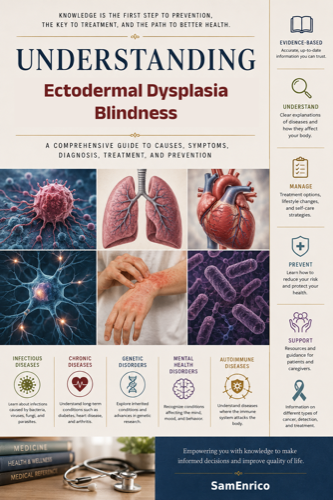
Understanding Ectodermal Dysplasia Blindness eBook
This disease publication, published by SamEnrico,
by Cary Shaunta
This disease publication, published by SamEnrico, covers Understanding Ectodermal Dysplasia Blindness
Formats
Free sample
Chapter 1: The Stranger in the Mirror...--The first time a parent looks at their newborn child and sees something the doctors cannot name, the world stops spinning on its normal axis. You expected crying, relief, exhaustion, joy. You did not expect a whispered conversation in the hallway, a geneticist you have never met paging through a textbook from 1992, and a phrase that sounds like a foreign language: Ectodermal Dysplasia with blindness. This chapter is not a clinical abstract. It is an invitation to step into a story that has no prologue written for you—and to learn how to write the next pages yourself.Before we go any further, a necessary truth.
The medical literature contains no large-scale studies, no clinical trials, no consensus guidelines for this specific condition. The most recent peer-reviewed description of what was once called "Rodrigues blindness" appeared in the early 1990s. That does not mean nothing is known. It means that families, caregivers, and thoughtful clinicians must become detectives. The information in this book draws from three sources: the existing case reports, clinical knowledge from related conditions (isolated microphthalmia, other ectodermal dysplasias, syndromic blindness), and the lived expertise of families who have navigated this terrain without a map.
You are not alone, but you are a pioneer. That distinction matters.The Name That Hides More Than It Reveals Let us start with the label itself: Ectodermal Dysplasia Blindness. On its face, it sounds straightforward. A condition affecting ectodermal tissues (skin, hair, teeth, sweat glands) plus blindness. But the reality is far more specific and far more confusing for families seeking answers.The term "ectodermal dysplasia" refers to a family of over 150 distinct genetic disorders, all affecting structures that develop from the ectoderm—the outermost layer of the embryo.
These include the skin, hair, nails, teeth, and sweat glands. Some forms of ectodermal dysplasia are relatively common (affecting 1 in 10,000 to 1 in 100,000 births). Others, like the specific combination with blindness, are vanishingly rare. Most people with ectodermal dysplasia have normal vision. That is the critical point.
When a general pediatrician or even a geneticist who has not specialized in this area hears "ectodermal dysplasia," they will almost certainly assume normal eyes. That assumption is wrong for your child.The specific syndrome we are discussing has appeared in the medical literature under several names. One of the earliest descriptions came from a researcher named Rodrigues, leading to the synonym "Rodrigues blindness." Other case reports have called it "ectodermal dysplasia with microphthalmia and sclerocornea" or simply "syndromic ectodermal dysplasia with ocular malformations." The lack of a consistent name tells you something important: this is not a condition that has been studied enough to earn a tidy label. In the world of rare diseases, naming is a form of attention. The absence of a standard name reflects the absence of research funding, not the absence of real families living with real challenges.What is the prevalence?
No one can give you a precise number. The best estimate from the available case literature suggests less than 1 in 1,000,000 births. To put that in perspective, a child born with Down syndrome has a prevalence of approximately 1 in 700. A child born with cystic fibrosis has a prevalence of about 1 in 3,500. A child born with this condition is so rare that most obstetricians, most neonatologists, and most general pediatricians will never see a single case in their entire career.
That rarity cuts both ways. It means you will have difficulty finding local expertise. It also means that when you do find a knowledgeable clinician, that person is extraordinarily valuable.The Core Components: What Actually Defines This Condition?For a diagnosis to warrant the label we are using in this book, three elements must be present. Understanding these elements is not an academic exercise. It is the foundation of every medical decision, every therapy referral, and every conversation with specialists.First, there must be structural malformations of the eye that cause severe visual impairment or blindness.
This is not a condition where vision can be corrected with glasses. The eye itself is abnormally formed. The most common findings are microphthalmia (the eye is abnormally small) and sclerocornea (the cornea, normally clear, is opaque and resembles the white of the eye). Other findings include microcornea (small cornea), cataracts (clouding of the lens), coloboma (gaps in eye tissue), and narrow palpebral fissures (the opening between the eyelids is smaller than usual). These are not problems with the retina or optic nerve that might someday be addressed with gene therapy.
These are problems with the basic architecture of the eye, formed in the first trimester of pregnancy.Second, there must be features of ectodermal dysplasia affecting at least two of the following: hair, teeth, skin, or sweat glands. The most common findings include sparse or fine hair (hypotrichosis), missing or malformed teeth (hypodontia or anodontia), and the inability to sweat properly (hypohidrosis). Some individuals also have dry, eczema-prone skin. The degree of involvement varies. One child might have nearly normal hair but severely missing teeth.
Another might have classic hypohidrosis but only mild dental abnormalities.Third, the condition must be congenital (present at birth) and non-progressive in its structural features. This means that the malformations are already established when the child is born. The eye will not become more malformed over time. The teeth will not become more missing. However, complications can develop.
For example, sclerocornea increases the risk of secondary glaucoma (elevated eye pressure) that can cause pain. Missing teeth can lead to feeding difficulties and nutritional concerns. The inability to sweat creates lifelong risks of heat stroke.It is essential to understand that this is a syndrome—a collection of features that occur together because they share a common underlying cause. That cause appears to be genetic, but as of the current medical literature, the specific gene or genes involved have not been definitively identified in most cases. Some families show autosomal recessive inheritance (both parents carry a silent mutation, and the child inherits two copies).
Other cases appear sporadic (a new mutation occurring in the child with no family history). This uncertainty is frustrating, but it is also honest. A book that promised you a simple genetic answer would be lying.The Danger of Misdiagnosis: Why Generalists Get It Wrong Let me tell you a story that has happened to more families than anyone has counted. A child is born with small, cloudy eyes. The delivery room pediatrician notices something unusual and calls an ophthalmologist.
The ophthalmologist diagnoses microphthalmia and sclerocornea. So far, so good. But the child also has sparse hair and a narrow nasal bridge. The ophthalmologist, focused on the eyes, does not mention these features. The parents, exhausted and overwhelmed, do not think to ask.
The child is discharged with a diagnosis of "isolated microphthalmia." Years pass. The child's teeth come in late and malformed. The parents struggle to manage heat intolerance during summer. No one connects these dots until a geneticist, years later, puts the pieces together.This is not a failure of individual doctors. It is a failure of pattern recognition in a system that sees thousands of common conditions for every one ultra-rare syndrome.
The ophthalmologist is not trained to think about sweat glands. The dermatologist is not trained to think about eye malformations.…
This is the end of the free sample. Get the eBook to keep going. Buy now
About this book
Details
- Author
- Cary Shaunta
- Publisher
- SamEnrico
- Language
- English
- Genre
- Non-Fiction, Informative, Educational
- Released
- 2026-06-02
- Pages (approx.)
- 153
- Available as
- eBook, Audiobook

Read better in the ZLOADR app
Your eBooks on your phone or tablet. Sign in with your SamEnrico account and start reading.
More by Cary Shaunta
 Hypnotic Symptom Substitution GuideCary Shaunta$11.99
 Senior Leader Relationship GuideCary Shaunta$11.99
 Family Meeting GuideCary Shaunta$11.99
 Sleep Success for StudentsCary Shaunta$11.99
 Essential Oils for Menstrual CrampsCary Shaunta$11.99
 The Skyward Dreamers: How Jesuit Astronomers Mapped the Stars from South America’s Highest PeaksCary Shaunta$11.99
 Phoenix Rising: The Unbreakable Will of the Iron HorseCary Shaunta$11.99
 How to Become a Carpenter-labor SupervisorCary Shaunta$11.99
 Design ConsultantCary Shaunta$11.99
 Israeli Data Breach GuideCary Shaunta$12.99
 Voiceover Non Union GuideCary Shaunta$12.99
You may also like
 Hong Kong Handover 1997Dunn Johnnie$11.99
 Zumba For Postnatal Recovery CourseNeal Christian$11.99
 Zumba for BeginnersLadner Nikia$11.99
 YouTube Comment Mining GuideHumes Pandora$12.99
 Worry Box MeditationCarlin Rudy$11.99
 Workplace Stress MeditationNguyen Lynn$11.99
 Workplace Stress and Sleep RepairHawley Ivory$11.99
 Workplace Perfectionism CureDelaney Jeffry$11.99
 Workplace Injustice Anger GuideWallen Isabelle$11.99
 Work Addiction and Burnout LinkGreenwood Ester$11.99
 Women in Yoga and WellnessBeattie Galina$11.99
 Women in Stand Up ComedyChun Evangeline$11.99