
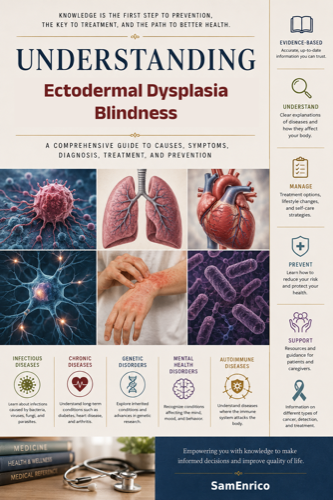
Non-FictionInformativeEducational
Understanding Ectodermal Dysplasia Blindness Audiobook
This disease publication, published by SamEnrico,
by Cary Shaunta
This disease publication, published by SamEnrico, covers Understanding Ectodermal Dysplasia Blindness
Formats
Free sample
Chapter 1: The Stranger in the Mirror...--The first time a parent looks at their newborn child and sees something the doctors cannot name, the world stops spinning on its normal axis. You expected crying, relief, exhaustion, joy. You did not expect a whispered conversation in the hallway, a geneticist you have never met paging through a textbook from 1992, and a phrase that sounds like a foreign language: Ectodermal Dysplasia with blindness. This chapter is not a clinical abstract. It is an invitation to step into a story that has no prologue written for you—and to learn how to write the next pages yourself.Before we go any further, a necessary truth.
The medical literature contains no large-scale studies, no clinical trials, no consensus guidelines for this specific condition. The most recent peer-reviewed description of what was once called "Rodrigues blindness" appeared in the early 1990s. That does not mean nothing is known. It means that families, caregivers, and thoughtful clinicians must become detectives. The information in this book draws from three sources: the existing case reports, clinical knowledge from related conditions (isolated microphthalmia, other ectodermal dysplasias, syndromic blindness), and the lived expertise of families who have navigated this terrain without a map.
You are not alone, but you are a pioneer. That distinction matters.The Name That Hides More Than It Reveals Let us start with the label itself: Ectodermal Dysplasia Blindness. On its face, it sounds straightforward. A condition affecting ectodermal tissues (skin, hair, teeth, sweat glands) plus blindness. But the reality is far more specific and far more confusing for families seeking answers.The term "ectodermal dysplasia" refers to a family of over 150 distinct genetic disorders, all affecting structures that develop from the ectoderm—the outermost layer of the embryo.
These include the skin, hair, nails, teeth, and sweat glands. Some forms of ectodermal dysplasia are relatively common (affecting 1 in 10,000 to 1 in 100,000 births). Others, like the specific combination with blindness, are vanishingly rare. Most people with ectodermal dysplasia have normal vision. That is the critical point.
When a general pediatrician or even a geneticist who has not specialized in this area hears "ectodermal dysplasia," they will almost certainly assume normal eyes. That assumption is wrong for your child.The specific syndrome we are discussing has appeared in the medical literature under several names. One of the earliest descriptions came from a researcher named Rodrigues, leading to the synonym…
This is the end of the free sample. Get the Audiobook to keep going. Buy now
About this book
Details
- Author
- Cary Shaunta
- Publisher
- SamEnrico
- Language
- English
- Genre
- Non-Fiction, Informative, Educational
- Released
- 2026-06-02
- Pages (approx.)
- 153
- Available as
- eBook, Audiobook

Listen in the VoxFlicks app
Audiobooks and audio dramas wherever you go. Sign in with your SamEnrico account and press play.
More by Cary Shaunta
 Hypnotic Symptom Substitution GuideCary Shaunta$11.99
 Senior Leader Relationship GuideCary Shaunta$11.99
 Family Meeting GuideCary Shaunta$11.99
 Sleep Success for StudentsCary Shaunta$11.99
 Essential Oils for Menstrual CrampsCary Shaunta$11.99
 The Skyward Dreamers: How Jesuit Astronomers Mapped the Stars from South America’s Highest PeaksCary Shaunta$11.99
 Phoenix Rising: The Unbreakable Will of the Iron HorseCary Shaunta$11.99
 How to Become a Carpenter-labor SupervisorCary Shaunta$11.99
 Design ConsultantCary Shaunta$11.99
 Israeli Data Breach GuideCary Shaunta$12.99
 Voiceover Non Union GuideCary Shaunta$12.99
You may also like
 Hong Kong Handover 1997Dunn Johnnie$11.99
 Zumba For Postnatal Recovery CourseNeal Christian$11.99
 Zumba for BeginnersLadner Nikia$11.99
 YouTube Comment Mining GuideHumes Pandora$12.99
 Worry Box MeditationCarlin Rudy$11.99
 Workplace Stress MeditationNguyen Lynn$11.99
 Workplace Stress and Sleep RepairHawley Ivory$11.99
 Workplace Perfectionism CureDelaney Jeffry$11.99
 Workplace Injustice Anger GuideWallen Isabelle$11.99
 Work Addiction and Burnout LinkGreenwood Ester$11.99
 Women in Yoga and WellnessBeattie Galina$11.99
 Women in Stand Up ComedyChun Evangeline$11.99