
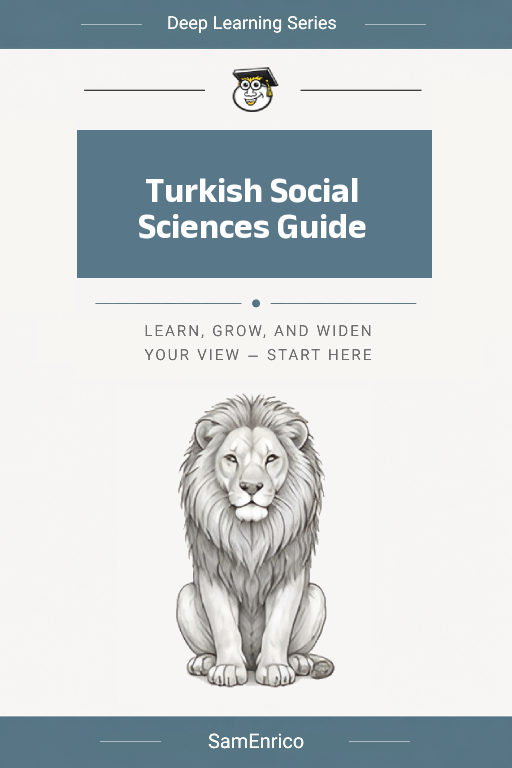
Non-FictionStudent's ShortcutSocial Sciences
Turkish Social Sciences Guide eBook
Study political science, international relations,
Study political science, international relations, and sociology at Bogazici and Ankara University.
Formats
Free sample
Chapter 1: The Two Souls--–- Every Turkish social scientist carries a map in their head. On one side of the Bosphorus, overlooking the water where Europe meets Asia, stands Boğaziçi University—its campus once a American missionary college, now a citadel of critical theory, human rights discourse, and cosmopolitan ambition. On the other side, in the flat, bureaucratic heart of Ankara, sits Mülkiye—the Faculty of Political Sciences of Ankara University, founded in 1859 to train the empire’s administrators, now the oldest and most state-centric school of governance in Turkey. These two institutions are not merely different. They are, in many ways, opposing universes.
And yet, to understand Turkish politics, international relations, or sociology, you must learn to navigate both. This book is your guide.This chapter introduces the two dominant institutional traditions in Turkish social sciences. Unlike later chapters that reference this binary without re-explaining it, here we build it from the ground up: the histories, the epistemologies, the curricula, the alumni networks, and the unspoken assumptions that shape how a Boğaziçi graduate and a Mülkiye graduate can look at the same event—a protest, a treaty, an election—and see completely different realities. By the end of this chapter, you will understand not only what each school teaches but how each school thinks. And you will be prepared to move between them, not by pretending the differences don’t exist, but by knowing exactly when to adopt one lens and when to switch to the other.The View from the Bosphorus: Boğaziçi University Boğaziçi University did not begin as a Turkish university.
It began as Robert College, founded in 1863 by Christopher Robert, a wealthy American philanthropist, and Cyrus Hamlin, a missionary educator. The college’s original mission was to educate the Ottoman Empire’s minority populations—Armenians, Greeks, Bulgarians, and Jews—in the liberal arts and sciences. From its earliest days, the language of instruction was English. The faculty were largely American and European. The curriculum emphasized critical thinking, debate, and the Western canon of philosophy and literature.When Turkey became a republic in 1923, Robert College continued operating as a private American institution.
For decades, it educated the children of Istanbul’s secular, Westernized elite. Future prime ministers, ambassadors, and business leaders walked its corridors. But the college also maintained a radical edge: it was one of the few places in Turkey where students could read Marx, Freud, and Sartre without state interference. The 1960s and 1970s saw Robert College become a hub of leftist organizing, student protests, and intellectual experimentation.In 1971, the Turkish government nationalized Robert College’s higher education division, transforming it into Boğaziçi University. The American high school continued separately.
But the spirit of Robert College—liberal, cosmopolitan, critical—remained embedded in Boğaziçi’s DNA. Today, Boğaziçi is consistently ranked as Turkey’s top university in social sciences and humanities. Its political science and international relations department is among the most selective in the country, admitting less than one percent of applicants.What Boğaziçi Teaches (And How)Boğaziçi’s social science curriculum is structured around four core principles: theoretical pluralism, methodological rigor, critical engagement, and global comparison.Theoretical Pluralism: Unlike Turkish universities that privilege a single paradigm (state-centric realism at Mülkiye, for instance), Boğaziçi exposes students to multiple and often competing theories. In a single semester, a student might read Kenneth Waltz on neorealism, Alexander Wendt on constructivism, Michel Foucault on power, and Judith Butler on performativity. The goal is not to find the “right” theory but to learn how to deploy different frameworks for different questions.Methodological Rigor: Boğaziçi requires all social science students to complete a two-semester sequence in research methods.
SOC 203 and SOC 206 (the core quantitative and qualitative methods courses) train students in statistical analysis, survey design, ethnographic fieldwork, and archival research. The department’s computational social science lab is one of the few in Turkey equipped to handle large-scale text analysis and network mapping.Critical Engagement: Boğaziçi faculty are overwhelmingly trained in North American and Western European Ph D programs. They bring with them a commitment to critical theory—the tradition that questions power, exposes hidden assumptions, and asks not only “What is happening?” but “Who benefits from describing it this way?” This means Boğaziçi research often focuses on contentious politics, human rights violations, state violence, and social movements. A typical Boğaziçi thesis might examine how the Turkish state constructs the Kurdish minority as a “security threat” through language, or how LGBTQ+ activists deploy social media to circumvent censorship.Global Comparison: Boğaziçi discourages Turkish exceptionalism—the idea that Turkey is unique and cannot be compared to other countries. Instead, students learn to place Turkey in regional and global contexts.
A comparative politics seminar might pair Turkey with Brazil on democratic backsliding, or with Indonesia on the rise of conservative neoliberalism. This comparative habit produces research that speaks to international audiences and gets published in English-language journals.The Boğaziçi Habitus Pierre Bourdieu, the French sociologist whose work appears throughout this book, coined the term “habitus” to describe the deeply ingrained dispositions, tastes, and habits that members of a social group share. Boğaziçi produces a distinctive habitus.Boğaziçi students speak English fluently, often mixing it with Turkish in casual conversation. They read the New York Times, the Guardian, and Le Monde Diplomatique. They are secular, often militantly so, and they view the AKP government with suspicion or outright hostility.
They gather in South Campus cafes—Küçük Ev, Kampus—to debate Foucault and discuss the latest İKSV film festival. Their professors invite international scholars for guest lectures; their theses are supervised by faculty who hold joint appointments at LSE or Columbia.This habitus is not merely cultural. It shapes research questions. A Boğaziçi political scientist is more likely to study civilian control of the military than military strategy, more likely to study hate speech laws than counterterrorism operations, more likely to study EU harmonization than the Montreux Convention. The unspoken assumption is that the state is a problem to be restrained, not a solution to be empowered.The Boğaziçi Alumni Network Boğaziçi graduates dominate certain corners of Turkish professional life: journalism (especially English-language outlets like Bianet and Duvar), international NGOs (Amnesty International, Human Rights Watch), think tanks with a liberal or left-wing orientation (TESEV, EDAM), and the private sector (brand management, corporate social responsibility, tech startups).
A Boğaziçi degree is also a passport to top Ph D programs abroad: every year, Boğaziçi graduates enter doctoral programs at Oxford, Harvard, Sciences Po, and the LSE.But Boğaziçi graduates are notably absent from the Turkish Ministry of Foreign Affairs, the judiciary, the National Intelligence Organization (MİT), and the upper ranks of the AKP bureaucracy. These institutions recruit from elsewhere—primarily from Mülkiye.The Heart of the State: Ankara University’s Faculty of Political Sciences (Mülkiye)Mülkiye is older than the Turkish Republic itself. It was founded in 1859 as the Mekteb-i Mülkiye-i Şahane (Imperial School of Civil Administration) under Sultan Abdülmecid. The empire needed trained…
This is the end of the free sample. Get the eBook to keep going. Buy now
About this book
Details
- Author
- Mcclanahan Gaynell
- Publisher
- SamEnrico
- Language
- English
- Genre
- Non-Fiction, Student's Shortcut, Social Sciences
- Released
- 2026-06-01
- Pages (approx.)
- 153
- Available as
- eBook, Audiobook

Read better in the ZLOADR app
Your eBooks on your phone or tablet. Sign in with your SamEnrico account and start reading.
More by Mcclanahan Gaynell
 Time Blocking for Asana UsersMcclanahan Gaynell$11.99
 Body Scan Meditation for MBSRMcclanahan Gaynell$11.99
 Workplace Anger Thought RestructuringMcclanahan Gaynell$11.99
 Peruvian Chef In New YorkMcclanahan Gaynell$11.99Peruvian Chef In New YorkMcclanahan Gaynell$11.99
 Mongolia Horse Expedition TrailMcclanahan Gaynell$11.99
 NamUs Medical Examiner BacklogMcclanahan Gaynell$11.99
 Atomic Habits For Paper TrackerMcclanahan Gaynell$11.99
 Maintenance Phase GuideMcclanahan Gaynell$11.99
 The Symphony of the Sun: Black Composers Who Shaped Western MusicMcclanahan Gaynell$11.99
 The Battle of Kleidion: Basil II’s Bloody RevengeMcclanahan Gaynell$11.99
 How to Produce Needles and HooksMcclanahan Gaynell$11.99
You may also like
 Hong Kong Handover 1997Dunn Johnnie$11.99
 Zumba For Postnatal Recovery CourseNeal Christian$11.99
 Zumba for BeginnersLadner Nikia$11.99
 YouTube Comment Mining GuideHumes Pandora$12.99
 Worry Box MeditationCarlin Rudy$11.99
 Workplace Stress MeditationNguyen Lynn$11.99
 Workplace Stress and Sleep RepairHawley Ivory$11.99
 Workplace Perfectionism CureDelaney Jeffry$11.99
 Workplace Injustice Anger GuideWallen Isabelle$11.99
 Work Addiction and Burnout LinkGreenwood Ester$11.99
 Women in Yoga and WellnessBeattie Galina$11.99
 Women in Stand Up ComedyChun Evangeline$11.99