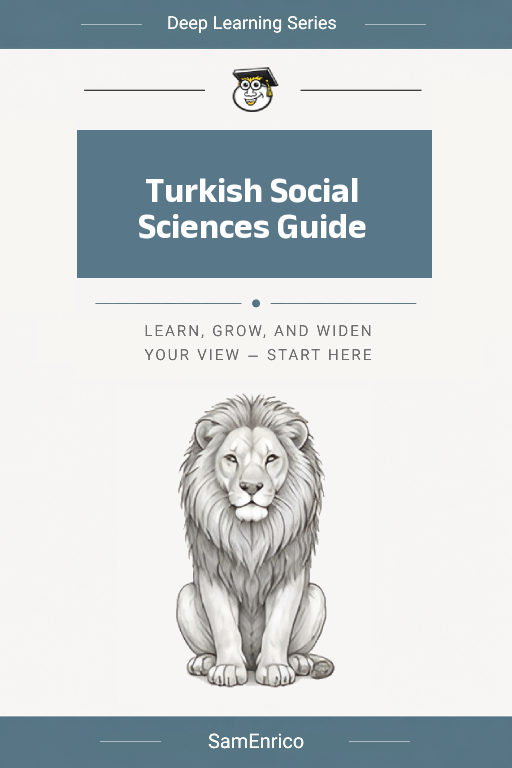
Turkish Social Sciences Guide
Study political science, international relations,
Study political science, international relations, and sociology at Bogazici and Ankara University.
Formats
About this book
Free sample
Chapter 1: The Two Souls--–- Every Turkish social scientist carries a map in their head. On one side of the Bosphorus, overlooking the water where Europe meets Asia, stands Boğaziçi University—its campus once a American missionary college, now a citadel of critical theory, human rights discourse, and cosmopolitan ambition. On the other side, in the flat, bureaucratic heart of Ankara, sits Mülkiye—the Faculty of Political Sciences of Ankara University, founded in 1859 to train the empire’s administrators, now the oldest and most state-centric school of governance in Turkey. These two institutions are not merely different. They are, in many ways, opposing universes.
And yet, to understand Turkish politics, international relations, or sociology, you must learn to navigate both. This book is your guide.This chapter introduces the two dominant institutional traditions in Turkish social sciences. Unlike later chapters that reference this binary without re-explaining it, here we build it from the ground up: the histories, the epistemologies, the curricula, the alumni networks, and the unspoken assumptions that shape how a Boğaziçi graduate and a Mülkiye graduate can look at the same event—a protest, a treaty, an election—and see completely different realities. By the end of this chapter, you will understand not only what each school teaches but how each school thinks. And you will be prepared to move between them, not by pretending the differences don’t exist, but by knowing exactly when to adopt one lens and when to switch to the other.The View from the Bosphorus: Boğaziçi University Boğaziçi University did not begin as a Turkish university.
It began as Robert College, founded in 1863 by Christopher Robert, a wealthy American philanthropist, and Cyrus Hamlin, a missionary educator. The college’s original mission was to educate the Ottoman Empire’s minority populations—Armenians, Greeks, Bulgarians, and Jews—in the liberal arts and sciences. From its earliest days, the language of instruction was English. The faculty were largely American and European. The curriculum emphasized critical thinking, debate, and the Western canon of philosophy and literature.When Turkey became a…
This is the end of the free sample. Get the eBook to keep going. Buy now
Contents
- Chapter 1
- Chapter 2
- Chapter 3
- Chapter 4
- Chapter 5
- Chapter 6
- Chapter 7
- Chapter 8
- Chapter 9
- Chapter 10
- Chapter 11
- Chapter 12
Details
- Author
- Mcclanahan Gaynell
- Publisher
- SamEnrico
- Language
- English
- Genre
- Non-Fiction, Student's Shortcut, Social Sciences
- Released
- 2026-06-01
- Pages (approx.)
- 153
- Available as
- eBook, Audiobook

Read better in the ZLOADR app
Your eBooks on your phone or tablet. Sign in with your SamEnrico account and start reading.
More by Mcclanahan Gaynell
 Time Blocking for Asana UsersMcclanahan Gaynell$11.99
 Body Scan Meditation for MBSRMcclanahan Gaynell$11.99
 Workplace Anger Thought RestructuringMcclanahan Gaynell$11.99
 Peruvian Chef In New YorkMcclanahan Gaynell$11.99Peruvian Chef In New YorkMcclanahan Gaynell$11.99
 Mongolia Horse Expedition TrailMcclanahan Gaynell$11.99
 NamUs Medical Examiner BacklogMcclanahan Gaynell$11.99
 Atomic Habits For Paper TrackerMcclanahan Gaynell$11.99
 Maintenance Phase GuideMcclanahan Gaynell$11.99
 The Symphony of the Sun: Black Composers Who Shaped Western MusicMcclanahan Gaynell$11.99
 The Battle of Kleidion: Basil II’s Bloody RevengeMcclanahan Gaynell$11.99
 How to Produce Needles and HooksMcclanahan Gaynell$11.99