
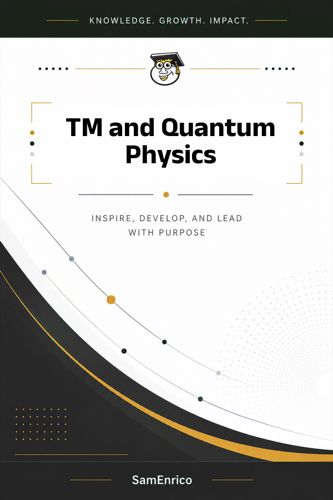
Non-FictionSelf-HelpQuantumPhysics
TM and Quantum Physics eBook
Speculative connections between transcendence and
Speculative connections between transcendence and quantum field theory.
Formats
Free sample
Chapter 1: The Clockwork Lie--–- The story begins with a funeral. Not for a person, but for a worldview—the comforting, mechanical universe that has dominated Western science for three hundred years. For centuries, we were told that reality is a giant clockwork mechanism: billions of separate billiard balls bouncing against one another in absolute space and absolute time, governed by deterministic laws so precise that if you knew the position and momentum of every particle in existence, you could predict the entire future with perfect accuracy. This was the Newtonian dream. It gave us bridges that don't collapse, rockets that reach the moon, and smartphones that fit in our pockets.
But it also gave us a profound and crippling lie: the lie that consciousness is irrelevant, that the mind is just a ghost in the machine, and that the universe would continue ticking along exactly the same whether we were here to witness it or not.That lie is dying. And this book is about what comes next.The Mechanistic Prison To understand why the clockwork universe is a prison, we first have to understand how we got locked inside it. Isaac Newton's Philosophiæ Naturalis Principia Mathematica (1687) was arguably the most influential scientific work ever written. Newton described a universe where every object exerts a force on every other object, where motion follows mathematical laws that work the same yesterday, today, and tomorrow. This was a radical departure from the medieval worldview, which saw the cosmos as alive, purposeful, and imbued with meaning.
Newton drained the meaning out and replaced it with mathematics. For the first time, the universe became a machine.The success of Newtonian physics was so overwhelming that it became the default metaphysics of the Western world. If the universe is a machine, then living things are complicated machines. The brain is a biological machine. The mind is what the brain does—an epiphenomenon, a side effect, a ghost that flickers and dies when the machine breaks.
This view reached its most extreme expression in the early twentieth century with logical positivism, which declared that any statement that could not be empirically verified was literally meaningless. "God exists" is meaningless. "The soul is immortal" is meaningless. "Consciousness is fundamental" is meaningless. Only measurable quantities matter.But there was a problem hiding inside the machinery.
A small crack in the clockwork. And that crack would eventually shatter the entire edifice.The Crack in the Clockwork The crack appeared in 1801, though nobody recognized it at the time. That year, a British polymath named Thomas Young performed a simple experiment that would, two centuries later, force physicists to confront the possibility that consciousness might be woven into the fabric of reality. Young's double-slit experiment—which we will explore in detail in the next chapter—showed that light behaves like a wave, creating interference patterns as if it passed through two slits simultaneously. Nothing strange there.
Waves do that.But then, in the early twentieth century, something strange happened. Albert Einstein demonstrated that light also behaves like a particle (the photoelectric effect, for which he won the Nobel Prize). And then Louis de Broglie showed that electrons—which everyone had assumed were particles—behave like waves. Matter and energy were not two separate things but two faces of the same coin. The clockwork universe, with its solid little billiard balls, was replaced by something far more unsettling: a universe of wave-functions, probabilities, and relationships.The death blow came with Werner Heisenberg's uncertainty principle (1927).
Heisenberg proved, mathematically and experimentally, that you cannot simultaneously know both the position and the momentum of a particle with perfect accuracy. The more precisely you measure one, the less precisely you know the other. This is not a limitation of our measuring instruments; it is a fundamental feature of reality. The universe does not have definite positions and momentums at the same time. The billiard ball does not have a definite location until you look at it.This was, to put it mildly, disturbing.
Einstein spent the rest of his life trying to prove that quantum mechanics was incomplete—that there must be "hidden variables" beneath the randomness, restoring the clockwork predictability he refused to abandon. "God does not play dice with the universe," he famously declared. But decades of experiments have shown that God does, in fact, play dice. The universe is fundamentally probabilistic, not deterministic. The clockwork is broken.The Ghost That Wouldn't Stay in the Machine If the universe is probabilistic, then the question of observation becomes unavoidable.
In classical physics, observation is passive. You can look at a falling apple without changing its trajectory (in principle). In quantum physics, observation is active. The act of measuring a particle's position forces it to choose a position from a cloud of possibilities. Before measurement, the particle exists in a superposition of all possible locations.
After measurement, it collapses into one actual location.This is the measurement problem. And it refuses to go away.The mathematician John von Neumann analyzed the measurement process with extraordinary rigor. He showed that you can draw a line anywhere along the chain from particle to detector to brain to conscious awareness, and the mathematics works the same. But at some point, he argued, the chain must end—and it ends with conscious experience. The physicist Eugene Wigner went further: he argued that consciousness is the only thing that can collapse the wave function.
A detector alone does not collapse it; a detector must be observed by a conscious mind.This position, known as the von Neumann-Wigner interpretation, has never been disproven. It has been ridiculed, marginalized, and ignored by mainstream physics, but it has never been refuted. Why? Because the alternative interpretations are even stranger.Consider the Many-Worlds interpretation, which has become fashionable in recent decades. According to Many-Worlds, there is no collapse.
Every time a quantum event occurs, the universe splits into parallel branches, each containing a different outcome. In one branch, the electron went through the left slit; in another, the right slit. Both branches are equally real. There are, at this moment, an infinite number of copies of you reading this sentence in parallel universes, each experiencing a slightly different version of reality. This is not science fiction; this is a serious proposal from serious physicists (Hugh Everett, Bryce De Witt, David Deutsch).
But is it really more parsimonious than saying consciousness collapses the wave function? An infinite number of parallel universes, each spawned by every quantum interaction, versus the simple acknowledgment that the only thing we know directly—consciousness—might be causally effective? The scales do not obviously tip toward Many-Worlds.Or consider Bohmian mechanics, which reintroduces hidden variables—invisible guiding waves that determine particle behavior without randomness. But Bohmian mechanics is non-local: the hidden variables must be connected across the entire universe instantaneously, which violates Einstein's relativity. Most physicists consider this a high price to pay to preserve determinism.The simple truth, uncomfortable as it may be, is this: we do not know why the wave function collapses.
We do not know whether consciousness is involved. But the possibility that consciousness is fundamental—not emergent, not epiphenomenal, but as real as space and time—has never…
This is the end of the free sample. Get the eBook to keep going. Buy now
About this book
Details
- Author
- Crespo Cristal
- Publisher
- SamEnrico
- Language
- English
- Genre
- Non-Fiction, Self-Help, Quantum, Physics
- Released
- 2026-06-09
- Pages (approx.)
- 141
- Available as
- eBook, Audiobook

Read better in the ZLOADR app
Your eBooks on your phone or tablet. Sign in with your SamEnrico account and start reading.
More by Crespo Cristal
 The One Tool ArtistCrespo Cristal$11.99
 Max Okada ExitCrespo Cristal$11.99
 Patient Anger for HealthcareCrespo Cristal$11.99
 The Postpartum Nutrition HandbookCrespo Cristal$11.99
 The Phantom of Prohibition: The Cursed Murders of the Speakeasy GhostCrespo Cristal$11.99
 Understanding PharmacophobiaCrespo Cristal$17.99
 How to Become a Community DietitianCrespo Cristal$11.99
 One Page Plan for Real EstateCrespo Cristal$12.99
 The Beatles: British InvasionCrespo Cristal$11.99The Beatles: British InvasionCrespo Cristal$11.99The Beatles: British InvasionCrespo Cristal$11.99
You may also like
 Hong Kong Handover 1997Dunn Johnnie$11.99
 Zumba For Postnatal Recovery CourseNeal Christian$11.99
 Zumba for BeginnersLadner Nikia$11.99
 YouTube Comment Mining GuideHumes Pandora$12.99
 Worry Box MeditationCarlin Rudy$11.99
 Workplace Stress MeditationNguyen Lynn$11.99
 Workplace Stress and Sleep RepairHawley Ivory$11.99
 Workplace Perfectionism CureDelaney Jeffry$11.99
 Workplace Injustice Anger GuideWallen Isabelle$11.99
 Work Addiction and Burnout LinkGreenwood Ester$11.99
 Women in Yoga and WellnessBeattie Galina$11.99
 Women in Stand Up ComedyChun Evangeline$11.99