
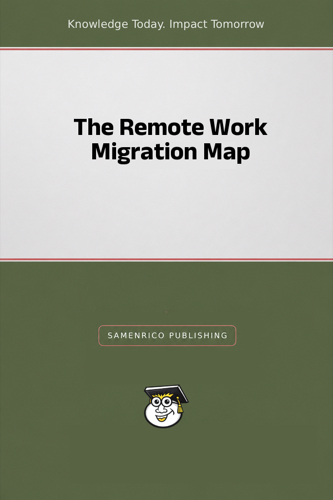
The Remote Work Migration Map eBook
Analyze how digital nomads and remote workers are
Analyze how digital nomads and remote workers are redistributing globally.
Formats
Free sample
Chapter 1: The Great Unanchoring--For most of human history, where you worked determined where you lived, and where you lived determined nearly everything else—your access to opportunity, your relationships, the schools your children attended, the air you breathed, and the trajectory of your entire life. The commute was not merely a daily inconvenience; it was a geographic prison sentence. Then, in the span of about eighteen months, that thousand-year-old logic collapsed.This chapter is about that collapse. It is about how millions of workers simultaneously realized that their labor could be decoupled from geography, and about what that realization has set in motion. The argument is straightforward but consequential: COVID-19 did not invent remote work.
The infrastructure for distributed labor—cloud computing, broadband internet, video conferencing, collaboration software—existed and was maturing for two decades. What the pandemic did was force a global, uncontrolled experiment that proved, to skeptical managers and conservative corporations alike, that productivity does not require physical presence. That experiment broke the psychological link between office attendance and professional legitimacy. We call this rupture the Great Unanchoring.The numbers tell the first part of the story. In 2019, before the pandemic reshaped every assumption about work, approximately 7.9 million Americans worked remotely on a regular basis.
That represented about 5.3 percent of the workforce. Digital nomads—those who actively combined remote work with geographic mobility—were a niche within a niche, estimated at fewer than 2 million globally. They were portrayed in business magazines as eccentric outliers: the tech freelancer coding from a beach in Thailand, the travel blogger monetizing Instagram aesthetics, the crypto trader with a passport full of obscure stamps. They were curiosities, not a movement.By the end of 2022, the number of remote-capable jobs in the United States had grown to roughly 58 million, of which approximately 35 percent were being performed remotely at least part of the time. The absolute number of fully remote workers had grown to over 18 million—a 131 percent increase from pre-pandemic levels.
And digital nomads, according to MBO Partners' annual State of Independence report, had grown to nearly 17 million workers in the United States alone. A niche had become a demographic. A curiosity had become a structural feature of the global economy.These numbers demand explanation. They cannot be attributed solely to lockdowns, because lockdowns ended. They cannot be attributed solely to technological improvement, because the technology was already good enough.
What changed was not the toolset but the permission structure. Before 2020, remote work was widely viewed by managers as a perk or, worse, a sign of low commitment. Workers who asked to work from home were often seen as less dedicated, less ambitious, less serious. The pandemic stripped away that stigma by force. Millions of employees who had never worked a single day outside an office were suddenly required to do so.
And the surprising result—surprising to executives, at least—was that work got done. Often, more work got done.Consider the data on productivity. A large-scale study of 10,000 employees at a Fortune 500 technology company found that the shift to remote work during the pandemic was associated with a 13 percent increase in productivity, measured by hours logged and output per hour. The gains were not evenly distributed: workers with young children at home saw productivity declines, while workers without caregiving responsibilities saw even larger increases. But the aggregate finding was clear: remote work did not destroy productivity.
In many contexts, it enhanced it.The reasons are not mysterious. Commuting consumes time, energy, and cognitive bandwidth. The average American commute in 2019 was 27.6 minutes each way—nearly an hour per day, 230 hours per year, roughly ten full days of unpaid labor simply to reach a location where paid labor could occur. When that time was reclaimed, some fraction of it was redirected to work. Additionally, the elimination of "presenteeism"—the performative act of looking busy while waiting for the clock to reach 5:00 PM—meant that work became more output-focused and less theater.
Managers could no longer evaluate employees by when they arrived and left. They had to evaluate them by what they produced.This shift, from input metrics (hours at a desk) to output metrics (tasks completed, value created), is one of the most underappreciated consequences of the Great Unanchoring. It changed not only where work happened but how work was measured. And that change, more than any technological innovation, enabled geographic mobility. Once your manager stopped caring about whether you were in the office at 9:00 AM and started caring only about whether you delivered your project by Friday, the question of where you delivered that project became irrelevant.The Pre-Pandemic Fringe To understand the Great Unanchoring, we must first understand the world that was unmade.
Before 2020, digital nomadism was a subculture with its own heroes, jargon, and pilgrimage sites. The foundational text was Timothy Ferriss's *The 4-Hour Workweek*, published in 2007, which introduced the concept of "lifestyle design" to a mainstream audience. Ferriss argued that the traditional career trajectory—work hard, save money, retire at sixty-five—was a trap. Instead, he proposed "mini-retirements": taking extended breaks throughout one's career, funded by automated businesses and outsourced labor. The book sold over two million copies and created a generation of aspiring location-independent entrepreneurs.The early digital nomads clustered in a handful of locations that offered the three essential ingredients: cheap cost of living, reliable internet, and a critical mass of other nomads.
Chiang Mai, Thailand, was the original capital. By 2015, the city had dozens of coworking spaces, hundreds of cafes with acceptable Wi-Fi, and a well-established infrastructure for long-term stays—visa agents, scooter rentals, laundry services, and English-speaking doctors. A nomad could live comfortably on $1,000 per month while earning a Western salary of $5,000 or more. The arbitrage was breathtaking.Other hotspots emerged. Canggu, Bali, offered surf and yoga alongside fiber-optic internet.
Medellín, Colombia, offered spring-like weather year-round and a time zone friendly to North American workers. Lisbon, Portugal, offered European culture with a lower price tag than London or Paris. Berlin, Budapest, and Barcelona attracted a more professional crowd of software developers and designers. Each location developed its own character, its own rituals, its own Whats App groups for apartment sublets and dinner plans.But for most of the 2010s, this remained a subculture. The typical digital nomad was young, single, childless, college-educated, and working in technology or creative services.
The lifestyle was often glorified on Instagram—laptop on a beach, coconut in hand—but the reality was less glamorous. Nomads spent long hours working in isolation, navigating visa uncertainty, and managing the logistical chaos of constant movement. The attrition rate was high. Most people who tried nomadism returned to stationary life within eighteen months, worn down by loneliness or bureaucracy or simple exhaustion.The pre-pandemic digital nomad was a pioneer, but pioneers are by definition few in number. What changed after 2020 was not the pioneer's lifestyle but its mainstreaming.
Millions of people who would never have considered selling their possessions and moving to Thailand suddenly found themselves working from their childhood bedrooms, then from Airbnbs in the next town, then from a different state, then from a different country. The pandemic did not create the desire for location independence. It removed the barriers that had…
This is the end of the free sample. Get the eBook to keep going. Buy now
About this book
Details
- Author
- Baldwin Roderick
- Publisher
- SamEnrico
- Language
- English
- Genre
- Non-Fiction, Forecast & Outlook, Remote Work
- Released
- 2026-06-10
- Pages (approx.)
- 147
- Available as
- eBook, Audiobook

Read better in the ZLOADR app
Your eBooks on your phone or tablet. Sign in with your SamEnrico account and start reading.
More by Baldwin Roderick
 Hawking Time Travel ParadoxBaldwin Roderick$11.99
 Gambling Addiction Recovery for Veterans GuideBaldwin Roderick$11.99
 The Parent Estate GuideBaldwin Roderick$11.99
 Surfer Back and Shoulder FlexibilityBaldwin Roderick$11.99
 The Silent Poisoner: The Strange Case of Dr. Thomas Neill CreamBaldwin Roderick$11.99
 Steel and Secrets: The Great Train Robbery That Shook a NationBaldwin Roderick$11.99
 How to Start a Hobby in Hula HoopingBaldwin Roderick$11.99
 One Page Retention Marketing PlanBaldwin Roderick$12.99
 Baby Boomer Spending Habits ManualBaldwin Roderick$12.99
 Understanding BallistophobiaBaldwin Roderick$17.99
 F&B ServerBaldwin Roderick$11.99
You may also like
 Remote Work Migration TrendsSizemore Shad$11.99
 The Cross Border Remote WorkMcneal Kenneth$11.99
 Remote Work Tech InvestmentJacob Pilar$11.99
 Remote Work Talent FlowsChan Vernice$11.99
 Remote Work Infrastructure GuideWomack Tamatha$11.99
 The Remote Work Talent Shift GuideCasteel Jerrold$11.99
 Remote Work Talent ShiftPinckney Filiberto$11.99