

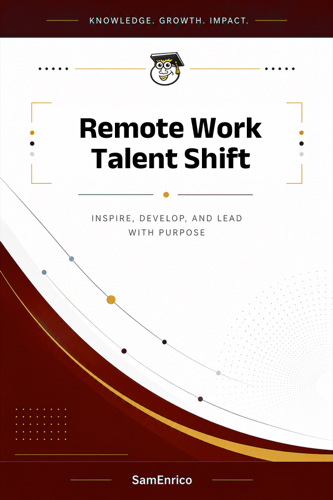
The Remote Work Talent Shift Guide
Forecasts geographic dispersion as digital nomads
Forecasts geographic dispersion as digital nomads leave high cost hubs for lifestyle destinations.
Formats
About this book
Free sample
Chapter 1: The Proximity Paradox--–- In March 2020, a strange thing happened to global productivity. As millions of knowledge workers packed up their monitors and fled corporate headquarters, economists and business leaders braced for catastrophe. The consensus was clear: without the magic of physical proximity—the impromptu whiteboard sessions, the watercooler insights, the hallway collisions—innovation would stall, trust would erode, and output would crater.None of that happened.Instead, something close to the opposite occurred. Across industries and continents, companies discovered that their employees were not only maintaining productivity from kitchen tables and spare bedrooms but often exceeding it. Microsoft reported that its remote workforce maintained or improved productivity for 90 percent of employees.
A meta-analysis of 1,600 studies conducted before the pandemic had already suggested that remote workers were 13 to 24 percent more productive than their office-bound counterparts. The crisis merely accelerated what the data had been whispering for years: the relationship between physical proximity and knowledge work productivity was not what anyone thought.This revelation sent shockwaves through the corporate world. If a decade of management science suggested that remote work was at least as productive as office work, why had so few companies embraced it before being forced? The answer reveals a profound misunderstanding about how proximity actually functions in modern organizations—a misunderstanding this chapter calls the Proximity Paradox.The Proximity Paradox is the false belief that daily, continuous physical proximity is necessary for productivity, trust, and culture. In reality, daily proximity contributes minimally to knowledge work output while imposing enormous costs—financial, temporal, and psychological.
At the same time, periodic, intentional proximity—gathering for specific purposes at planned intervals—delivers the relationship-building benefits that organizations actually need, at a fraction of the cost.This distinction is the foundation upon which the entire Remote Work Talent Shift Guide is built. Until leaders internalize the difference between daily and periodic proximity, every other strategy—from async systems to compensation models to destination hiring—will rest on shaky ground. Conversely, employees who understand this paradox gain immediate bargaining power, because they can articulate precisely why their physical location does not determine their value.This chapter dismantles the…
This is the end of the free sample. Get the eBook to keep going. Buy now
Contents
- Chapter 1
- Chapter 2
- Chapter 3
- Chapter 4
- Chapter 5
- Chapter 6
- Chapter 7
- Chapter 8
- Chapter 9
- Chapter 10
- Chapter 11
- Chapter 12
Details
- Author
- Casteel Jerrold
- Publisher
- SamEnrico
- Language
- English
- Genre
- Non-Fiction, Forecast & Outlook, Remote Work
- Released
- 2026-06-06
- Pages (approx.)
- 147
- Available as
- eBook, Audiobook

Read better in the ZLOADR app
Your eBooks on your phone or tablet. Sign in with your SamEnrico account and start reading.
More by Casteel Jerrold
 Mindfulness for Test Anxiety WorkbookCasteel Jerrold$11.99
 Mindful Driving Stress ReductionCasteel Jerrold$11.99
 Teen Self Esteem and Chronic IllnessCasteel Jerrold$11.99
 Ayurvedic Lung Health GuideCasteel Jerrold$11.99
 The Forge of the First Sword: Arthur’s Lost Creation MythCasteel Jerrold$11.99
 UltimateCasteel Jerrold$11.99
 Data Cleansing Automation GuideCasteel Jerrold$12.99
 Brazil Dropshipping Automation ToolsCasteel Jerrold$12.99
 Understanding Methylmalonyl-coenzyme a Mutase DeficiencyCasteel Jerrold$17.99
 How to Start a Building Materials Made of Vegetable Substances Business (Beginners Guide)Casteel Jerrold$11.99
You may also like
 The Remote Work Migration MapBaldwin Roderick$11.99
 Remote Work Migration TrendsSizemore Shad$11.99
 The Cross Border Remote WorkMcneal Kenneth$11.99
 Remote Work Tech InvestmentJacob Pilar$11.99
 Remote Work Talent FlowsChan Vernice$11.99
 Remote Work Infrastructure GuideWomack Tamatha$11.99
 Remote Work Talent ShiftPinckney Filiberto$11.99