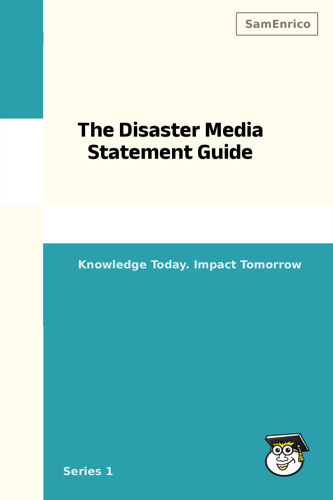
The Disaster Media Statement Guide
Provides press release templates, spokesperson tip
by Dwyer Beula
Provides press release templates, spokesperson tips, and social media holds.
Formats
About this book
Free sample
Chapter 1: The Golden Hour...--–- At 9:14 AM on a Tuesday that no one would forget, a Boeing 737 slid off the runway at Denver International Airport. By 9:16 AM, the first passenger video was on Twitter. By 9:18 AM, CNN had broadcast it six times. By 9:22 AM, the hashtag #Denver Crash was trending in seventeen countries. And at 10:45 AM — ninety-one minutes after the plane stopped moving — the airline's legal team finally approved a statement.The statement was perfect.
Legally bulletproof. Carefully vetted. Empathetically phrased. It took four layers of approval, two conference calls, and one very anxious general counsel to produce. It said all the right things: concern for passengers, cooperation with investigators, a promise to update the public as more information became available.No one read it.By the time that statement landed in newsroom inboxes, the internet had already tried, convicted, and sentenced the airline.
Reddit threads had dissected the pilot's history. Tik Tok compilations had set the crash footage to ominous music. A former National Transportation Safety Board member had gone on cable news to speculate about "possible mechanical failure." And the airline's silence — that long, deafening ninety-one minutes of nothing — had been interpreted by the public as guilt.The perfect statement, issued too late, was worthless.This is the central tragedy of modern crisis communication. Organizations spend millions on legal defense, brand management, and public relations, only to watch their reputations evaporate in the time it takes to schedule a conference call. The gap between "the right thing to say" and "the right time to say it" has never been wider.
And in that gap, reputations die.The Old Rules Are Dead For most of the twentieth century, crisis communication followed a predictable rhythm. An incident occurred. The organization gathered facts. Lawyers reviewed every word. A statement was issued — sometimes hours later, sometimes days.
The public waited. The news cycle was patient. Print deadlines allowed time for reflection. Evening news broadcasts had limited slots. A four-hour delay was considered responsible.Those days are over.The modern information environment is not a cycle; it is a firehose.
Social media platforms process millions of posts per minute. News alerts reach smartphones within seconds. Citizen journalists with camera phones…
This is the end of the free sample. Get the eBook to keep going. Buy now
Contents
- Chapter 1
- Chapter 2
- Chapter 3
- Chapter 4
- Chapter 5
- Chapter 6
- Chapter 7
- Chapter 8
- Chapter 9
- Chapter 10
- Chapter 11
- Chapter 12
Details
- Author
- Dwyer Beula
- Publisher
- SamEnrico
- Language
- English
- Genre
- Non-Fiction, Crisis Management, PR
- Released
- 2026-06-05
- Pages (approx.)
- 143
- Available as
- eBook, Audiobook

Read better in the ZLOADR app
Your eBooks on your phone or tablet. Sign in with your SamEnrico account and start reading.
More by Dwyer Beula
 Bedtime Letting Go Breath GuideDwyer Beula$11.99
 Lithuanian American Return To Vilnius CourseDwyer Beula$11.99
 The Body Language for ChefsDwyer Beula$11.99
 Metta for Depression RecoveryDwyer Beula$11.99
 The Healing Hands of Dr. Daniel Hale Williams: The Pioneer of Open-Heart SurgeryDwyer Beula$11.99
 Family Practice PhysicianDwyer Beula$11.99
 Knowledge Base Article GuideDwyer Beula$12.99
 UAE VAT on Second Hand Goods Margin SchemeDwyer Beula$12.99
 Understanding Moeschler–clarren SyndromeDwyer Beula$17.99
 How to Become a Laboratory-sample CarrierDwyer Beula$11.99