
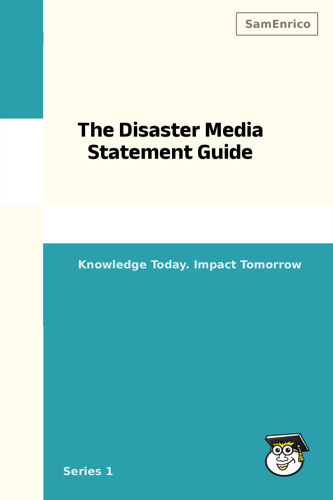
Non-FictionCrisis ManagementPR
The Disaster Media Statement Guide eBook
Provides press release templates, spokesperson tip
by Dwyer Beula
Provides press release templates, spokesperson tips, and social media holds.
Formats
Free sample
Chapter 1: The Golden Hour...--–- At 9:14 AM on a Tuesday that no one would forget, a Boeing 737 slid off the runway at Denver International Airport. By 9:16 AM, the first passenger video was on Twitter. By 9:18 AM, CNN had broadcast it six times. By 9:22 AM, the hashtag #Denver Crash was trending in seventeen countries. And at 10:45 AM — ninety-one minutes after the plane stopped moving — the airline's legal team finally approved a statement.The statement was perfect.
Legally bulletproof. Carefully vetted. Empathetically phrased. It took four layers of approval, two conference calls, and one very anxious general counsel to produce. It said all the right things: concern for passengers, cooperation with investigators, a promise to update the public as more information became available.No one read it.By the time that statement landed in newsroom inboxes, the internet had already tried, convicted, and sentenced the airline.
Reddit threads had dissected the pilot's history. Tik Tok compilations had set the crash footage to ominous music. A former National Transportation Safety Board member had gone on cable news to speculate about "possible mechanical failure." And the airline's silence — that long, deafening ninety-one minutes of nothing — had been interpreted by the public as guilt.The perfect statement, issued too late, was worthless.This is the central tragedy of modern crisis communication. Organizations spend millions on legal defense, brand management, and public relations, only to watch their reputations evaporate in the time it takes to schedule a conference call. The gap between "the right thing to say" and "the right time to say it" has never been wider.
And in that gap, reputations die.The Old Rules Are Dead For most of the twentieth century, crisis communication followed a predictable rhythm. An incident occurred. The organization gathered facts. Lawyers reviewed every word. A statement was issued — sometimes hours later, sometimes days.
The public waited. The news cycle was patient. Print deadlines allowed time for reflection. Evening news broadcasts had limited slots. A four-hour delay was considered responsible.Those days are over.The modern information environment is not a cycle; it is a firehose.
Social media platforms process millions of posts per minute. News alerts reach smartphones within seconds. Citizen journalists with camera phones outnumber credentialed reporters by a factor of ten thousand to one. By the time your legal team has finished its first draft, the narrative is already written — and you are not the author.Bradley Akubuiro, in his seminal work Faster. Messier.
Tougher., documents this shift with brutal clarity. He argues that the organizations which survive crises in the 2020s are not those with the most careful statements, but those with the fastest responses. Speed, he contends, has become a strategic asset — not despite the risk of error, but because of it. An imperfect statement issued within minutes signals transparency, urgency, and human concern. A perfect statement issued hours later signals calculation, evasion, and institutional indifference.The research bears this out.
A landmark study published in the Journal of Crisis Communication found that organizations issuing any statement within the first sixty minutes of a crisis retained forty percent more public trust than those who waited three hours. Not a better statement. Not a more accurate statement. Just a faster one. The content mattered less than the timing.
The public did not demand perfection; they demanded presence.This sixty-minute window is the Communications Golden Hour — a fixed, non-negotiable deadline that will govern every page of this book. The term borrows from emergency medicine, where the first hour after a traumatic injury is critical to survival. In crisis communication, the metaphor is exact. The first hour after a disaster breaks is when public opinion is most malleable, when trust is most easily won or lost, and when your organization has the greatest opportunity to shape the narrative before it shapes itself.Why Silence Is Now Guilt The old strategy of "no comment" was never beloved, but it was once viable. A company could decline to speak, wait for facts to emerge, and issue a statement when the picture was clearer.
The public might grumble, but they would wait. The news media might push, but they had few alternatives.That era is over for three structural reasons.First, the information vacuum created by silence is no longer empty. It is filled instantly by other voices: witnesses, competitors, activists, politicians, and anonymous social media accounts. In the absence of your statement, the public will accept someone else's. And that someone else is unlikely to be charitable.
A 2024 analysis of crisis narratives on Twitter found that organizations that remained silent for more than ninety minutes lost control of the primary narrative in eighty-three percent of cases. By the time they spoke, they were no longer setting the agenda — they were reacting to it.Second, silence is now interpreted as guilt. Behavioral psychology research has demonstrated that humans are wired to fill gaps in information with worst-case assumptions. When a person goes silent, we assume they are hiding something. When an organization goes silent, we assume they are calculating liability.
The default inference is not "they are gathering facts" but "they have something to hide." This is not irrational; it is Bayesian. The public has learned from decades of corporate scandals that silence usually precedes a cover-up, not an investigation.Third, the asymmetry of speed has inverted. In the twentieth century, organizations had faster communication systems than the public. A company could issue a press release that reached newspapers before word of mouth spread. Today, the public has faster communication systems than organizations.
A passenger's tweet reaches the world before the airline's public relations team has even confirmed the flight number. Your stakeholders are no longer waiting for your statement; they are already reacting to someone else's.Consider the case of a major hotel chain that experienced a data breach in 2023. Hackers accessed the personal information of five million guests. The company discovered the breach on a Thursday evening. Its legal team advised waiting until Monday morning to issue a statement, citing the need for a thorough investigation.
Over that weekend, angry customers filled social media with speculation. A class action lawsuit was organized via Reddit. By Monday morning, the hashtag #Hotel Hack had been viewed forty million times. The company's eventual statement — well-written, accurate, and legally sound — was drowned out by a narrative that had already hardened.The holding statement could have changed everything. A simple acknowledgement on Thursday night — "We are aware of a potential issue with our guest data systems.
We are investigating urgently. The security of your information is our highest priority" — would have filled the vacuum, signaled transparency, and bought the company time to investigate properly. Instead, they chose silence. And silence cost them.The Holding Statement Defined A holding statement is a low-commitment, high-empathy placeholder that acknowledges awareness, expresses concern, and promises forthcoming facts — all without admitting liability or speculating about unconfirmed details. It is not a final answer.
It is a bridge. It says to the public: "We see you. We hear you. We are working on it. We will be back."The holding statement serves four critical functions in the Golden Hour:First, it fills the information vacuum.
By issuing any statement — even a statement that says "we don't know much yet" — you prevent other voices…
This is the end of the free sample. Get the eBook to keep going. Buy now
About this book
Details
- Author
- Dwyer Beula
- Publisher
- SamEnrico
- Language
- English
- Genre
- Non-Fiction, Crisis Management, PR
- Released
- 2026-06-05
- Pages (approx.)
- 143
- Available as
- eBook, Audiobook

Read better in the ZLOADR app
Your eBooks on your phone or tablet. Sign in with your SamEnrico account and start reading.
More by Dwyer Beula
 Bedtime Letting Go Breath GuideDwyer Beula$11.99
 Lithuanian American Return To Vilnius CourseDwyer Beula$11.99
 The Body Language for ChefsDwyer Beula$11.99
 Metta for Depression RecoveryDwyer Beula$11.99
 The Healing Hands of Dr. Daniel Hale Williams: The Pioneer of Open-Heart SurgeryDwyer Beula$11.99
 Family Practice PhysicianDwyer Beula$11.99
 Knowledge Base Article GuideDwyer Beula$12.99
 UAE VAT on Second Hand Goods Margin SchemeDwyer Beula$12.99
 Understanding Moeschler–clarren SyndromeDwyer Beula$17.99
 How to Become a Laboratory-sample CarrierDwyer Beula$11.99
You may also like
 Hong Kong Handover 1997Dunn Johnnie$11.99
 Zumba For Postnatal Recovery CourseNeal Christian$11.99
 Zumba for BeginnersLadner Nikia$11.99
 YouTube Comment Mining GuideHumes Pandora$12.99
 Worry Box MeditationCarlin Rudy$11.99
 Workplace Stress MeditationNguyen Lynn$11.99
 Workplace Stress and Sleep RepairHawley Ivory$11.99
 Workplace Perfectionism CureDelaney Jeffry$11.99
 Workplace Injustice Anger GuideWallen Isabelle$11.99
 Work Addiction and Burnout LinkGreenwood Ester$11.99
 Women in Yoga and WellnessBeattie Galina$11.99
 Women in Stand Up ComedyChun Evangeline$11.99