
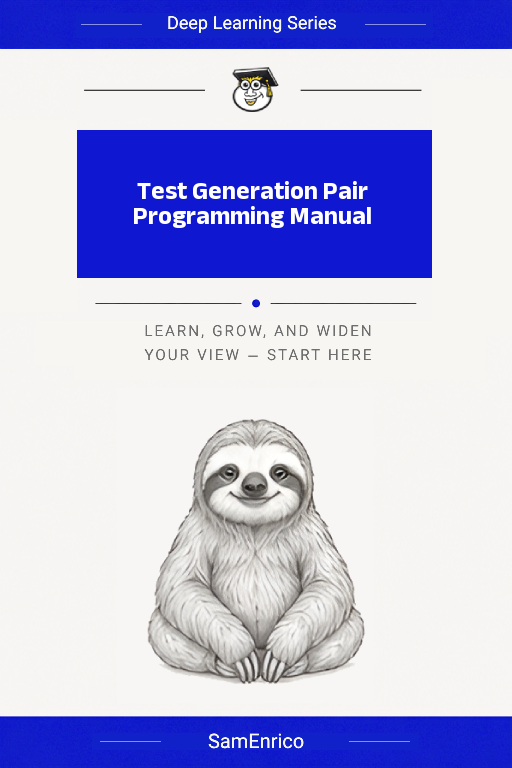
Test Generation Pair Programming Manual eBook
Write unit, integration, and property-based tests
Write unit, integration, and property-based tests using natural language prompts. Achieve higher coverage faster with AI-suggested edge cases.
Formats
Free sample
Chapter 1: The Specification Shift--–- Every developer remembers the moment they realized testing was not a one-time investment but a crushing maintenance burden. For some, it arrives during a refactoring session when twenty unit tests turn red for reasons that have nothing to do with correctness. For others, it comes during a deadline week when the team collectively decides to skip writing tests altogether, promising to “add them later” – a promise that survives approximately zero sprints. The problem is not that developers are lazy or that testing frameworks are inadequate. The problem is that we have been writing tests the wrong way for decades, and artificial intelligence has finally made the old approach obsolete.This book is not about teaching you to write better assertions or to master a new testing framework.
It is about fundamentally redefining your relationship with test code. The thesis is simple but radical: you should stop typing assertions and start specifying behaviors. The artificial intelligence becomes your pair programmer, translating your high-level specifications into executable tests, learning from failures, and maintaining the suite as your code evolves. You become a specification designer, not a test typist.The old model of software testing resembles manual transcription. You study a function, think about its inputs and outputs, and then manually translate those thoughts into assertion statements.
Each assertion is a tiny piece of executable documentation that says, “Given this input, I expect this output.” But manual translation is slow, error-prone, and scales poorly with codebase complexity. Worse, when requirements change, you must manually revisit every affected test and update its assertions – a process that breeds frustration, shortcuts, and eventually, test suites that nobody trusts.The new model, which this book calls Specification-Driven Testing, flips the relationship. Instead of typing assertions, you write structured natural language specifications that describe the behavior you expect. The artificial intelligence generates the corresponding test code, runs it, observes failures, and corrects its own output. Your role shifts from low-level assertion typing to high-level specification design.
You think about edge cases, invariants, and business rules. The artificial intelligence handles the mechanical translation to code.This chapter introduces the foundational mindset shift required to succeed with AI-paired test generation. You will learn why traditional test maintenance creates a hidden tax on velocity, how specification-driven workflows eliminate that tax, and why the role of “test architect” is more valuable than “test typist.” By the end of this chapter, you will never look at a unit test the same way again.The Hidden Tax of Manual Test Maintenance Software testing suffers from a pernicious economic reality: tests accrue maintenance debt faster than production code. Production code changes for new features, bug fixes, and performance improvements. Each change potentially invalidates existing tests.
When a test fails after a code change, a developer must diagnose whether the failure indicates a real regression or an outdated test expectation. This diagnostic cost is the hidden tax.Consider a typical development scenario. A team maintains a payment processing service with three hundred unit tests. A product manager requests a change: discounts should now apply before taxes instead of after. The developer modifies the production code accordingly.
Twenty-three tests fail. For each failure, the developer must examine whether the new behavior is correct and the test is wrong, or whether the code change introduced a regression. Fifteen of the failures are due to outdated test expectations; eight reveal actual bugs in the new logic. The developer updates the fifteen outdated tests manually, fixes the eight bugs, and commits the changes. The entire process takes four hours.Now imagine the same scenario with an AI test generation system.
The developer writes a specification: “When calculating the final price, apply the discount to the subtotal before adding taxes.” The artificial intelligence generates updated tests that match the new specification, runs them against the code, identifies the same eight regressions, and proposes corrected test expectations for the remaining fifteen. The developer reviews the proposals, approves them, and commits. The process takes forty-five minutes.The difference is not magic; it is automation of mechanical translation. Manual test maintenance forces developers to spend cognitive energy on low-level assertion updates – exactly the kind of repetitive, pattern-matching work that artificial intelligence excels at. The hidden tax grows superlinearly with team size and codebase age.
Studies cited in the 2024 State of Software Quality report indicate that teams spending less than twenty percent of their development time on testing actually spend over forty percent when including test maintenance. The discrepancy arises because maintenance is rarely tracked as testing time; it appears as “debugging,” “code review,” or “integration work.”The hidden tax also manifests as test avoidance. When developers know that changing a core function will require hours of test updates, they hesitate to refactor. They take shortcuts. They write tests that are too coarse-grained to provide safety or too brittle to survive change.
The test suite becomes a liability rather than an asset. This is the death spiral of manual test maintenance: tests become painful to maintain, so developers maintain them poorly, which makes them less effective, which leads to more bugs, which requires more tests, which increases maintenance pain.The Specification Designer Mindset Escaping the death spiral requires a mental model shift. You must stop thinking of yourself as someone who writes tests and start thinking of yourself as someone who specifies behaviors. The distinction is subtle but profound.A test writer asks: “What assertions should I write to verify this function?” The test writer thinks in terms of code: assert Equals, assert True, mock setups, and teardown methods. The test writer’s primary artifact is the test file, and success is measured by line coverage and green builds.A specification designer asks: “What behaviors should this function exhibit under various conditions?” The specification designer thinks in terms of contracts: “Given a valid input, the function returns a non-null result.” “Given a negative amount, the function throws an Invalid Argument Exception.” “For any list, reversing it twice yields the original list.” The specification designer’s primary artifact is the specification document – which may be as simple as structured comments or as formal as a domain-specific language – and success is measured by behavioral coverage and regression prevention.The artificial intelligence bridges the gap between specification and code.
You describe behaviors in natural language; the artificial intelligence translates those descriptions into assertions, mocks, and test structure. When the code changes, you update the specification (if the behavior changed) or leave it unchanged (if the behavior remained correct). The artificial intelligence propagates those changes to the test suite automatically.This shift changes the economics of testing. Updating a specification takes seconds: “Change the discount rule from post-tax to pre-tax.” Updating twenty-three assertions takes much longer. The specification designer operates at the level of intent, not implementation.
The artificial intelligence handles the implementation details.The specification designer also thinks differently about coverage. Traditional coverage metrics count lines of code executed by tests. A test that executes a line without verifying anything meaningful still contributes to line coverage. Specification designers care about behavioral coverage: the proportion of specified behaviors that have corresponding test verification. A function might have one hundred lines of code but only five…
This is the end of the free sample. Get the eBook to keep going. Buy now
About this book
Details
- Author
- Keith Candance
- Publisher
- SamEnrico
- Language
- English
- Genre
- Non-Fiction, AI Operator, Test Automation, TDD
- Released
- 2026-05-28
- Pages (approx.)
- 145
- Available as
- eBook, Audiobook

Read better in the ZLOADR app
Your eBooks on your phone or tablet. Sign in with your SamEnrico account and start reading.
More by Keith Candance
 John Lewis MarchKeith Candance$11.99
 Problem Validation Interview ScriptKeith Candance$11.99
 Intermittent Fasting WorkbookKeith Candance$11.99
 Nonprofit Worker Stress GuideKeith Candance$11.99
 Medical Trauma Dream WorkKeith Candance$11.99
 The Collaborative CanvaKeith Candance$11.99
 TM for ConsultantsKeith Candance$11.99
 No Days Off Discipline CodeKeith Candance$11.99
 HGH And EpigeneticsKeith Candance$11.99
 The House Always Wins: How a Vegas Showgirl Built a Billion-Dollar EmpireKeith Candance$11.99
 Blacktop Lament: The Phantom of Route 666Keith Candance$11.99
 The Star Map of the Dogon: Ancient Astronomy in MaliKeith Candance$11.99