
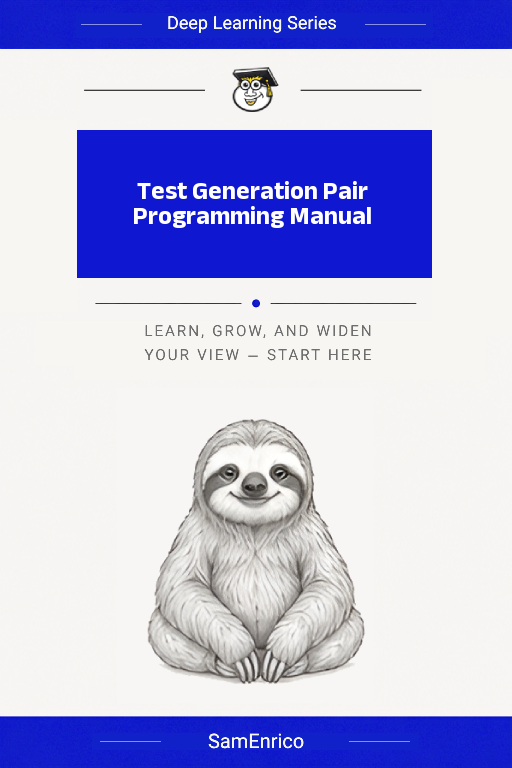
Test Generation Pair Programming Manual
Write unit, integration, and property-based tests
Write unit, integration, and property-based tests using natural language prompts. Achieve higher coverage faster with AI-suggested edge cases.
Formats
About this book
Free sample
Chapter 1: The Specification Shift--–- Every developer remembers the moment they realized testing was not a one-time investment but a crushing maintenance burden. For some, it arrives during a refactoring session when twenty unit tests turn red for reasons that have nothing to do with correctness. For others, it comes during a deadline week when the team collectively decides to skip writing tests altogether, promising to “add them later” – a promise that survives approximately zero sprints. The problem is not that developers are lazy or that testing frameworks are inadequate. The problem is that we have been writing tests the wrong way for decades, and artificial intelligence has finally made the old approach obsolete.This book is not about teaching you to write better assertions or to master a new testing framework.
It is about fundamentally redefining your relationship with test code. The thesis is simple but radical: you should stop typing assertions and start specifying behaviors. The artificial intelligence becomes your pair programmer, translating your high-level specifications into executable tests, learning from failures, and maintaining the suite as your code evolves. You become a specification designer, not a test typist.The old model of software testing resembles manual transcription. You study a function, think about its inputs and outputs, and then manually translate those thoughts into assertion statements.
Each assertion is a tiny piece of executable documentation that says, “Given this input, I expect this output.” But manual translation is slow, error-prone, and scales poorly with codebase complexity. Worse, when requirements change, you must manually revisit every affected test and update its assertions – a process that breeds frustration, shortcuts, and eventually, test suites that nobody trusts.The new model, which this book calls Specification-Driven Testing, flips the relationship. Instead of typing assertions, you write structured natural language specifications that describe the behavior you expect. The artificial intelligence generates the corresponding test code, runs it, observes failures, and corrects its own output. Your role shifts from low-level assertion typing to high-level specification design.
You think about edge cases, invariants, and business rules. The artificial intelligence handles the mechanical translation to code.This chapter introduces…
This is the end of the free sample. Get the eBook to keep going. Buy now
Contents
- Chapter 1
- Chapter 2
- Chapter 3
- Chapter 4
- Chapter 5
- Chapter 6
- Chapter 7
- Chapter 8
- Chapter 9
- Chapter 10
- Chapter 11
- Chapter 12
Details
- Author
- Keith Candance
- Publisher
- SamEnrico
- Language
- English
- Genre
- Non-Fiction, AI Operator, Test Automation, TDD
- Released
- 2026-05-28
- Pages (approx.)
- 145
- Available as
- eBook, Audiobook

Read better in the ZLOADR app
Your eBooks on your phone or tablet. Sign in with your SamEnrico account and start reading.
More by Keith Candance
 John Lewis MarchKeith Candance$11.99
 Problem Validation Interview ScriptKeith Candance$11.99
 Intermittent Fasting WorkbookKeith Candance$11.99
 Nonprofit Worker Stress GuideKeith Candance$11.99
 Medical Trauma Dream WorkKeith Candance$11.99
 The Collaborative CanvaKeith Candance$11.99
 TM for ConsultantsKeith Candance$11.99
 No Days Off Discipline CodeKeith Candance$11.99
 HGH And EpigeneticsKeith Candance$11.99
 The House Always Wins: How a Vegas Showgirl Built a Billion-Dollar EmpireKeith Candance$11.99
 Blacktop Lament: The Phantom of Route 666Keith Candance$11.99
 The Star Map of the Dogon: Ancient Astronomy in MaliKeith Candance$11.99