
Non-FictionSelf-HelpInnovation
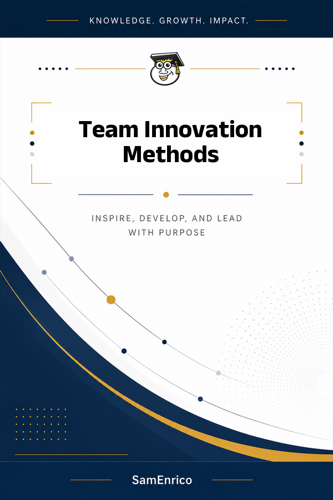
Team Innovation Methods eBook
Systematic approaches for group creativity.
Systematic approaches for group creativity.
Formats
Free sample
Chapter 1: The Lone Genius Delusion--The story you have been told about innovation is a lie.It is a beautiful lie, seductive and enduring. It features a solitary figure—Edison in his workshop, Einstein at his thought experiment, Jobs on a minimalist stage—who alone sees what others cannot. In this story, creativity strikes like lightning. The genius has a vision. The world changes.
Everyone applauds.This lie sells books, fuels biopics, and makes venture capitalists believe they can spot the next unicorn by interviewing the “brilliant founder.” But it has also quietly destroyed more teams than any other myth in business.Because when you believe innovation belongs to lone geniuses, you do one of three things: you hire “creatives” and expect magic, you wait for a hero to save your struggling project, or you conclude that your ordinary team is simply not creative enough. All three paths lead to the same destination: stagnation.This book exists to offer a different path. Not the path of the lone genius, but the path of the system. Not waiting for lightning, but building a lightning rod that any team can operate. Not hiring saviors, but engineering the conditions where ordinary people do extraordinary work together.Before we build that system, however, we must first complete a necessary demolition.
We must expose the Lone Genius myth for what it is—a cultural artifact, not a scientific fact. Then we must look squarely at the truth: innovation is fundamentally, irreducibly, and beautifully social.And finally, we must diagnose your team’s current reality. Because you cannot fix a system you have not yet measured.The Invention That Wasn’t Solitary Let us begin with Thomas Edison, the patron saint of the lone inventor. The light bulb, we are told, sprang from his singular genius. The phonograph.
Motion pictures. Over a thousand patents. One man, one workshop, one brilliant mind.Here is what the myth leaves out.Edison did not work alone. He built the Menlo Park laboratory—not a shed, but a compound. At its peak, it employed over forty machinists, scientists, glassblowers, and draftsmen.
He called them his “muckers,” and they were not assistants. They were collaborators. Charles Batchelor, a master machinist, co-developed the light bulb filament. John Kruesi, a Swiss clockmaker, built the first working phonograph from Edison’s sketches. Francis Upton, a Princeton-trained mathematician, handled the complex calculations Edison could not perform.Edison’s true genius was not solitary invention.
It was system building. He created a process for rapid, iterative, team-based experimentation. He divided labor, encouraged cross-pollination, and maintained what we would now call a culture of psychological safety—muckers could challenge his ideas without fear. When a competitor called Edison’s team “a gang of mechanics,” Edison took it as a compliment.The light bulb was not a solo performance. It was a team sport.The Collaborative Emergence of Great Ideas The late Keith Sawyer, a creativity researcher at Washington University, spent decades studying how innovation actually happens.
He coined the term that will serve as our foundation: collaborative emergence.Collaborative emergence describes a process where ideas evolve through small contributions from multiple people, building on each other, until something emerges that no single person could have predicted. It is the opposite of the “aha moment.” It is the slow, messy, social accretion of insights.Sawyer studied jazz ensembles, improv comedy troupes, and product design teams. In every case, the pattern was identical. A musician plays a phrase. Another responds with a variation.
A third adds a countermelody. After eight bars, they have created something none of them individually planned. No one had the whole idea in their head. The idea existed between them, in the space of collaboration.Improv comedy works the same way. The rule of “yes, and” is not just a nicety.
It is a cognitive mechanism. One performer offers a premise—“We are astronauts stranded on Mars.” Another adds—“And our oxygen is running out.” A third—“And the Martian who lives in that crater offered us tea.” The scene becomes hilarious or profound not because any single performer is a genius, but because the group generates possibilities that no individual would have reached alone.Product design follows the same logic. The original i Pod was not Steve Jobs’s idea. It was Jon Rubinstein’s observation that a Toshiba hard drive was small enough for a music player. It was Tony Fadell’s vision of a simplified interface.
It was Jony Ive’s minimalist enclosure. It was the software team’s scroll wheel. Jobs’s contribution was crucial—but it was the contribution of an editor and integrator, not a solitary originator. He saw what his team had produced, recognized its potential, and pushed them further.Collaborative emergence has a radical implication: the best idea in the room does not belong to anyone in the room. It belongs to the interaction between them.Why the Lone Genius Myth Persists If collaboration is the engine of innovation, why does the Lone Genius myth endure?
Three reasons, each rooted in human psychology.First, the narrative simplification bias. We crave stories with protagonists. A team of forty people is a messy ensemble; a single inventor is a character we can love, hate, or emulate. Biographers and journalists face enormous pressure to simplify. “Edison invented the light bulb” fits in a headline.
“Edison’s team of forty collaborated over six years to develop a commercially viable incandescent lamp following decades of prior work by Swan and others” does not.Second, the attribution error. When we see a successful outcome, we instinctively attribute it to the most visible person. The CEO gets credit for a turnaround that two thousand employees executed. The lead designer gets the award for a product that user research shaped. The professor’s name goes first on a paper that graduate students wrote.
This is not malice—it is cognitive economy. Our brains prefer single causes to complex systems.Third, and most damaging, the hero myth serves power. Organizations that believe in lone geniuses can pay one executive a spectacular salary rather than invest in team processes. Venture capitalists can fund charismatic founders rather than build due diligence systems. Managers can wait for a savior rather than do the hard work of creating psychological safety.
The myth justifies hierarchy, inequality, and passivity.Your job, as a reader of this book, is to resist all three biases. The payoff will be enormous: you will stop waiting for geniuses to appear and start building systems that make your existing team creative.The Pixar Braintrust: Structure, Not Magic No case study better illustrates the power of systematic team creativity than Pixar Animation Studios. Over three decades, Pixar has produced more critically and commercially successful films than any studio in history: Toy Story, Finding Nemo, The Incredibles, Up, Inside Out. This is not luck. It is not a run of genius directors.
It is a system.That system is called the Braintrust.The Braintrust is a small group of senior filmmakers—directors, writers, producers—who meet every few months to review a film in progress. Here is what makes it extraordinary.First, the Braintrust has no authority. It cannot mandate changes. It cannot fire anyone.…
This is the end of the free sample. Get the eBook to keep going. Buy now
About this book
Details
- Author
- Miner Reynalda
- Publisher
- SamEnrico
- Language
- English
- Genre
- Non-Fiction, Self-Help, Innovation
- Released
- 2026-06-07
- Pages (approx.)
- 156
- Available as
- eBook, Audiobook

Read better in the ZLOADR app
Your eBooks on your phone or tablet. Sign in with your SamEnrico account and start reading.
More by Miner Reynalda
 Anticipatory Grief For ChaplainsMiner Reynalda$11.99
 Electric Car Quiet Anger ReductionMiner Reynalda$11.99
 Postpartum Social Worker GuideMiner Reynalda$11.99
 Metastatic Breast Cancer GuideMiner Reynalda$11.99
 Sleep Mantra RepetitionMiner Reynalda$11.99
 Anniversary Trauma ReactionMiner Reynalda$11.99
 Persuasion for DoctorsMiner Reynalda$11.99
 Orpheus and Eurydice: A Lament in ShadowsMiner Reynalda$11.99
 The Secret Life of the Ice Age Cave Artists: A Child’s DiscoveryMiner Reynalda$11.99
 How to Produce Cooking TorchesMiner Reynalda$11.99
 Deutsche Brackes: German Scent HoundMiner Reynalda$11.99
 Post Study Work Argentina HandbookMiner Reynalda$12.99
You may also like
 Hong Kong Handover 1997Dunn Johnnie$11.99
 Zumba For Postnatal Recovery CourseNeal Christian$11.99
 Zumba for BeginnersLadner Nikia$11.99
 YouTube Comment Mining GuideHumes Pandora$12.99
 Worry Box MeditationCarlin Rudy$11.99
 Workplace Stress MeditationNguyen Lynn$11.99
 Workplace Stress and Sleep RepairHawley Ivory$11.99
 Workplace Perfectionism CureDelaney Jeffry$11.99
 Workplace Injustice Anger GuideWallen Isabelle$11.99
 Work Addiction and Burnout LinkGreenwood Ester$11.99
 Women in Yoga and WellnessBeattie Galina$11.99
 Women in Stand Up ComedyChun Evangeline$11.99