
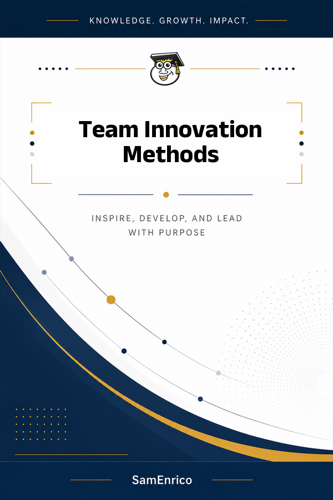
Non-FictionSelf-HelpInnovation
Team Innovation Methods Audiobook
Systematic approaches for group creativity.
Systematic approaches for group creativity.
Formats
Free sample
Chapter 1: The Lone Genius Delusion--The story you have been told about innovation is a lie.It is a beautiful lie, seductive and enduring. It features a solitary figure—Edison in his workshop, Einstein at his thought experiment, Jobs on a minimalist stage—who alone sees what others cannot. In this story, creativity strikes like lightning. The genius has a vision. The world changes.
Everyone applauds.This lie sells books, fuels biopics, and makes venture capitalists believe they can spot the next unicorn by interviewing the “brilliant founder.” But it has also quietly destroyed more teams than any other myth in business.Because when you believe innovation belongs to lone geniuses, you do one of three things: you hire “creatives” and expect magic, you wait for a hero to save your struggling project, or you conclude that your ordinary team is simply not creative enough. All three paths lead to the same destination: stagnation.This book exists to offer a different path. Not the path of the lone genius, but the path of the system. Not waiting for lightning, but building a lightning rod that any team can operate. Not hiring saviors, but engineering the conditions where ordinary people do extraordinary work together.Before we build that system, however, we must first complete a necessary demolition.
We must expose the Lone Genius myth for what it is—a cultural artifact, not a scientific fact. Then we must look squarely at the truth: innovation is fundamentally, irreducibly, and beautifully social.And finally, we must diagnose your team’s current reality. Because you cannot fix a system you have not yet measured.The Invention That Wasn’t Solitary Let us begin with Thomas Edison, the patron saint of the lone inventor. The light bulb, we are told, sprang from his singular genius. The phonograph.
Motion pictures. Over a thousand patents. One man, one workshop, one brilliant mind.Here is what the myth leaves out.Edison did not work alone. He built the Menlo Park laboratory—not a shed, but a compound. At its peak, it employed over forty machinists, scientists, glassblowers, and draftsmen.
He called them his “muckers,” and they were not assistants. They were collaborators. Charles Batchelor, a master machinist, co-developed the light bulb filament. John Kruesi, a Swiss clockmaker, built the first working phonograph from Edison’s sketches. Francis Upton, a Princeton-trained mathematician, handled the complex calculations Edison could not perform.Edison’s true…
This is the end of the free sample. Get the Audiobook to keep going. Buy now
About this book
Details
- Author
- Miner Reynalda
- Publisher
- SamEnrico
- Language
- English
- Genre
- Non-Fiction, Self-Help, Innovation
- Released
- 2026-06-07
- Pages (approx.)
- 156
- Available as
- eBook, Audiobook

Listen in the VoxFlicks app
Audiobooks and audio dramas wherever you go. Sign in with your SamEnrico account and press play.
More by Miner Reynalda
 Anticipatory Grief For ChaplainsMiner Reynalda$11.99
 Electric Car Quiet Anger ReductionMiner Reynalda$11.99
 Postpartum Social Worker GuideMiner Reynalda$11.99
 Metastatic Breast Cancer GuideMiner Reynalda$11.99
 Sleep Mantra RepetitionMiner Reynalda$11.99
 Anniversary Trauma ReactionMiner Reynalda$11.99
 Persuasion for DoctorsMiner Reynalda$11.99
 Orpheus and Eurydice: A Lament in ShadowsMiner Reynalda$11.99
 The Secret Life of the Ice Age Cave Artists: A Child’s DiscoveryMiner Reynalda$11.99
 How to Produce Cooking TorchesMiner Reynalda$11.99
 Deutsche Brackes: German Scent HoundMiner Reynalda$11.99
 Post Study Work Argentina HandbookMiner Reynalda$12.99
You may also like
 Hong Kong Handover 1997Dunn Johnnie$11.99
 Zumba For Postnatal Recovery CourseNeal Christian$11.99
 Zumba for BeginnersLadner Nikia$11.99
 YouTube Comment Mining GuideHumes Pandora$12.99
 Worry Box MeditationCarlin Rudy$11.99
 Workplace Stress MeditationNguyen Lynn$11.99
 Workplace Stress and Sleep RepairHawley Ivory$11.99
 Workplace Perfectionism CureDelaney Jeffry$11.99
 Workplace Injustice Anger GuideWallen Isabelle$11.99
 Work Addiction and Burnout LinkGreenwood Ester$11.99
 Women in Yoga and WellnessBeattie Galina$11.99
 Women in Stand Up ComedyChun Evangeline$11.99