
Non-FictionHealth & WellnessFood
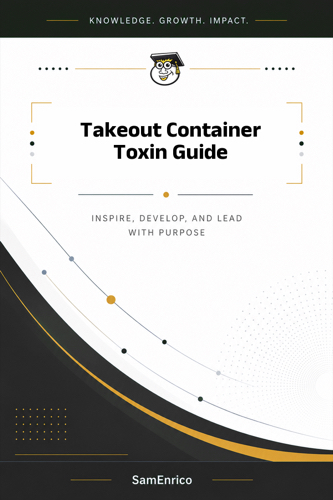
Takeout Container Toxin Guide
Teaches transferring food from styrofoam and avoid
Teaches transferring food from styrofoam and avoiding heated plastic containers.
Formats
About this book
Free sample
Chapter 1: The Recycling Lie--–- The first time I saw a patient with unexplained hormonal dysfunction who also ate every single meal from takeout containers, I assumed it was a coincidence. The second time, I started taking notes. By the fifteenth patient—a thirty-four-year-old marathon runner with fertility issues and a fridge full of margarine tubs repurposed as food storage—I knew I had stumbled onto something that the plastic industry had spent decades trying to hide.You have been lied to. Not by a malicious villain twirling a mustache, but by a carefully constructed system of symbols, labels, and half-truths designed to make you feel safe while you slowly poison yourself. The small triangle on the bottom of your takeout container.
The words "microwave-safe" stamped on a plastic lid. The cheerful green recycling logo that suggests environmental responsibility. These are not safety guarantees. They are marketing tools, and they have been deployed with extraordinary effectiveness.This chapter will teach you to read the recycling code the way a toxicologist reads a lab report. By the time you finish, you will never look at a yogurt tub the same way again.
You will understand why "microwave-safe" is one of the most dangerous phrases in the English language. And you will learn a simple, memorable rule that will reduce your daily exposure to plastic toxins by more than half, starting today.The Deceptive Triangle In 1988, the Society of the Plastics Industry introduced the Resin Identification Code (RIC)—those numbered triangles from 1 to 7 that you see on almost every plastic container. The stated purpose was noble: to help recycling facilities sort plastics more efficiently. The unstated consequence was something else entirely. Consumers began to interpret the triangle as a seal of approval, a stamp of safety, a guarantee that the container had been tested and approved for food contact.
None of that is true.The RIC tells you what type of plastic was used to make the container. It tells you nothing about whether that plastic is safe for storing food, safe for reheating, or safe for repeated use. In fact, some of…
This is the end of the free sample. Get the eBook to keep going. Buy now
Contents
- Chapter 1
- Chapter 2
- Chapter 3
- Chapter 4
- Chapter 5
- Chapter 6
- Chapter 7
- Chapter 8
- Chapter 9
- Chapter 10
- Chapter 11
- Chapter 12
Details
- Author
- Devries Robby
- Publisher
- SamEnrico
- Language
- English
- Genre
- Non-Fiction, Health & Wellness, Food
- Released
- 2026-06-09
- Pages (approx.)
- 147
- Available as
- eBook, Audiobook

Read better in the ZLOADR app
Your eBooks on your phone or tablet. Sign in with your SamEnrico account and start reading.
More by Devries Robby
 Preteen Dream WorldDevries Robby$11.99
 Postpartum Supplement GuideDevries Robby$11.99
 Essential Amino Acid ProtocolDevries Robby$11.99
 Lactose Intolerance Pregnancy GuideDevries Robby$11.99
 Bipolar Suicide PreventionDevries Robby$11.99
 Transcendental Meditation Coloring BookDevries Robby$11.99
 Arthritis And Sexuality GuideDevries Robby$11.99
 Hanging Rescue SurvivorDevries Robby$11.99
 Whispers of Whitehall: The Secret Diaries of the Regent’s MistressDevries Robby$11.99
 Moana’s Forgotten Navigator: The Curse of the Star CompassDevries Robby$11.99
 The Maestro of Mars: Napoleon's Symphony of WarDevries Robby$11.99
 Local Media Buying StrategiesDevries Robby$11.99
You may also like
 Hong Kong Handover 1997Dunn Johnnie$11.99
 Zumba For Postnatal Recovery CourseNeal Christian$11.99
 Zumba for BeginnersLadner Nikia$11.99
 YouTube Comment Mining GuideHumes Pandora$12.99
 Worry Box MeditationCarlin Rudy$11.99
 Workplace Stress MeditationNguyen Lynn$11.99
 Workplace Stress and Sleep RepairHawley Ivory$11.99
 Workplace Perfectionism CureDelaney Jeffry$11.99
 Workplace Injustice Anger GuideWallen Isabelle$11.99
 Work Addiction and Burnout LinkGreenwood Ester$11.99
 Women in Yoga and WellnessBeattie Galina$11.99
 Women in Stand Up ComedyChun Evangeline$11.99