
Non-FictionHealth & WellnessFood
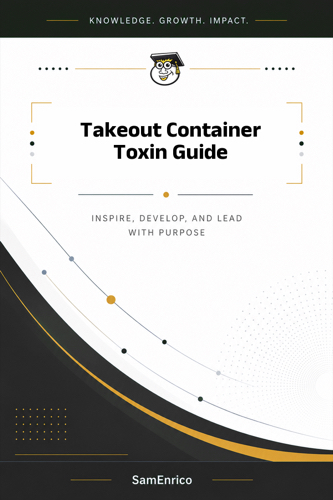
Takeout Container Toxin Guide eBook
Teaches transferring food from styrofoam and avoid
Teaches transferring food from styrofoam and avoiding heated plastic containers.
Formats
Free sample
Chapter 1: The Recycling Lie--–- The first time I saw a patient with unexplained hormonal dysfunction who also ate every single meal from takeout containers, I assumed it was a coincidence. The second time, I started taking notes. By the fifteenth patient—a thirty-four-year-old marathon runner with fertility issues and a fridge full of margarine tubs repurposed as food storage—I knew I had stumbled onto something that the plastic industry had spent decades trying to hide.You have been lied to. Not by a malicious villain twirling a mustache, but by a carefully constructed system of symbols, labels, and half-truths designed to make you feel safe while you slowly poison yourself. The small triangle on the bottom of your takeout container.
The words "microwave-safe" stamped on a plastic lid. The cheerful green recycling logo that suggests environmental responsibility. These are not safety guarantees. They are marketing tools, and they have been deployed with extraordinary effectiveness.This chapter will teach you to read the recycling code the way a toxicologist reads a lab report. By the time you finish, you will never look at a yogurt tub the same way again.
You will understand why "microwave-safe" is one of the most dangerous phrases in the English language. And you will learn a simple, memorable rule that will reduce your daily exposure to plastic toxins by more than half, starting today.The Deceptive Triangle In 1988, the Society of the Plastics Industry introduced the Resin Identification Code (RIC)—those numbered triangles from 1 to 7 that you see on almost every plastic container. The stated purpose was noble: to help recycling facilities sort plastics more efficiently. The unstated consequence was something else entirely. Consumers began to interpret the triangle as a seal of approval, a stamp of safety, a guarantee that the container had been tested and approved for food contact.
None of that is true.The RIC tells you what type of plastic was used to make the container. It tells you nothing about whether that plastic is safe for storing food, safe for reheating, or safe for repeated use. In fact, some of the most dangerous plastics for food storage carry numbers that consumers have been trained to think of as "good."Let me be clear about something that will be repeated throughout this book because it is the single most important fact you will learn: there is no such thing as a completely safe plastic for food contact when heat is involved. Leaching begins at 100°F, which is cooler than a hot cup of coffee and only slightly warmer than a summer day. Some plasticizers begin migrating at just 80°F when in contact with fatty foods.
The only question is how much leaches, not whether it leaches.Among the seven categories, three stand out as materials you should never, under any circumstances, use for storing or reheating food. These are numbers 3, 6, and 7. But before we dive into each one, you need to understand the mechanism that makes them dangerous.The Chemistry of Poisoning Plastics are made of long chains of repeating molecules called polymers. These chains are what give plastic its structure and strength. But pure polymer chains are brittle, rigid, and difficult to work with.
To make plastic flexible, clear, or shatter-resistant, manufacturers add plasticizers, stabilizers, and other chemical additives. These additives are not chemically bonded to the polymer chains. They are mixed in, suspended between the chains like marbles in a jar.This is where the problem begins. Because the additives are not bonded, they can move. When a plastic container comes into contact with food—especially hot food, fatty food, or acidic food—the additives can migrate out of the plastic and into your meal.
This process is called leaching, and it happens constantly, invisibly, and inevitably.Think of the plastic container as a sponge soaked with chemicals. When you add heat, you squeeze the sponge. When you add fat or acid, you dissolve the sponge's internal structure. The result is the same: chemicals flow from the container into your food.Number 3: The Hidden Hormone Disruptor Polyvinyl chloride, or PVC, carries the number 3. You will find it in clear food wrap, some squeeze bottles (like those containing condiments or cooking oils), and the harder plastic containers that hold some takeout salads or deli items.
PVC is also the plastic used to make pipes, shower curtains, and the soft plastic toys that were banned in several countries after studies linked them to developmental harm in children.The problem with PVC is not the plastic itself but the additives required to make it flexible. Pure PVC is rigid and brittle. To turn it into something you can wrap around a sandwich or squeeze ketchup from, manufacturers add phthalates—a class of chemicals that soften plastic by embedding themselves between the polymer chains. Phthalates do not bond permanently to the plastic. They are designed to migrate, which is exactly what makes them effective as plasticizers and exactly what makes them dangerous in food contact.When a phthalate molecule encounters a fatty food, it happily leaves the plastic and dissolves into your meal.
From there, it enters your body and begins to mimic or block your natural hormones. Phthalates are known endocrine disruptors. They have been linked to reduced sperm count in men, early puberty in girls, and a range of metabolic disturbances including insulin resistance and obesity.Here is the infuriating part: you cannot see phthalates. They have no taste and no smell. Your food wrapped in PVC cling film looks and tastes exactly the same as food wrapped in anything else.
The damage happens invisibly, silently, and cumulatively.A 2014 study published in Environmental Health Perspectives found that people who ate more meals prepared outside the home (and therefore more food that had been wrapped, stored, or served in plastic) had urinary phthalate levels nearly forty percent higher than those who ate primarily at home. The study controlled for age, income, and geographic location. The only variable that mattered was exposure to commercial food packaging.Number 6: The Foam That Fools You Expanded polystyrene—number 6—is the white, foam-like material that has become synonymous with takeout containers, coffee cups, and the clamshell boxes that hold your pad thai or lo mein. It is also one of the most thoroughly studied food-contact materials in existence, and the findings are uniformly concerning.Polystyrene is made from styrene monomers linked together in long chains. Under normal conditions, these chains are stable.
But heat breaks the bonds. When you pour hot soup into a styrofoam cup, when you microwave leftover noodles in their original foam container, when you ask a restaurant to pack your steaming curry into a polystyrene box—you are initiating a chemical reaction. The polymer chains begin to vibrate, stretch, and eventually snap, releasing individual styrene monomers into your food.Styrene is classified by the International Agency for Research on Cancer (IARC) as a Group 2B carcinogen—meaning it is possibly carcinogenic to humans. The classification is based on limited evidence in humans but sufficient evidence in animal studies. Rats exposed to styrene developed lung tumors, breast tumors, and leukemias.
Human workers exposed to high levels of styrene in manufacturing settings showed increased rates of lymphohematopoietic cancers.But you are not…
This is the end of the free sample. Get the eBook to keep going. Buy now
About this book
Details
- Author
- Devries Robby
- Publisher
- SamEnrico
- Language
- English
- Genre
- Non-Fiction, Health & Wellness, Food
- Released
- 2026-06-09
- Pages (approx.)
- 147
- Available as
- eBook, Audiobook

Read better in the ZLOADR app
Your eBooks on your phone or tablet. Sign in with your SamEnrico account and start reading.
More by Devries Robby
 Preteen Dream WorldDevries Robby$11.99
 Postpartum Supplement GuideDevries Robby$11.99
 Essential Amino Acid ProtocolDevries Robby$11.99
 Lactose Intolerance Pregnancy GuideDevries Robby$11.99
 Bipolar Suicide PreventionDevries Robby$11.99
 Transcendental Meditation Coloring BookDevries Robby$11.99
 Arthritis And Sexuality GuideDevries Robby$11.99
 Hanging Rescue SurvivorDevries Robby$11.99
 Whispers of Whitehall: The Secret Diaries of the Regent’s MistressDevries Robby$11.99
 Moana’s Forgotten Navigator: The Curse of the Star CompassDevries Robby$11.99
 The Maestro of Mars: Napoleon's Symphony of WarDevries Robby$11.99
 Local Media Buying StrategiesDevries Robby$11.99
You may also like
 Hong Kong Handover 1997Dunn Johnnie$11.99
 Zumba For Postnatal Recovery CourseNeal Christian$11.99
 Zumba for BeginnersLadner Nikia$11.99
 YouTube Comment Mining GuideHumes Pandora$12.99
 Worry Box MeditationCarlin Rudy$11.99
 Workplace Stress MeditationNguyen Lynn$11.99
 Workplace Stress and Sleep RepairHawley Ivory$11.99
 Workplace Perfectionism CureDelaney Jeffry$11.99
 Workplace Injustice Anger GuideWallen Isabelle$11.99
 Work Addiction and Burnout LinkGreenwood Ester$11.99
 Women in Yoga and WellnessBeattie Galina$11.99
 Women in Stand Up ComedyChun Evangeline$11.99