
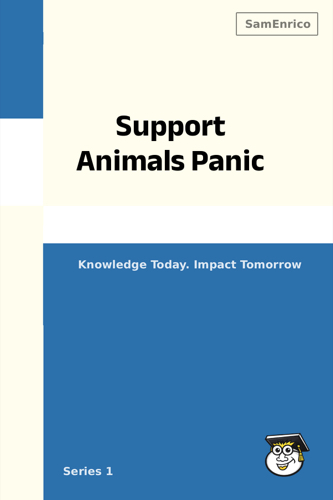
Non-FictionHealth & WellnessAnimal
Support Animals Panic eBook
Explains emotional support animals for agoraphobia
by Stein Fumiko
Explains emotional support animals for agoraphobia.
Formats
Free sample
Chapter 1: The Wall of Fear--–- The morning light came through the blinds in thin, accusatory strips. Sarah had been awake since 4:47 AM, though she had not slept. At 9:15 AM, she put on jeans—the pair with the elastic waistband, because the button-up ones felt like a commitment she could not keep. At 9:47 AM, she brushed her teeth. At 10:03 AM, she stood at the front door of her own apartment, fully dressed, keys in hand, and she could not turn the knob.Her heart rate was 142 beats per minute.
She had been standing here for forty-seven minutes. The destination was a pharmacy three blocks away—a place she had visited hundreds of times before the fear took hold. She needed a prescription refill. The bottle had been empty for four days. She had already skipped two doses of her antidepressant because the thought of walking those three blocks, past the bus stop, past the convenience store where the cashier sometimes said hello, past the fire hydrant where a dog had once barked at her, was insurmountable.She was not afraid of the open space.
She was not afraid of the sky or the wind or the wide pavement. She was afraid of having nowhere to hide. She was afraid of being seen. She was afraid of the sudden, crushing certainty that she would collapse, or vomit, or scream, and that no one would help her, or worse—that everyone would watch. That is agoraphobia.The term comes from the Greek words agora (marketplace) and phobos (fear), but the ancient Greeks misunderstood it as a fear of public spaces themselves.
Modern clinical psychology knows better. Agoraphobia is not the fear of open places. It is the fear of being in situations where escape might be difficult or embarrassing, or where help might not be available during a panic attack. The Diagnostic and Statistical Manual of Mental Disorders, Fifth Edition (DSM-5-TR), defines it as marked fear or anxiety about two or more of the following: using public transportation, being in open spaces, being in enclosed spaces, standing in line or being in a crowd, or being outside the home alone.But definitions do not capture the experience. The experience is this: a person standing at a door for forty-seven minutes, holding a key, crying silently because their own front door has become a wall.The Geography of Fear Agoraphobia is a disorder of shrinking.
It begins, often, with a single panic attack—unexpected, terrifying, seemingly without cause. The heart races. The breath shortens. The world tilts. The person thinks, I am dying.
I am going crazy. I am losing control. And then, minutes later, the attack passes, and the person is left with a new knowledge: This can happen anywhere. This can happen again.So the mind begins to map danger. The grocery store aisle where the last attack occurred becomes marked in red.
The highway exit where the tunnel vision started becomes a no-go zone. The coffee shop line where the sweating began becomes a trap. At first, the person avoids only the specific locations. Then they avoid locations that resemble those locations. Then they avoid any location where escape might be difficult—which is, eventually, almost any location outside the home.The clinical term for this is safety behaviors.
These are actions taken to prevent or manage a feared catastrophe. A person with agoraphobia might always sit near an exit, carry a water bottle, bring a "safe person," keep a phone charged, wear loose clothing, avoid caffeine, or rehearse escape routes. Safety behaviors provide temporary relief, but they are a poison dressed as medicine. Each time you use a safety behavior, you tell your brain: That situation was genuinely dangerous. You were right to be afraid.
And the only reason you survived is because you had your water bottle / sat near the door / had your phone ready.The brain listens. The next time, the fear is worse.Then comes avoidance. The person stops going to the grocery store. Then stops going to the pharmacy. Then stops going to the mailbox.
Then stops leaving the bedroom except for the bathroom. The world shrinks from a continent to a city to a neighborhood to a block to a room. The person becomes a prisoner of their own "safe" spaces—though even those are not truly safe, because the fear of having a panic attack inside the safe space is always present, like a low hum.This is the vicious cycle: panic attack → safety behaviors → avoidance → shrinking world → increased fear of future panic → another panic attack. The cycle is self-perpetuating. It does not require new trauma.
It runs on its own fuel.The Hidden Epidemic: Agoraphobia After the Pandemic For decades, agoraphobia was considered a rare disorder, affecting approximately 1.7% of adults in any given year. Those numbers have changed. The COVID-19 pandemic, and the mass isolation it required, created the perfect conditions for agoraphobia to flourish. Millions of people who had never experienced significant anxiety before found themselves, after eighteen months of lockdown, unable to re-enter the world.A 2022 study published in The Lancet Psychiatry found that rates of agoraphobia symptoms tripled among young adults between 2019 and 2021. Another study from the University of Cambridge reported that 34% of participants who had no prior history of anxiety disorders developed clinically significant avoidance behaviors during the pandemic.
The mechanism is straightforward: the brain learned, through repeated experience, that "outside" is dangerous and "home" is safe. The brain does not know that the pandemic ended. The brain only knows what it has been taught.This is not a character flaw. This is not weakness. This is the brain doing exactly what it evolved to do: protect you from perceived threats.
The tragedy is that the threat is no longer there, but the protective machinery is still running at full power.One of the most striking findings from post-pandemic research is the phenomenon of "half-life agoraphobia." These are people who can leave their homes but only for short, predictable, highly controlled trips. They can go to the mailbox but not the corner store. They can drive to work via one specific route but cannot take a detour. They can stand in line for three minutes but not five. They are not housebound, but they are not free.
They are living in a narrow corridor of safety, and any deviation triggers a cascade of terror.If this describes you, you are not alone. You are not broken. You are one of millions whose brains adapted to an unnatural situation and have not yet adapted back. The good news is that the brain can learn again. It can be retrained.
And one of the most powerful tools for that retraining is also one of the most ancient: the animal who walks beside you.Why the Dog? The Ancient Contract The relationship between humans and canines is approximately 40,000 years old. For most of that history, the dog was not a pet. The dog was a partner—in hunting, in herding, in guarding, in survival. The dog watched while you slept.
The dog alerted when danger approached. The dog stayed close in the dark. The dog did not ask questions. The…
This is the end of the free sample. Get the eBook to keep going. Buy now
About this book
Details
- Author
- Stein Fumiko
- Publisher
- SamEnrico
- Language
- English
- Genre
- Non-Fiction, Health & Wellness, Animal
- Released
- 2026-06-06
- Pages (approx.)
- 148
- Available as
- eBook, Audiobook

Read better in the ZLOADR app
Your eBooks on your phone or tablet. Sign in with your SamEnrico account and start reading.
More by Stein Fumiko
 The Gambling Thought Reframe WorkbookStein Fumiko$11.99
 Cardiac Risk CalculatorStein Fumiko$11.99
 Affirmations for AccountantsStein Fumiko$11.99
 Western Front Railway LogisticsStein Fumiko$11.99
 Matching Vocal ToneStein Fumiko$11.99
 Joint Account BoundariesStein Fumiko$11.99
 Glacier Crevasse EscapeStein Fumiko$11.99
 Blitzkrieg of the Spanish Succession: Marlborough's Triumph at BlenheimStein Fumiko$11.99
 Service Providers Guide to Chimney RepairStein Fumiko$11.99
 How to Produce Tennis Ball MachinesStein Fumiko$11.99
 How to Become a Rate SupervisorStein Fumiko$11.99
 Harbin Institute Technology GuideStein Fumiko$12.99
You may also like
 Hong Kong Handover 1997Dunn Johnnie$11.99
 Zumba For Postnatal Recovery CourseNeal Christian$11.99
 Zumba for BeginnersLadner Nikia$11.99
 YouTube Comment Mining GuideHumes Pandora$12.99
 Worry Box MeditationCarlin Rudy$11.99
 Workplace Stress MeditationNguyen Lynn$11.99
 Workplace Stress and Sleep RepairHawley Ivory$11.99
 Workplace Perfectionism CureDelaney Jeffry$11.99
 Workplace Injustice Anger GuideWallen Isabelle$11.99
 Work Addiction and Burnout LinkGreenwood Ester$11.99
 Women in Yoga and WellnessBeattie Galina$11.99
 Women in Stand Up ComedyChun Evangeline$11.99