
Non-FictionSelf-HelpCognitive Restructuring
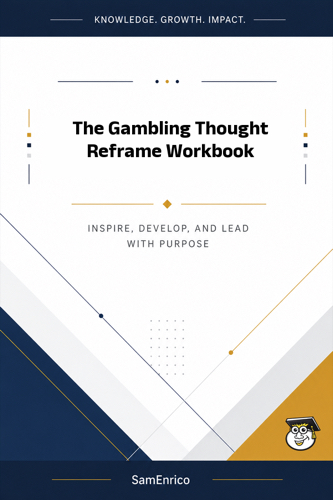
The Gambling Thought Reframe Workbook
Challenge and replace irrational gambling thoughts
by Stein Fumiko
Challenge and replace irrational gambling thoughts with rational alternatives using worksheets.
Formats
About this book
Free sample
Chapter 1: The Silent Sentence...--The thought arrives before the money leaves. Before the screen loads, before the dice tumble, before the card is turned. It arrives in a fraction of a second, dressed in your own voice, and it feels like truth. You are probably not even aware of it. Most gamblers are not.This chapter is about making that hidden sentence visible.
Not judging it. Not trying to crush it with willpower. Simply seeing it for what it is: a thought, not a command; a guess, not a fact; a habit, not a destiny.If you have ever said to yourself, "I knew I shouldn't have placed that bet" immediately after losing, you experienced the paradox of gambling thoughts. In the moment before the bet, the same thought felt completely reasonable, even inevitable. The loss did not change the thought's content—it changed your perspective on the thought.
But the thought itself was there, silent and fast, doing its work before you could examine it.This is the central problem that no amount of willpower can solve. Willpower operates in slow motion. It requires deliberation, conscious effort, and time. The automatic thought that drives gambling operates in milliseconds. By the time your willpower wakes up, the bet is already placed.The solution is not faster willpower—there is no such thing.
The solution is to train yourself to catch the thought before it becomes a bet. That is what this chapter teaches.The Three-Second Gap Between the thought and the action, there is a tiny window. Neuroscience research suggests this window is approximately three seconds. In that window, you have the opportunity to observe the thought without automatically obeying it. The problem is that most gamblers have never been taught to look into that window.
They experience the urge and the action as a single, fused event: "I felt like gambling, so I gambled."This chapter introduces the concept of thought-action fusion—the cognitive error of treating a thought as equivalent to an action or as a command that must be obeyed. "I thought about placing a bet" becomes "I must…
This is the end of the free sample. Get the eBook to keep going. Buy now
Contents
- Chapter 1
- Chapter 2
- Chapter 3
- Chapter 4
- Chapter 5
- Chapter 6
- Chapter 7
- Chapter 8
- Chapter 9
- Chapter 10
- Chapter 11
- Chapter 12
Details
- Author
- Stein Fumiko
- Publisher
- SamEnrico
- Language
- English
- Genre
- Non-Fiction, Self-Help, Cognitive Restructuring
- Released
- 2026-06-10
- Pages (approx.)
- 141
- Available as
- eBook, Audiobook

Read better in the ZLOADR app
Your eBooks on your phone or tablet. Sign in with your SamEnrico account and start reading.
More by Stein Fumiko
 Cardiac Risk CalculatorStein Fumiko$11.99
 Affirmations for AccountantsStein Fumiko$11.99
 Western Front Railway LogisticsStein Fumiko$11.99
 Matching Vocal ToneStein Fumiko$11.99
 Support Animals PanicStein Fumiko$11.99
 Joint Account BoundariesStein Fumiko$11.99
 Glacier Crevasse EscapeStein Fumiko$11.99
 Blitzkrieg of the Spanish Succession: Marlborough's Triumph at BlenheimStein Fumiko$11.99
 Service Providers Guide to Chimney RepairStein Fumiko$11.99
 How to Produce Tennis Ball MachinesStein Fumiko$11.99
 How to Become a Rate SupervisorStein Fumiko$11.99
 Harbin Institute Technology GuideStein Fumiko$12.99
You may also like
 Hong Kong Handover 1997Dunn Johnnie$11.99
 Zumba For Postnatal Recovery CourseNeal Christian$11.99
 Zumba for BeginnersLadner Nikia$11.99
 YouTube Comment Mining GuideHumes Pandora$12.99
 Worry Box MeditationCarlin Rudy$11.99
 Workplace Stress MeditationNguyen Lynn$11.99
 Workplace Stress and Sleep RepairHawley Ivory$11.99
 Workplace Perfectionism CureDelaney Jeffry$11.99
 Workplace Injustice Anger GuideWallen Isabelle$11.99
 Work Addiction and Burnout LinkGreenwood Ester$11.99
 Women in Yoga and WellnessBeattie Galina$11.99
 Women in Stand Up ComedyChun Evangeline$11.99